
Container Marking and Identification (ISO 6346, Custom Codes, RFID)
Container marking and identification is a systematic process that assigns each cargo container a unique alphanumeric code and a series of other visual and electronic marks according to the global ISO 6346 standard. This identification system is the backbone of global container transport – it enables rapid, automated and error-free tracking of container movements, management of their lifecycle and security oversight from manufacturer to final recipient.
Why is marking essential?
- Increases efficiency and speed of clearance in ports, railways and road transport.
- Minimizes the risk of container confusion or loss.
- Ensures compliance with legislative and safety requirements (customs procedures, transport of dangerous goods, etc.).
- Supports digitalization and automation of logistics (e.g. via RFID and IoT sensors).
- Enables global interoperability between different carriers, terminals, customs authorities and IT systems.
More than 80% of global goods flow in ISO containers – without a robust marking system, global logistics would collapse.
ISO 6346 Standard – Foundation of the Global Marking System
Overview and Importance of the Standard
ISO 6346:2022 (4th edition) is an international standard issued by ISO and managed by BIC (Bureau International des Containers). It is mandatory for all intermodal transport containers complying with ISO 668 (standard for dimensions and strength), ISO 1496 (design details of specific container types) and ISO 8323.
The standard establishes:
- Mandatory and optional visual marks and their physical implementation.
- The precise system of identification code.
- Coding of container type and dimensions.
- Placement, size and readability of individual marks.
- Conditions for automated identification (AEI, EDI, RFID).
Marking according to ISO 6346 is used not only in transport, but also in documentation, customs procedures, insurance, maintenance and asset management.
Structure of the Main Identification Code
Each container has a unique 11-digit code that is stamped on its doors and sides:
| Segment | Number of Characters | Description | Example |
|---|---|---|---|
| Owner Code | 3 letters | Owner identification (BIC) | HLX |
| Equipment Category Identifier | 1 letter | Type of equipment (U/J/Z) | U |
| Serial Number | 6 digits | Unique within the fleet | 123456 |
| Check Digit | 1 number | Verification of correct entry | 7 |
Full Code: HLXU 123456 7
Detailed Explanation of Segments
- Owner Code
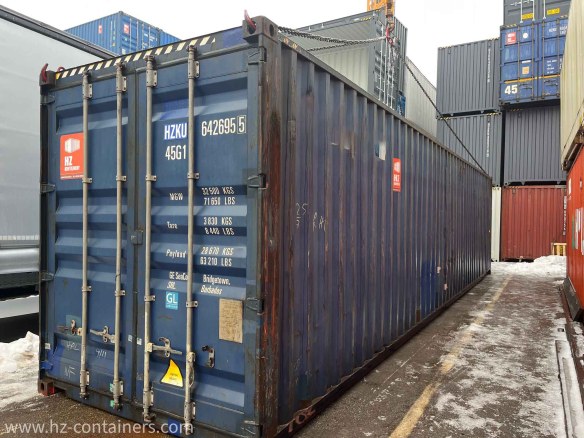
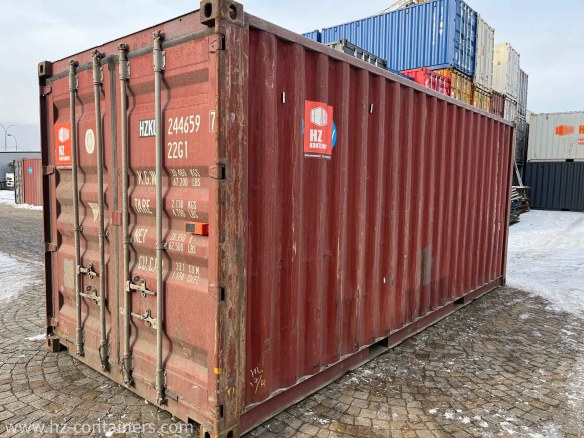
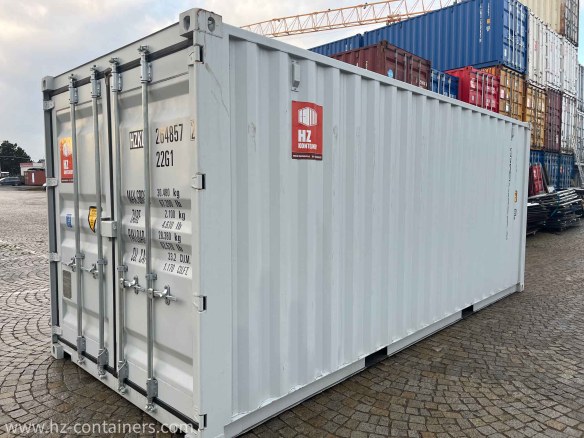
- Three-letter code that uniquely identifies the owner/operator (e.g. HZK = HZ CONTAINERS s.r.o.).
- Codes are publicly available and never repeat.
- Equipment Category Identifier
U– standard freight containerJ– removable equipment (e.g. cooling units, gensets)Z– chassis, trailers- Each designation must correspond to the type of equipment for which it is issued.
- Serial Number
- Six digits, unique within the owner
- Assigned by the owner, usually in sequential order
- Check Digit
- Calculated according to a detailed algorithm – protects against typos in administration and IT systems.
Significance of the Check Digit
When entering the code, the check digit is automatically calculated by software; each letter is converted to a numerical value according to a table, numbers are multiplied by powers of 2 and the sum is divided by 11. If the remainder is 10, the check digit is 0. This system minimizes errors when entering data into systems.
Container Size and Type Codes
In addition to the main code, each ISO container must have a four-digit size and type code according to ISO 6346.
Code Structure
| Segment | Position | Description | Values (Examples) |
|---|---|---|---|
| Length Code | 1 | Container length | 2 (20′), 4 (40′), L (45′), M (48′), P (53′) |
| Height/Width Code | 2 | Height and/or width | 2 (8’6″), 5 (9’6″ High Cube), 6 (8′), 0 (non-standard) |
| Type Code | 3 | Basic designation | G (dry cargo), R (refrigerated), U (open top), T (tank), P (platform), B (bulk) |
| Variant Code | 4 | Design details | 0, 1 (standard), other digits for specifics |
Overview of Common Codes
| Code | Meaning |
|---|---|
| 22G1 | 20′, height 8’6″, universal dry cargo |
| 45R1 | 40′, High Cube (9’6″) refrigerated container |
| 22T1 | 20′, tank for dangerous liquids |
| 42U1 | 40′, open top (open roof) |
| 45P3 | 40′, High Cube platform |
Practical Significance
- The specific code determines what handling equipment is needed, where the container can be stored (height limits), what goods can be transported, etc.
- The code is always located to the right below the main identification number.
Mandatory and Optional Marking (Operational Marks)
In addition to identification codes, each container must contain other operational marks established by ISO and other international conventions (e.g. CSC – Convention for Safe Containers, IMO):
Mandatory Marks
| Designation | Description | Mandatory? |
|---|---|---|
| MAX GROSS | Maximum permitted weight (including cargo) | Yes |
| TARE | Weight of empty container | Yes |
| NET/PAYLOAD | Maximum possible cargo weight (MAX GROSS – TARE) | Yes |
| CUB. CAP. | Internal volume in m³ | Yes |
| CSC plate | Safety approval plate with construction information | Yes (IMO, CSC) |
| Height (High Cube) | Special marking for elevated containers (yellow/black symbol) | If applicable |
| Warnings | E.g. electrical hazard symbol, stacking limits, handling | If applicable |
The CSC plate is a metal plate fastened with rivets to the doors, containing among other things:
- Manufacturer, year of manufacture
- Country of approval, inspection number
- Permitted load limits, stacking, dynamic forces, etc.
Placement of Marks
- Identification code: top right on both side walls and right doors.
- Size/type code: below the main code.
- Weights, volume: on the doors.
- CSC plate: on the left door wing (metal plate).
Custom Codes and Specific Systems
In addition to the standard ISO 6346 system, some entities use internal or regional codes for their own purposes. These codes are intended for:
- Detailed asset management and maintenance (internal numbers, QR codes, barcodes).
- Specific railway requirements (e.g. USA – Association of American Railroads).
- RFID/IoT system identification (see below).
Important: These systems must not replace ISO 6346 in international transport! The main ISO code must always be preserved.
RFID and Modern Identification Technologies
What is RFID?
RFID (Radio-Frequency Identification) is a technology that enables contactless automated identification of containers using radio waves.
- An RFID tag (chip) is attached to the container, which contains ID and other data.
- RFID gates, scanners or handheld readers can read hundreds of tags per second without the need for physical contact or direct visibility.
- RFID tags are resistant to weather, vibrations, dirt and can be combined with sensors (temperature, humidity, vibration).
Advantages of RFID in Containers
- Automation: Instant container passage through gates, real-time evaluation (e.g. ports, warehouses, terminals).
- Accuracy: Eliminates errors caused by poor readability or human factor.
- Wide Range of Data: RFID can contain the entire ISO code, information about goods, maintenance history, transport records, cargo status (via IoT).
- Security: Instant identification in case of theft, loss or damage.
Integration of RFID and ISO 6346
- RFID never replaces mandatory visual marking according to ISO 6346 – it serves as a supplement to accelerate and automate processes.
- Common combinations with barcodes, QR codes and other digital elements (EDI, AEI).
- In the future, massive expansion is expected due to requirements for digitalization of supply chains.
Practical Tips for Reading and Checking Marking
- Upon receipt: Always check that the code on the container matches the transport documentation.
- When entering into the system: Use validation automation with check digit.
- When buying/selling: Verify the validity of the owner code in the registry.
- When transporting dangerous or sensitive shipments: Monitor RFID/IoT data (temperature, humidity, vibrations).
Final Summary
Without clear marking and identification, it would not be possible to efficiently manage the flow of millions of containers on a global scale. The ISO 6346 standard, mandatory operational marks and modern technologies such as RFID together form a robust system that ensures safety, transparency, speed and interoperability in international logistics.
Key Benefits:
- Unique global identification of each container.
- Acceleration and cost reduction of clearance, handling and customs procedures.
- Precise tracking of shipment movement and status in real time.
- Support for digitalization and automation of logistics processes.
- Protection against errors, fraud and losses.
 Czech Republic, Třebíč
  FREE SHIPPING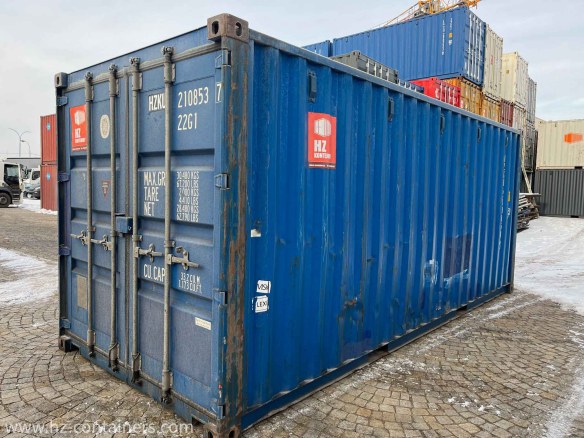
Other container news...

High Cube container specifications
A high cube container — also referred to as an HC container, HQ container, or high-cube — is an intermodal shipping container that stands one foot taller than the standard ISO container. While a standard general-purpose container measures 8 feet 6 inches (2.59 m) in external height, a high cube container extends to 9 feet 6 inches (2.89 m). This extra 12 inches of vertical clearance translates into approximately 10–15% more cubic capacity without altering the container’s footprint — the same length and width are maintained, meaning the container occupies the same floor space on a vessel, chassis, or storage yard.

Shipping container parts
A shipping container looks like a simple steel box from the outside, but it is an assembly of dozens of precisely engineered shipping container parts — each governed by international standards, each designed to survive decades of ocean transit, crane lifts, and stacking loads that would crush an ordinary structure. Whether you are buying a used container, planning a container home, troubleshooting a repair, or simply building your logistics vocabulary, understanding every individual component is the difference between making an informed decision and an expensive mistake.

40 Foot Container Dimensions
If you have ever booked ocean freight, planned a warehouse layout, or designed a modular building project, you have asked the same question: what are the exact 40 foot container dimensions — and what do they mean for what you can actually load? The numbers are standardized worldwide, but the practical implications of those numbers are surprisingly nuanced. A 40-foot container is not simply 40 feet of usable space, and its weight limits are not what most people assume. This guide covers every measurement, every weight rating, and every loading consideration you need to make informed decisions about the world’s most common shipping container.
Quick Answer: A standard ISO 40-foot shipping container measures 12.19 m (40 ft) long × 2.44 m (8 ft) wide × 2.59 m (8 ft 6 in) high externally and provides approximately 67.7 m³ (2,390 ft³) of usable internal volume. The maximum gross weight is 30,480 kg (67,200 lbs), with a typical payload capacity of approximately 26,700–26,800 kg (58,900–59,000 lbs).

Cargo worthy container
If you have ever shopped for a used shipping container, you have almost certainly encountered the term cargo worthy — often abbreviated as CW or CWO (Cargo Worthy Only). It is one of the most important classifications in the container industry, yet it is also one of the most misunderstood. A cargo worthy container is not a container that looks new. It is not necessarily a container that has a valid CSC plate. And it is definitely not the same as a wind and watertight container. This guide explains what cargo worthy really means — from its technical definition and historical origins to the precise structural criteria, inspection process, cost implications, and common misconceptions that trip up even experienced buyers.