
Can I Claim a Cargo Worthy Shipping Container When It’s Repaired?
Claiming a Repaired Shipping Container in Cargo Worthy (CW) Category
Claiming a repaired shipping container in the Cargo Worthy (CW) category is a process in which a buyer raises a claim against the seller because the delivered container, although declared as CW, does not meet the agreed or legally established quality and condition requirements. The key point is not the fact that the container was repaired – this is completely standard for used units – but the quality of the repairs performed and the overall condition in terms of applicable standards (IICL, UCIRC, CSC, ISO).
Answer to the question “Can I claim a CW container when it’s repaired?”
Yes, a claim is possible if the repair was not carried out in accordance with technical and safety standards and the container, as a result of repairs, does not meet CW requirements (for example, it is not watertight, has damaged structure, lacks a valid CSC plate, etc.). The mere existence of quality repairs, such as patches, welds, or surface rust, is not grounds for a claim – these signs are standard for CW containers.
This article explains in detail all aspects of the issue:
- Definition of key concepts
- Valid reasons for claiming
- Practical procedure for claiming
- Technical standards and certification
- Recommendations for inspection and prevention
I. Definition and Understanding of Key Concepts
What is a shipping container?
A shipping container is a universal transport unit made from highly durable Corten steel (COR-TEN), designed for long-term use in extreme conditions of both maritime and land transport.
Technical parameters:
- Standard dimensions: 20′ (6.058 × 2.438 × 2.591 m), 40′ (12.192 × 2.438 × 2.591 m), standard height or High Cube (2.896 m).
- ISO Certification: ISO 668 (dimensions), ISO 1496 (construction), ISO 6346 (marking).
- Construction: Corner castings for handling, plywood floor on steel frame, double doors with multi-point locking, ventilation openings.
Versatility:
- Used not only for transport but also as storage, mobile workshop, foundation for building or residential modules.
- After the end of its transport life, it is in demand for secondary use.
What does “Cargo Worthy” (CW) mean?
Cargo Worthy (CW) indicates that a used container meets international criteria for safe cargo transport in international shipping. CW condition is lower than “new” or “one-trip,” but higher than “wind and watertight” (WWT).
Criteria for CW:
- Structural integrity: No major deformations, cracks, or holes in load-bearing elements (corners, frame, walls).
- Watertightness and wind resistance: Leaks are not permitted (tested by closing and checking light penetration, or by water test).
- Doors: Fully functional, seals undamaged, locking mechanisms operational.
- Floor: No major damage, rotted or broken parts, capable of bearing declared load.
- Valid CSC plate: Confirmation of safety and suitability for international transport (see below).
Notes on condition:
- A CW container may have:
- Professionally performed patches, welds, surface rust, dents, and scratches (cosmetic defects are not grounds for a claim).
- Repair history (the vast majority of CW containers are repaired according to applicable standards).
What does “Repaired” container mean?
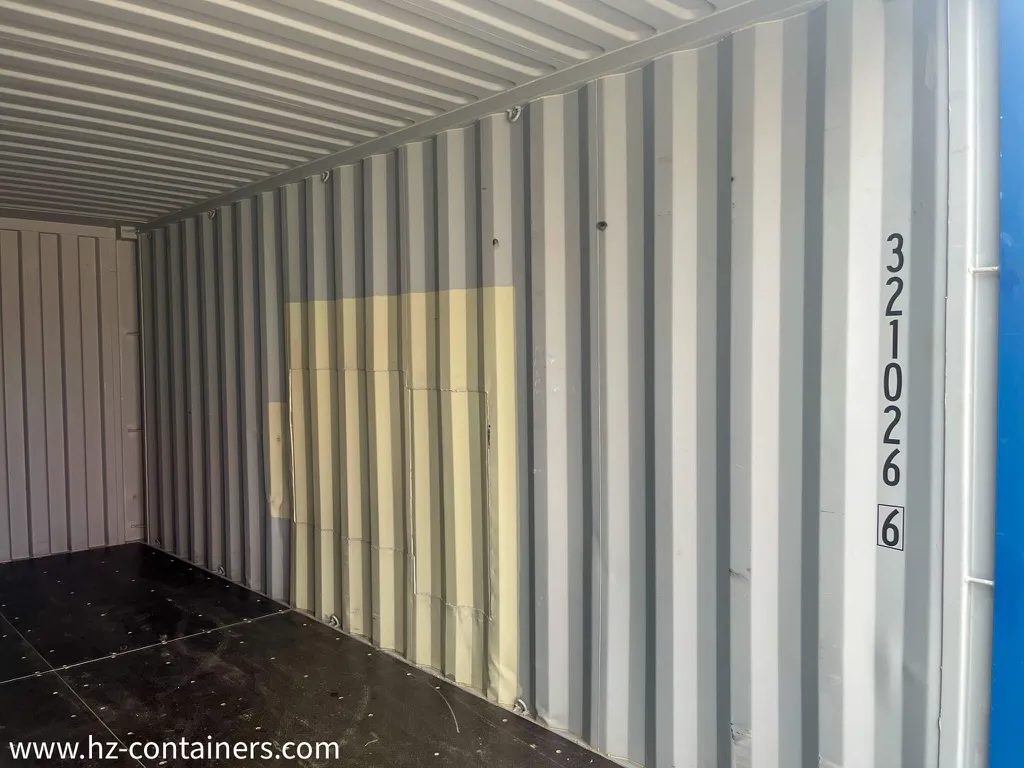
A repaired container is one that was restored to a serviceable condition according to standards (IICL, UCIRC) in a certified depot due to damage during its operation.
Repair process:
- Inspection: Thorough inspection according to IICL/UCIRC – assessment of structural, surface, and functional defects.
- Repair: Welding holes, straightening frame, floor replacement, seal replacement, patches on walls/roof.
- Certification: Final inspection and issuance of a fitness certificate (CW, CSC plate).
Repair itself is not a defect if performed in accordance with standards – functionality and safety are decisive.
II. Right to Claim: When Is It Valid?
Valid reasons for claiming a CW container
Typical technical repair defects:
- Leaks: Water leaks into the container or the interior space is lit by light (visible light points).
- Poor quality welds/patches: Patch is welded unprofessionally, cracks, corrodes quickly, is not part of the load-bearing structure.
- Damaged floor: Rotted, deformed, dangerous for cargo handling, unsuitable for transport.
- Non-functional doors: Doors cannot be opened/closed, locking does not work, seals are swollen or missing.
- Missing CSC plate: Container is not suitable for international transport without a valid CSC plate (see below).
- Hidden defects: Rotted floor masked by paint, mold, heavy contamination (chemicals, pests).
Non-compliance with purchase agreement:
- Container does not match the description (e.g., declared as “one-trip,” but reality is CW).
When a claim will NOT be accepted
- Cosmetic defects: Surface rust, scratches, color differences, minor dents – if they do not endanger functionality and safety.
- Standard patches and welds: If performed professionally and do not impair function.
- Odor: If not extreme or toxic – normal odor from previous cargo is not claimable.
- Late claims: Visible defects discovered only after pickup and removal from the depot (seller may claim damage occurred at customer’s location).
III. Practical Guide to Claiming
Prevention: Inspection at the depot
Upon pickup, perform a very thorough inspection (ideally in person):
| Inspection Point | What to Check |
|---|---|
| Walls and roof | Look for holes, cracks, deep corrosion, poor quality patches |
| Floor | Walk the entire area, stomp on boards, look for soft spots |
| Doors and seals | Open/close several times, check seals and locks |
| Interior tightness | Close yourself inside, observe light penetration |
| CSC plate | Validity, readability, match with container number |
| Odor/cleanliness | Especially if suspecting chemicals, mold, pests |
TIP: Thorough photography and documentation of condition before pickup is key for potential claims!
Procedure when a defect is found
- Do not accept the container: If you find a serious defect, refuse pickup and loading.
- Communicate with the seller: Contact the seller immediately (ideally by phone and in writing).
- Document the condition: Take detailed photos, video, request confirmation from depot staff.
- Written claim: State container number, description of defect, photo documentation, requested solution (replacement, discount, repair).
IV. Warranty vs. Claim
| Type | What It Covers | Typical Duration |
|---|---|---|
| Claim for defect | Container condition at pickup | Immediately |
| Quality warranty | Duration of declared property (watertightness, etc.) | New: 5–10 years, CW: 0–12 months |
- New containers: Warranty on construction and watertightness (up to 10 years).
- Used containers (CW): Warranty is usually short (mostly 0–12 months, only on watertightness).
- Warranty does not cover wear, surface rust, improper handling.
V. Standards and Certification
ISO Standards
- ISO 668: Container dimensions and types
- ISO 1496: Construction, strength, testing
- ISO 6346: Identification marking
CSC Plate (Convention for Safe Containers)
- Mandatory for containers in international transport (required by IMO).
- Contains: number, manufacturing date, operating limits, date of next inspection.
- Without a valid CSC plate, a CW container CANNOT be used in transport.
IICL Standard
- IICL 5/6: Highest standard for repairs, used for leased containers.
- Criteria: Deformation tolerances, maximum corrosion extent, minimum residual strength, repair execution method.
- Most CW containers do not meet strict IICL but are repaired according to UCIRC.
UCIRC (Unified Container Inspection and Repair Criteria)
- International inspection and repair standard, used for assessment and repair of containers in all major depots worldwide.
- Developed in cooperation with BIC, ICS, WSC.
- Defines:
- Acceptable and unacceptable damage: Precise limits for deformations, corrosion, cracks, holes in individual container parts.
- Repair methods: Welding, section replacement, patching, straightening, floor replacement, door adjustment, contaminant removal.
- Distinction between wear and defect: Normal operational wear (scratches, minor dents, surface rust) is not a defect.
| Component | Acceptable Damage (selected UCIRC examples) |
|---|---|
| Walls, roof | Deformation up to 50 mm, holes must be repaired |
| Floor | Rotted or broken boards must be replaced, minor delaminations tolerated |
| Doors | Must close and lock, seals undamaged |
| Corner castings | No cracks and deformations preventing handling |
| Corrosion | Surface ok, through-corrosion (holes) requires repair |
VI. Practical Tips and Market Experience
- Most CW containers have visible repairs – what matters is their quality and compliance with standards (IICL/UCIRC).
- Leading sellers offer the option of replacement if a defect is found at the depot.
- When delivered to your location, always thoroughly document the container’s condition (in case of dispute, you prove it).
- Claiming a CW container is successful only if there is a breach of function, safety, or significant non-compliance with the agreed description.

 Czech Republic, Sokolov
  FREE SHIPPING


Other container news...

40 Foot High Cube Container Dimensions
Everything you need to know about 40 foot high cube container dimensions — interior and exterior measurements, door sizes, weight capacity, pallet loading, and how the high cube compares to a standard 40-foot container. Full specifications in feet, inches, and meters.

20-Foot Shipping Container
You see them stacked high at ports, rumbling down highways on semi-trucks, and increasingly converted into homes, offices, and pop-up shops. The 20-foot shipping container is arguably the single most important physical object in global trade — and one of the most versatile steel boxes ever engineered. But what exactly is a 20-foot shipping container, and why does it matter so much?

20HC vs 20GP Container
Every container decision ultimately comes down to cargo geometry and economics. If your goods are taller than 2.28 meters, the 20HC is not a preference — it is a requirement. If your goods are dense and heavy, the 20GP does the job for less money. For everything in between, this guide gives you the numbers to make the call with confidence.

How Much Does a Shipping Container Cost?
If you have ever typed “how much does a shipping container cost” into a search engine, you already know the answer is rarely straightforward. One seller lists a 20ft used container at $1,300. Another quotes $4,800 for what sounds like the same thing. The gap is not random — it reflects real differences in size, condition grade, geography, and market forces that most buyers do not understand until they are deep into the purchasing process.