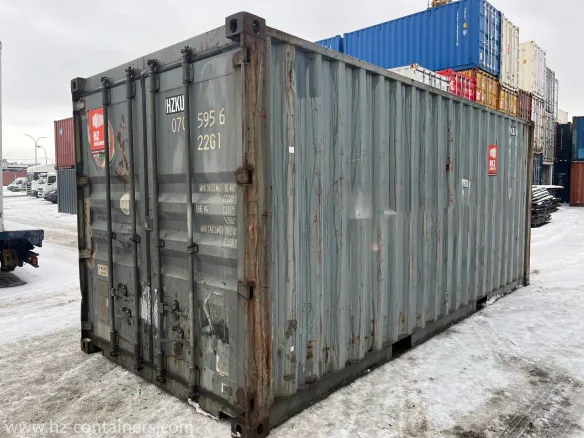
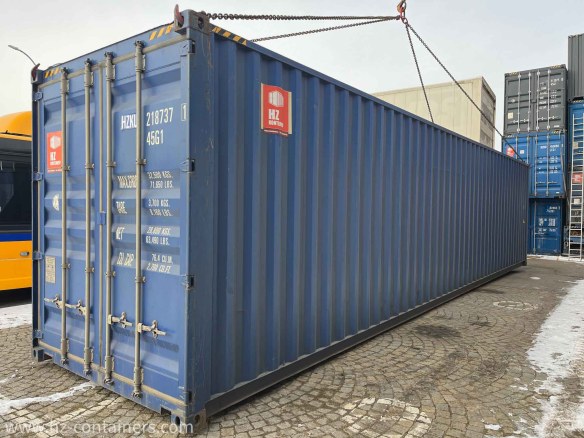
Shipping Container iC 83
What is Shipping Container iC 83?
Shipping container iC 83 is a standard transport container that bears the specific designation “iC 83”. This designation is a supplementary certification code that confirms the container meets technical and safety requirements for transport on the European railway network.

- iC: Abbreviation for “InterContainer”, a mark awarded to containers approved for railway transport in accordance with International Union of Railways (UIC) regulations.
- 83: Numerical code designating Italian State Railways (Ferrovie dello Stato Italiane, FS), which represents the UIC and performs certification.
Key difference: The iC 83 mark, or iC83, does not identify the container type, but confirms its suitability for railway transport according to European standards.
Detailed Explanation: The Role of iC Code in Intermodal Transport
Intermodal transport enables the transport of goods in a single container across various modes of transport (maritime, railway, road) without the need to unload the goods themselves. For smooth operation, all used containers must comply with specific technical standards.
Significance of iC marking in practice
- Ensures interoperability: Only containers with valid iC certification can be automatically accepted on railway cars in Europe.
- Eliminates unnecessary inspections: The mark is a “ticket” to the European railway network without the need for further verification.
- Facilitates customs and transport processes: Certification is recognized across UIC member states.
International Union of Railways (UIC) and Its Role
UIC (Union Internationale des Chemins de fer) is a global organization that unifies technical and safety standards for railway transport, including container transport. Within Europe, it plays a key role in:
| Area | Significance for containers |
|---|---|
| Standardization of dimensions | Ensures containers safely pass through all tunnels, bridges and signals. |
| Safety standards | Defines strength parameters and attachment points for handling. |
| Certification process | Delegates verification of suitability to national railway companies. |
Significance of “InterContainer” Certification
The “iC” designation certifies that the container was:
- Inspected and approved by a national railway company that is a UIC member.
- Registered in the European register of interoperable containers.
- Equipped with a unique two-digit identifier identifying the approving entity.
Table of selected iC codes (examples):
| Code | Country / Organization |
|---|---|
| 81 | Austrian Federal Railways (ÖBB) |
| 83 | Italian State Railways (FS) |
| 85 | German Railways (DB) |
| 87 | French National Railways (SNCF) |
The mark can be found on the side or doors of the container, usually in the form of a small sticker or label.
Difference Between iC Code and Standard ISO 6346 Marking
For proper identification and logistics, it is important to distinguish between mandatory ISO marking and supplementary IC/UIC code.
ISO 6346: Global identification system
- Every container must have a unique number according to ISO 6346 standard.
- This number is the basic information for tracking, registration and insurance in international transport.
Structure of Container Identification Number (ISO 6346)
| Part | Description | Example |
|---|---|---|
| Owner code | 3 letters registered with BIC | HLC |
| Category | 1 letter indicating equipment type (usually “U”) | U |
| Serial number | 6 digits, unique within owner | 123456 |
| Check digit | 1 digit, verifies correctness of entire code | 7 |
Example of complete ISO number: HZKU 123456 7
Size and Type Codes
- 4-digit code below the main number (e.g. 45G1).
- First two digits: length and height (e.g. 45 = 40 feet, high cube).
- Last two letters: construction type (e.g. G1 = general purpose container).
Important: The iC 83 designation is always in addition to the ISO code and serves only for railway transport purposes in Europe.
Specific Significance of Code “83”: Italian Certification
Why is iC 83 crucial?
Italian State Railways (FS) as a UIC member performs certification of containers for use on all railway lines in Italy and this is recognized in other countries as well.
Technical requirements for iC 83, iC83
- Structural integrity: The container frame must meet strict requirements for strength under vibrations, acceleration and train braking.
- Dimensioning: Dimensions must correspond to the clearance profile of Italian railways (including tunnels and bridges).
- Handling elements: Corner fittings and other points must be compatible with European loaders and cranes.
Practical significance
- Key for routes through Italy: Ports such as Genoa, La Spezia, Trieste ensure the transfer from maritime to railway transport to the interior of Europe.
- Continuity of transport chains: Containers without this certification may be decommissioned from transport in Italy.
Types of Containers Bearing the iC 83 Mark
All major ISO types can be certified if they meet UIC requirements:
| Container type | ISO code | Characteristics | Use in railway transport |
|---|---|---|---|
| 20′ GP (standard) | 22G1 | Basic dry container | Universal, widely used |
| 40′ GP (standard) | 42G1 | Double length, dry | Common type on European trains |
| 40′ High Cube | 45G1 | Increased height (9’6″) | Requires special assessment |
| Open Top | 22U1/42U1 | No fixed roof | Oversized cargo |
| Flat Rack/Platform | 22P1/42P1 | Fixed ends, open sides | Heavy/large machinery, vehicles |
| Tank Container | 22T6 | For liquids and gases | Special safety requirements |
| Reefer (refrigerated) | 22R1/42R1 | Refrigerated, with own unit | Food, pharmaceuticals |
Note: iC 83 certification does NOT apply to internal equipment or purpose, but only to construction, strength and dimensional compatibility with European railways.
Related Terminology and Concepts
| Term | Meaning |
|---|---|
| ISO 6346 | Global standard for container marking. Every container must have a unique identification number according to this standard. |
| Bureau International des Conteneurs (BIC) | Organization managing the allocation of owner codes (BIC code) for containers. |
| Intermodal transport | Transport of goods in a single cargo unit (e.g. container) by multiple modes of transport without unloading the goods themselves. |
| TEU (Twenty-foot Equivalent Unit) | Unit of volume in container transport, corresponding to a 20-foot container. 40′ container = 2 TEU. |
| CSC Plate (Convention for Safe Containers) | Mandatory safety mark according to the international convention of 1972, certifying that the container has passed strength tests and regular inspections. |
Conclusion and Summary
Shipping container iC 83 is a standard transport container that has obtained specific European railway certification under the direction of Italian State Railways (FS). This designation is absolutely essential for smooth and safe transport of goods by rail within the European intermodal network, especially on routes through Italian ports.
Key facts:
- iC 83 means approval of the container for railway transport according to UIC standards.
- Code 83 always belongs to Italian State Railways (FS).
- Certification is necessary to prevent delays and complications when transferring between transport modes in Europe.
- The iC 83 designation is a supplement to the globally mandatory ISO 6346 marking – it never replaces it.
 Czech Republic, Opava
  FREE SHIPPING