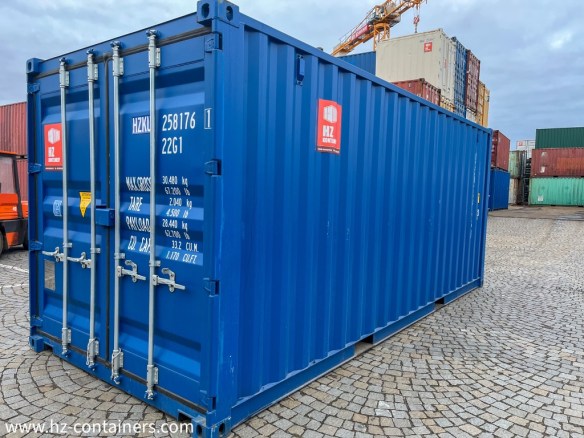
Load-Bearing Points of Shipping Containers
What Are Load-Bearing Points of Shipping Containers?
Load-bearing points of shipping containers, or the structural support points of a shipping container, refer to the key technical elements of the container that carry loads, maintain its structural integrity, and enable safe handling during transport and storage. These points are designed to withstand enormous pressures, distribute weight evenly, and ensure stability whether the container is loaded, stacked, or transported by sea, rail, or road.
Shipping containers, which are the cornerstone of global trade, are carefully designed to handle various stresses and forces. Structural support points include elements such as corner castings, anchor points, and reinforced frame structures, which play a crucial role in load bearing, cargo securing, and intermodal transport. These components are technically engineered so that containers remain durable and functional even under various environmental and operational conditions.
Key Components of Load-Bearing Points of Shipping Containers
1. Corner Castings
Corner castings are the most critical structural support points of a shipping container. They are located at all eight corners of the container and are made from highly durable steel, serving several functions:
- Load Transfer: Corner castings carry the weight of stacked containers during transport and storage. They enable stacking of containers up to eight or more units high and effectively distribute vertical loads.
- Securing Points: Locking mechanisms, such as twist locks, stacking cones, or other securing systems, are attached to corner castings during transport by ship, truck, or rail. These points ensure that containers remain firmly in place during movement.
- Handling: Crane hooks and spreader bars are attached to these points for lifting and moving containers. Their standardized design ensures compatibility with handling equipment worldwide.
The International Organization for Standardization (ISO) establishes the dimensions and strength requirements for corner castings to ensure universal compatibility across different transport methods and equipment. Corner castings are also key for modular construction projects, where they provide anchoring points and structural alignment.
2. Anchor Points
Anchor points are additional securing elements located along the interior walls, floor, and sometimes on the roof of the container. They are used to securely fasten cargo inside the container and prevent it from shifting during transport.
Key Features:
- Maximum Securing Load (MSL): Anchor points typically support loads up to 1,000 daN (decanewtons), although this may depend on the design and type of container.
- Location: They are found at regular intervals and are positioned to accommodate cargo of various sizes and shapes. Their strategic placement increases flexibility when securing diverse loads.
- Functionality: They allow the attachment of ropes, straps, or other securing mechanisms to stabilize goods. This is particularly important in intermodal transport, where cargo movement could lead to damage or accidents.
Anchor points are essential for maintaining cargo integrity and ensuring safe transport, especially for valuable or fragile goods.
3. Floor and Side Rails
Floor and side rails are an integral part of the container’s structural frame. They provide horizontal support and even weight distribution.
Floor Rails:
- Typically made from high-strength steel or aluminum, floor rails are designed to withstand heavy loads from forklifts or other handling equipment. They distribute weight evenly across the container’s base, minimizing stress on floor panels.
Side Rails:
- Side rails increase the rigidity of the container frame and, together with the floor and roof, prevent deformation under pressure. They are key to maintaining the rectangular shape and structural integrity of the container.
Together, floor and side rails form the backbone of the container’s structure and enable it to withstand demanding conditions during loading, unloading, and transport.
4. Roof and Wall Panels
Although not primary load-bearing components, roof and wall panels contribute to overall structural integrity and cargo protection.
Roof Panels:
- Designed to support limited vertical loads, such as snow accumulation. Roof panels are typically corrugated to increase strength and durability.
Wall Panels:
- Provide lateral stability and protect cargo from environmental factors such as rain, wind, and seawater. They are reinforced at key points to prevent deformations caused by internal pressure or external impacts.
While roof and wall panels are secondary to corner castings and rails, they play a crucial role in maintaining the integrity and functionality of the container.
5. Corner Posts
Corner posts connect corner castings vertically and serve as critical points for transferring loads between stacked containers. They are designed to withstand significant pressures, particularly during stacking on ships.
Corner posts are constructed to handle high stacking scenarios, evenly distributing the weight of containers above them to the corner castings below them. This ensures stability even under demanding conditions, such as rough seas or strong winds.
Why Are Load-Bearing Points of Shipping Containers Important?
1. Weight Distribution
Efficient weight distribution is essential in container transport. Structural support points ensure even distribution of forces, preventing structural damage and ensuring stability.
2. Stacking and Intermodal Transport
Shipping containers are designed to be stacked up to eight or more units high. Corner castings and posts carry the entire weight of containers above them, enabling stability even in dynamic conditions.
3. Cargo Securing
Proper cargo securing ensures safety during transport. Anchor points and other securing mechanisms prevent cargo from shifting, which could lead to damage or accidents.
4. Standardization
Structural support points are standardized according to ISO standards, ensuring compatibility with cranes, trucks, and ships worldwide. This standardization facilitates seamless movement of containers between different transport modes.
Related Terms
Shipping Containers
Standardized steel containers used for transporting goods by sea, rail, and road. They come in various types, such as 20-foot, 40-foot, and high-cube containers.
Load Capacity
The maximum weight a container can safely carry without compromising its structural integrity. For example, a 20-foot container typically has a load capacity of around 28,000 kg.
Maximum Securing Load (MSL)
The maximum load that can be applied to an anchor point or securing element without compromising safety.
Twist Locks
Devices used to secure containers to each other or to a transport vehicle by locking into corner castings.
Challenges and Maintenance
1. Overloading
Exceeding the maximum load capacity of a container can damage its structural support points, which may lead to failure during transport.
2. Corrosion
Exposure to saltwater and adverse weather can cause corrosion of corner castings, rails, and posts. Regular maintenance is necessary to extend the service life of the container.
Load-bearing points of shipping containers form the backbone of modern shipping containers, enabling efficient, safe, and reliable transport of goods worldwide. From corner castings to anchor points, each structural element plays a crucial role in maintaining the integrity and functionality of the container. Understanding these elements is essential for anyone involved in logistics, transport, or container conversion projects.

 Czech Republic, Kopřivnice
  FREE SHIPPING