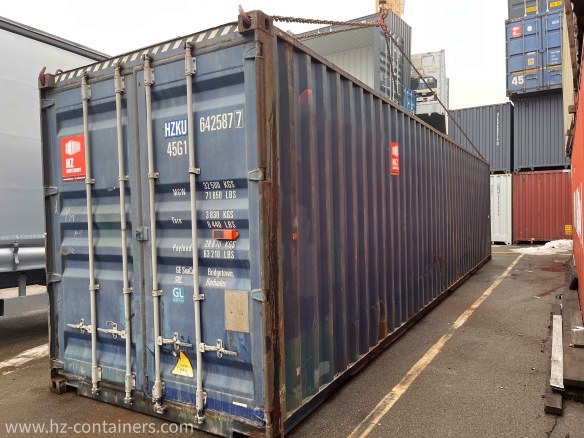
CAUTION 9’6″ HIGH CONTAINER
Warning – CAUTION 9’6″ HIGH CONTAINER is a critical operational and safety marking placed on the outer shell of a specific type of intermodal container, known as a High Cube container. This warning is absolutely essential for all persons involved in the logistics chain – it is intended for crane operators, truck drivers, railway employees, and warehouse operators, as it clearly signals that the height of the container exceeds the standard dimensions of a standard shipping container.
Meaning of Individual Parts of the Marking
- Warning: Equivalent of “Caution”, emphasizing the international nature of transport and the fact that containers may be marked in different languages, depending on the origin or routes of the container owner.
- CAUTION: A universally understandable expression in English, required by international standards.
- 9’6″ HIGH CONTAINER: Precise specification of the external height of the container – 9 feet and 6 inches, which is approximately 2.896 meters.
This marking is a standardized safety element according to the international standard ISO 6346, which unifies the marking and identification of containers worldwide. Its main purpose is to prevent accidents that may occur when passing under bridges, entering tunnels, warehouse entrances, or other spaces with limited height. The marking is not just a sticker, but an essential message that is part of a global safety system in logistics.
High Cube Container: Detailed Overview
What is a High Cube Container?
High Cube container (HC, HQ) is a type of shipping container that has the same length and width dimensions as a standard container, but is exactly one foot (approximately 30 cm) higher. This added height significantly increases the internal volume and usable capacity, which is advantageous for transporting light, bulky goods that would fill the volume in a standard container before reaching the maximum permitted weight.
- Standard container height: 8 feet 6 inches (8’6″ = approximately 2.591 m)
- High Cube height: 9 feet 6 inches (9’6″ = approximately 2.896 m)
High Cube containers are often used for transporting large machinery, technological units, pallets with high loads, or where it is necessary to maximize space for bulky but light goods (for example, electronics, textiles, plastic components).
Overview of Basic Dimensions and Specifications (typically 40′ High Cube)
| Specification | Imperial (ft/in, lbs) | Metric (m, kg) | Note |
|---|---|---|---|
| External length | 40′ 0″ | 12.192 m | Standardized for transport equipment |
| External width | 8′ 0″ | 2.438 m | Standardized |
| External height | 9′ 6″ | 2.896 m | Key feature of High Cube |
| Internal length | 39′ 5 3/4″ | 12.03 m | Minor variations by manufacturer |
| Internal width | 7′ 8 1/2″ | 2.35 m | Minor variations by manufacturer |
| Internal height | 8′ 10 1/16″ | 2.694 m | Usable height for cargo |
| Door width | 7′ 8 1/16″ | 2.338 m | Key for handling larger items |
| Door height | 8′ 5 3/4″ | 2.585 m | |
| Weight of empty container (Tare) | approximately 8,930 lbs | approximately 4,050 kg | |
| Maximum useful load (Payload) | approximately 58,270 lbs | approximately 26,430 kg | |
| Maximum gross weight (Max Gross) | 67,200 lbs | 30,480 kg | (Tare + Payload) |
| Internal volume | approximately 2,690 cu. ft. | approximately 76.2 m³ | Total internal volume |
Note: Dimensions and weights may vary depending on the manufacturer and age of the container.
Significance of the “CAUTION 9’6″ HIGH” Marking
Why is This Warning Necessary?

Most transport infrastructure is designed for the standard container height of 8’6″. When transporting a High Cube container, the following risks exist:
- Collision with infrastructure: Impact with low bridges, tunnels, warehouse entrances, transfer points, etc.
- Risk of injury: Collisions can lead to damage to the container, cargo, vehicle, and public infrastructure, and in extreme cases, endanger human lives.
- Damage to technological equipment: Contact with overhead electrical lines is extremely dangerous, especially in older facilities.
The marking “CAUTION 9’6″ HIGH” therefore serves as a final and clear warning for all those who handle the container to pay attention to the height when planning the route or handling.
Standardization and Placement of the Marking (according to ISO 6346)
The ISO 6346 standard prescribes clear and uniform marking of all containers higher than 2.6 m. The mandatory markings include in particular:
- Height warning box: A rectangular field (often yellow or white with black text) indicating the height in meters and feet (e.g., “2.9m / 9’6″ HIGH CONTAINER”). It is placed on each side wall on the right at the top below the identification number.
- Yellow-black diagonal stripes: A warning band of diagonal yellow and black stripes on the top edge of the container, clearly visible from the side and front – visual signaling even at greater distances.
This redundant visual communication minimizes the risk of human error.
Complete Overview of Markings on a High Cube Container
Each container is marked with a number of mandatory data according to ISO 6346:
Main Identification Elements
- Container identification number: In the format ABCD 123456 7
- Owner code (ABCD): The first three letters identify the owner, the fourth (usually “U”) indicates the type of equipment (cargo container).
- Serial number (123456): A six-digit sequential number.
- Check digit (7): Used to validate the correctness of the number by automated systems.
- Operational markings:
- MAX. GROSS: Maximum permitted weight including cargo and container.
- TARE: Weight of the empty container.
- NET/PAYLOAD: Maximum weight of cargo (MAX GROSS – TARE).
- CU. CAP. / CUBE: Internal volume in m³ or cu. ft.
- ISO size and type code (e.g., 45G1 for 40’HC):
- 4: Length 40 feet.
- 5: Height 9’6″ (High Cube).
- G1: Universal container with passive ventilation.
- CSC plate (Container Safety Convention):
- A metal plate confirming that the container meets structural requirements for international transport. It lists the manufacturer, inspection dates, maximum load, etc.
Construction and Structural Elements of a High Cube Container
- Material: Most commonly Corten steel (COR-TEN), which creates a protective corrosion layer and significantly extends service life. The floor is usually made of marine plywood at least 28 mm thick, often also bamboo.
- Doors: Equipped with robust locks, seals, and massive hinges to protect cargo from weather and theft.
- Lashing eyes: Strong steel eyes on the floor and walls for secure fastening of cargo with straps or chains (load capacity typically up to 2,500–6,000 kg per eye).
- Corner castings: Eight standardized corners for handling (crane, forklift) and safe stacking.
- Ventilation: Passive openings with covers preventing water ingress, designed to minimize condensation.
Logistics and Operational Aspects
Road Transport
For the transport of High Cube containers, it is necessary to use special chassis types such as “gooseneck” or “drop deck”, which allow the total height of the vehicle combination to be reduced below the maximum legal limit (for example in the Czech Republic typically 4.00 m). If a standard flat chassis is used, the combination would exceed the limit and there would be a risk of fines or collisions.
Digital Cargo Management
In modern logistics, the physical movement of a container is always accompanied by digital documentation (so-called content uploads): bill of lading, photographs of the loaded container, weighing protocol (VGM), customs data, etc. It is essential to correctly declare the maximum gross weight – exceeding the limit is a serious violation of regulations!
Legal and Commercial Framework
- International standards: ISO 6346 (marking), ISO 668 (dimensions), ISO 1496 (testing and construction) – compliance with these is a prerequisite for transport worldwide.
- Contractual terms: When purchasing or renting a container, issues of liability for damage (including cases where the driver ignores the warning “CAUTION 9’6″ HIGH”), insurance coverage, mandatory inspections, etc., are addressed in detail.
- Data protection: Online platforms for cargo management and tracking protect user and shipment data in accordance with applicable GDPR and other regulations (see Privacy Policy).
Summary
The marking CAUTION 9’6″ HIGH CONTAINER is an integral part of the global safety and communication system in logistics. Its main task is to protect health, property, and infrastructure by clearly and understandably warning of the increased height of the High Cube container. Thanks to strict standardization according to ISO 6346, this message is understandable and respected worldwide, enabling safe and efficient movement of goods within international trade.
 Czech Republic, Opava
  FREE SHIPPING