Bearing Bracket Outer L – Large Door Bar Clamp
In global logistics, shipping containers are the foundation of international trade. Their robust steel construction is designed for transport by sea, rail, and road, with the outer shell, corner posts, and beams ensuring structural integrity. A critical, yet often overlooked, role in container safety and functionality is played by small components – for example, bearing brackets, which are crucial for the proper functioning of container doors. One of the most important is the Bearing Bracket Outer L – the large outer bearing bracket.
This article provides an expert insight into this part, including its function, construction, material composition, standards, and role in the entire container door securing system. Knowledge of this part is essential for inspectors, maintenance technicians, repair depots, and container owners.
Catalog Number: HZ000268
What is Bearing Bracket Outer L? Detailed Definition and Description
The Bearing Bracket Outer L is a heavy steel part that is welded to the outer surface of a shipping container’s door panel. Its main function is to hold and guide the vertical locking bar of the door, which rotates and secures the door against opening.
Meaning of the designation “Outer L”
- Outer – denotes the outer part of a two-piece clamp system (the outer bracket is welded, the inner is bolted).
- L (Large) – specifies the size of the bracket; it is the main load-bearing part of the bar, unlike smaller guides.
Technical definition: The Bearing Bracket Outer L is the larger outer part of a two-piece bearing bracket assembly, which, in combination with the inner bracket, forms a firm yet rotatable mounting for the container door’s locking bar.
Alternative Terminology
Due to varying manufacturer and regional terminology, you may also encounter these names:
- Locking Bar Bracket
- Outer Large Bearing Bracket
- Lock Rod Bracket
On a standard container, there are typically four large outer bearing brackets on each door (eight in total per container), which, together with the inner parts, form a complete assembly.
Function within the Container Door Locking System
To understand the importance of the Bearing Bracket Outer L, it is necessary to know the entire container door locking system. This system is designed for maximum strength, security, and ease of operation.
Key Components of the Door Mechanism:
| Component | Function |
|---|---|
| Locking Bar | Steel vertical bar passing through the door, the main locking element. |
| Cam (cam lock) | Cams on the upper and lower ends of the bar that engage with keepers when rotated. |
| Keepers (cam keepers) | Steel stops on the upper and lower door frame, securing the door in the closed position. |
| Door Handle | Lever for rotating the bar and securing the cams. |
| Bearing Brackets (outer and inner) | Mounting and guiding of the door locking bar. |
Relationship between Outer and Inner Bracket
- Outer (“Outer L”): Welded, robust element that bears the main load.
- Inner: Flat, bolted part that forms the clamp for the bar with the outer part.
This two-piece system is crucial for maintenance – it allows for easy replacement of the bar or bush without having to detach the entire assembly from the door.
Importance of the Plastic Bearing (“split bush”)
Inside each assembly is a plastic (nylon) bearing that:
- Reduces friction – allows smooth rotation of the heavy steel bar.
- Protects against corrosion – separates metal parts and prevents electrolytic corrosion.
Typically, a polymer alloy such as Nylatron is used, which is resistant to wear and seawater.
Technical Specifications, Materials, and Manufacturing Standards
Material Composition
| Material | Properties | Application |
|---|---|---|
| SS400 | Structural steel, tensile strength ≥ 400 MPa | Standard containers, resistance to mechanical stress |
| Q235B | Low-alloy carbon steel, high plasticity | Common choice in Asian containers due to good weldability |
| Stainless steel (optional) | Corrosion resistance | Special containers (reefer, tanks) |
Surface Treatment
- Hot-dip galvanizing – a zinc layer protects against corrosion (salt spray, precipitation, aggressive environments).
- Typical appearance: matte silvery surface.
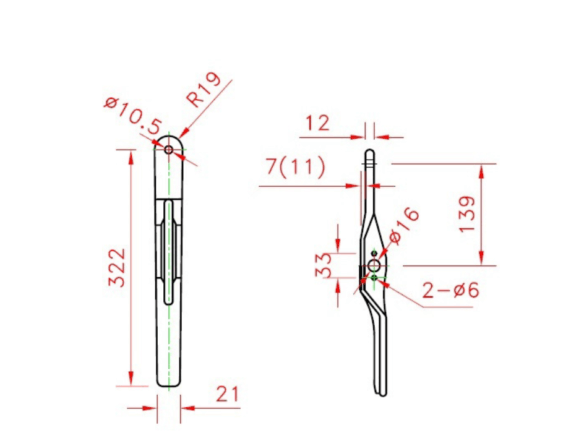
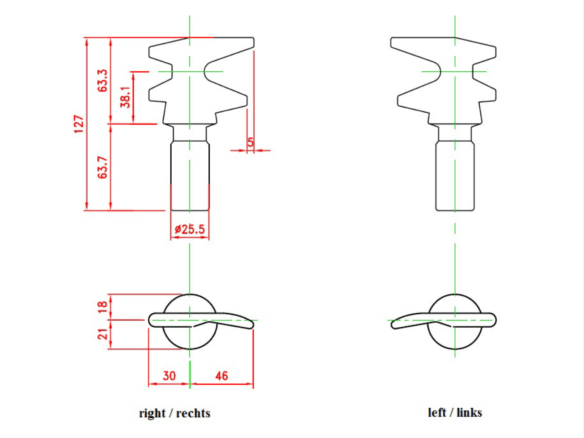
Dimensions and Catalog Parameters
Each manufacturer may have small deviations in dimensions, so it is necessary to verify:
- Overall length, width, height of the bracket
- Diameter of the housing for the bar (usually approx. 27–32 mm, depending on the bar type)
- Pitch and diameter of holes for inner part screws
- Weight: typically 0.35–0.45 kg per outer bracket
Example Product Images:
Compliance with ISO Standards
- ISO 1496-1 – sets structural, dimensional, and safety requirements for containers.
- All door mechanism parts must meet requirements for strength, functionality, and interchangeability within global transport.
Typical Defects, Inspection, Repairs
Most Common Types of Damage
- Deformation (bending, denting) – mostly due to impact (handling, stacking, transport).
- Cracks, tears – in the bracket body or in the weld to the door panel, critical for safety.
- Loose/dismantled – vibrations can loosen the screws of the inner part; in extreme cases, the entire clamp may be lost.
- Corrosion – damaged zinc surface leads to corrosion and weakening of the metal.
- Worn bearing – increased play, stiff operation, or noisy vibrations of the locking bar.
Recommended Repair Procedures
| Type of Defect | Recommended Repair |
|---|---|
| Minor deformation | Repair by heating and straightening (heat straightening) |
| Weld crack | Cutting out, re-welding by a certified welder |
| Loose screws | Tightening to specified torque, replacing missing ones |
| Severe corrosion | Complete part replacement, re-galvanizing |
| Bearing replacement | Removal of inner part, replacement of plastic bush |
Inspection and Maintenance
- Regular inspections are mandatory for extending the validity of CSC certification (Container Safety Convention).
- Use only original or approved spare parts – non-original parts can compromise container safety and certification validity.
Purchase and Logistics of Spare Parts
Catalog Navigation and Ordering
When ordering, it is important to:
- State the exact specification: “bearing bracket outer large”, catalog number (e.g., D.BB.OL), required standard, and material.
- Verify compatibility according to the container manufacturer (CIMC, CXIC, Singamas, etc.).
- Check dimensions and photos – visual comparison with the original part is essential.
Modern E-commerce Tools
- Ability to add items to an inquiry basket and create a bulk request.
- Comparison of individual part parameters on the supplier’s website.
- Downloading technical drawings and transparent images for easy comparison.
Example Product Images from Catalogs:
Summary: A Pillar of Container Door Security
Bearing Bracket Outer L is a part whose importance far exceeds its size. It forms the basic support of the entire locking mechanism of the shipping container door. Thanks to its robust construction, resistance to corrosion and ease of replacement, it is a key element for the safety of the cargo and the long life of the container.
For technicians, depot managers and fleet owners, knowledge of this part and its proper maintenance are essential. Replacement or repair must always be carried out according to standards and using original or approved parts.
 Czech Republic
  WITHOUT SHIPPING