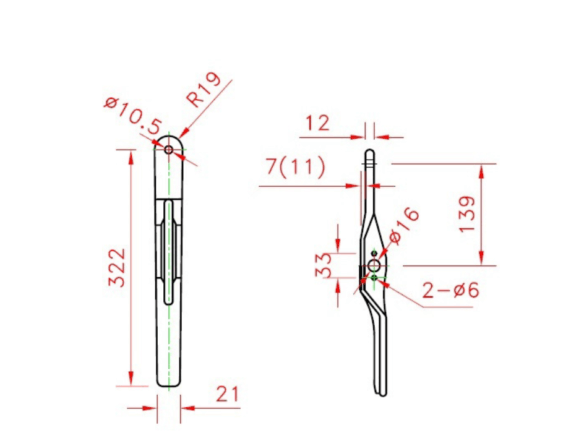
Bearing Bracket Outer S – Small Door Bar Clamp
Outer Bearing Bracket S (Small Outer Bearing Bracket) for Shipping Containers
Introduction and Basic Definitions
The Outer Bearing Bracket S (also known as Small Outer Bearing Bracket, often also Locking Bar Guide or Guide Bracket, Outside – Small) is a robust, welded steel part located on the exterior side of the shipping container door. Its main function is the precise guidance of the vertical locking bar (lock rod), which ensures the locking of the container doors. The bracket ensures that the bar remains straight and correctly centered during rotation, which is crucial for the reliable function of the locking cams and their securement in the cam keepers. Although it is a relatively small and seemingly inconspicuous part, its importance for the safety of transported goods and the lifespan of the entire container is crucial.
Catalog Number: HZ000065
Meaning of the designations “Outer” and “S (Small)”
- Outer: Location on the exterior (outer face) of the container door panel.
- S (Small): Indicates a smaller dimension compared to “L (Large)” – the large bearing bracket, which bears the main load and often contains a plastic insert (bushing).
Function in the Container Door Assembly
Locking Bar Guidance
The locking bar (lock rod) is a long steel rod that must be precisely guided during container operation to prevent bending the door panel, snagging, and to allow secure locking of the cams into the keepers.
The Outer Bearing Bracket S is welded to the door surface at strategic points approximately one-third and two-thirds along the length of the locking bar. Thanks to its shaped design, it creates a guide channel that prevents lateral movement of the bar and ensures its parallel alignment with the door edge.
Ensuring Correct Position and Safety
If the bracket were damaged, bent, or missing, the locking bar could deform during handling, which often leads to:
- Imperfect door seating (poor sealing),
- Excessive effort during operation (risk of injury),
- Compromised cargo security (incomplete locking).
Difference Compared to the Large Bearing Bracket
| Parameter | Small Outer Bracket (S) | Large Bracket (L, with bushing) |
|---|---|---|
| Function | Guidance and stabilization | Main rotation and load bearing |
| Location | Middle of bar | End of bar (top/bottom) |
| Contains plastic insert? | No | Yes (split bush) |
| Dimensions (typically) | 100x50x50 mm | 120x70x55 mm and more |
Construction and Technical Parameters
Material, Manufacturing, and Surface Treatment
- Material: High-strength rolled or forged structural steel (e.g., Q235B, SS400). This type of steel is standardized for container parts according to ISO 1496.
- Manufacturing: Stamping, forging, or precision casting ensure high strength, fatigue resistance, and impact resistance.
- Surface Treatment: In the vast majority of cases, hot-dip galvanizing, sometimes combined with passivation or powder coating to increase corrosion resistance in aggressive environments (sea salt, industrial emissions).
Why galvanization?
Zinc protects steel not only as a barrier but also cathodically – minor surface damage “heals” through zinc oxidation, which prevents rust development around the damage.
Dimensions, Weight, Catalog Numbers
From manufacturing catalogs and e-shop data:
| Parameter | Typical value |
|---|---|
| Length | 100 mm |
| Width | 50 mm |
| Height | 50 mm |
| Weight | 0.1 – 0.12 kg |
| Surface | Zinc layer (silver color) |
| Material | Steel Q235B, SS400 |
| Catalog number | LG87009S (Secure A Load) and others |
Related System Components
- Locking bar (Lock rod): Steel rod whose rotation locks the doors.
- Door panel: Profiled steel wall to which the bracket is welded.
- Large bearing brackets: Are located at the ends of the bar and bear the main load.
- Plastic insert (split bush): Reduces friction in the main bearing brackets.
- Cam and Cam Keeper: Ensure mechanical locking of the doors.
- Door handle and retainer: Used for manual locking operation.
Location and Installation on the Container
Typical Position on the Door
Standard ISO container doors have two locking bars. Each bar is guided and supported by this scheme:
- Upper large bearing bracket (with bushing)
- Small outer bracket (guide)
- Small outer bracket (guide, sometimes a third one)
- Lower large bearing bracket (with bushing)
This arrangement ensures force distribution and minimizes the risk of bar deformation during handling.
Installation Method (Welding)
- Installation: The bracket is welded directly to the outer surface of the door panel. Welding must be performed by a qualified welder according to ISO 3834 standards.
- Replacement: A damaged bracket is cut off, the surface is cleaned and prepared, and a new bracket is precisely positioned and welded. After cooling, it is recommended to repair (restore) the zinc surface using zinc spray.
Importance for Container Safety and Function
Cargo Protection and Operational Safety
- Cargo safety: A missing or damaged bracket represents a weak point – during vibrations, the bar may become misaligned and the doors may open, which in practice means a threat to valuable cargo, risk of loss, damage to goods, and theft.
- Worker safety: An improperly guided or loose bar is dangerous during handling – it can cause injury (pinching, injury from excessive force).
Impact on the Lifespan of the Locking System
- Force distribution: Failure of one bracket means overloading other components, which often leads to subsequent failures of large brackets, bushing wear, and in extreme cases, deformation of the door panel.
- Operational efficiency: Smooth door operation is crucial in ports and warehouses – any snagging causes delays and increases the cost of container handling.
Failures and Wear
Typical Defects and Their Identification
- Bend, dent: Most often caused by impact from forklift forks or transport equipment.
- Crack, tear: Occurs due to long-term overloading or material fatigue.
- Loose bracket: Imperfect weld or its breakage, often due to vibrations.
- Missing bracket: Consequence of extreme mechanical damage.
- Corrosion: If the zinc layer is damaged, rapid rust development and subsequent material weakening can occur.
Most Common Causes of Damage
- Impact by equipment: Handling equipment in the port often hits the bracket during loading/unloading.
- Rough handling: Unprofessional or overly forceful operation of the locking bar.
- Corrosion: Older containers or containers with compromised surface treatment are prone to rapid rust development.
- Door deformation: Sudden shifting of heavy cargo inside the container can cause door bulging and subsequent bracket damage.
Maintenance, Repairs, and Replacement
Inspection Procedures
- Regular visual inspection: All brackets are checked for deformations, cracks, corrosion, or looseness.
- Functional test: The rotation of the locking bar must be smooth and free of play.
- Record in inspection protocol: All identified defects are recorded and evaluated.
Recommended Repair Methods
- Straightening: Minor bends can be straightened, but there is always a risk of material weakening.
- Re-welding: A loose bracket can be re-welded if the material is not damaged.
- Replacement: In case of major damage, cracks, severe corrosion, or a missing part, complete cutting off and welding of a new bracket (always galvanized) is necessary.
Conclusion: The Indispensable Role of a Small Part
The Outer Bearing Bracket S is a typical example of a part whose size and cost do not reflect its importance. It is a crucial link in the chain of safety and functionality of a shipping container. Only correctly fitted and maintained brackets ensure that the container protects cargo from weather, damage, and theft, while also enabling fast, safe handling in logistics operations.
Frequently Asked Questions (FAQ)
How many small outer bearing brackets does a standard container have?
Usually 4–6 per door (2–3 on each locking bar).
Is there a difference between a Small Outer Bearing Bracket and a Locking Bar Bracket?
Yes. A Locking Bar Bracket usually refers to a large bearing bracket with a plastic insert. A Small Outer Bearing Bracket is a smaller guide bracket without an insert.
Can I use a container with a missing bracket?
It is not recommended – there is a risk of damage to the locking system and reduced cargo and handling safety.
Are inner and outer brackets different?
The outer bracket is the main one (U-profile welded from the outside). The inner bracket is usually more of a flat counter-plate in the case of a large bearing bracket.
 Czech Republic
  WITHOUT SHIPPING