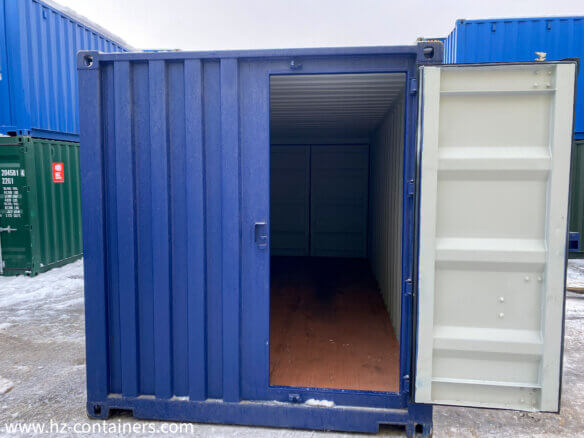
3 Doors – Shipping Containers
In the rapidly evolving world of logistics, construction, storage, and modular architecture, shipping containers have become an indispensable tool. Their robustness, modularity, and variability have enabled the creation of many specific modifications that have pushed their use far beyond the boundaries of ordinary cargo transportation. One of the most practical and growing modifications is the 3 Doors shipping container, often referred to as the Tridoor container. This article provides the most detailed explanation of this concept, its technical parameters, usage options, comparison with other types, and practical advice from the perspective of an experienced expert.
What is a 3 Doors (Tridoor) Shipping Container?
The 3 Doors shipping container (internationally also referred to as Tridoor container or Tri Door Shipping Container) is a specially modified ISO container equipped with three separate entrances. The most common configuration includes:
- Standard double-leaf cargo doors on one of the shorter sides of the container (two entrances).
- Single-leaf personnel door (“man door”), usually located on the opposite shorter side of the container (third entrance).
This combination allows not only maximum accessibility but also efficient division of internal space. Tridoor containers are designed for a wide range of applications – from mobile warehouses, through workshops to basic building modules for modular buildings such as shipping container homes and shipping container houses.
Construction Diagram
| Element | Location | Function | Material | Safety Features |
|---|---|---|---|---|
| Cargo Doors | Shorter end (standard) | Loading/unloading cargo | Corten steel | Locking bars, sealing |
| Personnel Door | Opposite end/side wall | Quick personnel access | Steel/steel+insulation | Cylindrical lock, handle |
| Steel reinforcement frame | Around personnel doors | Static integrity | Steel profile | Welded and corrosion-protected |
Key Features and Component Definitions
1. Standard Cargo Doors
- Material: High-strength Corten steel, corrugated for maximum rigidity.
- Dimensions: Typically height 2,280 mm, width 2,340 mm (for 20′ and 40′ containers).
- Sealing: Industrial EPDM rubber sealing around the entire perimeter, guarantees 100%25 water and dust tightness.
- Locking system: 2 to 4 robust locking bars with cam-lock mechanism, possibility of adding padlocks, security covers.
- Ergonomics: Possibility of full door opening up to the container wall (180°), easy maneuvering even with pallet equipment.
2. Personnel Doors
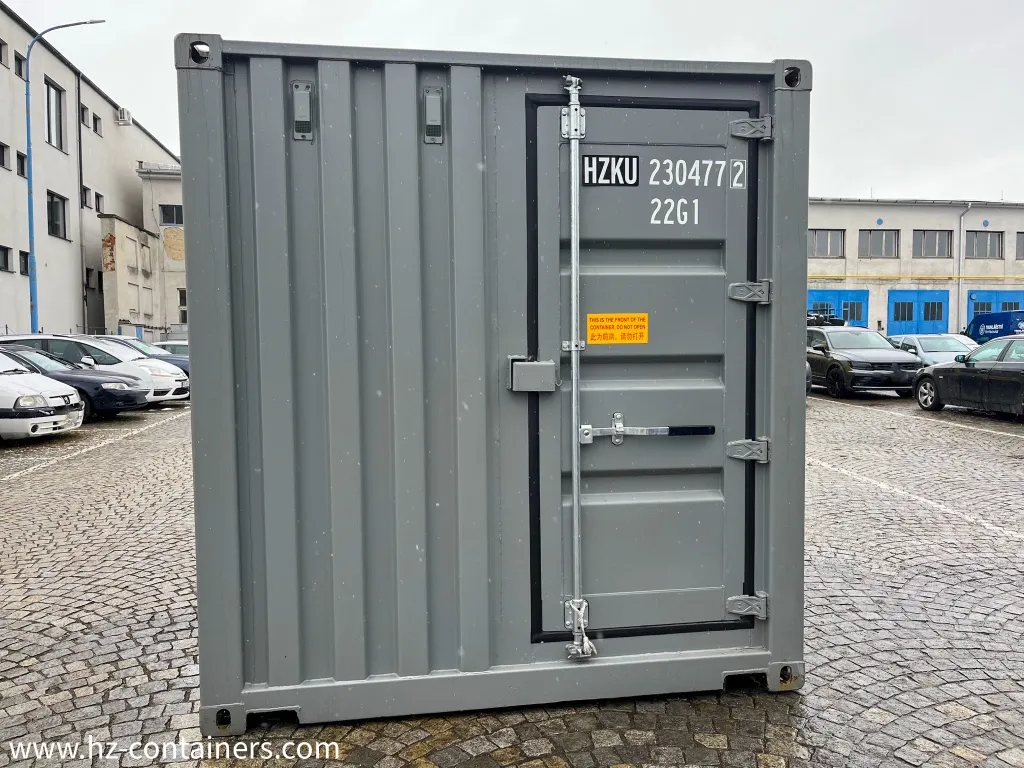
- Construction: Steel doors with safety reinforcements, often with the option of PUR foam or mineral wool insulation.
- Dimensions: Standard 900 × 2,000 mm, but can be customized as required.
- Installation: Cut and welded into the container wall, steel frame transfers load and restores body strength.
- Safety: Equipped with multi-point locks, possibility of safety latches, external safety hinges, and possibly a water ingress threshold.
- Insulation and sealing: In higher specifications, internal/external sealing can be added, as well as fire resistance.
3. Structural Integrity
- Reinforcements: Around each opening (personnel door, any other openings) it is necessary to weld a steel frame from closed profiles (e.g., 100 × 40 × 4 mm), which distributes forces and ensures stackability.
- Statics: Proper execution means that the container can still be safely stacked (ISO corner castings), which is essential for transport and storage.
- Corrosion protection: All new welds and cuts are treated with anti-corrosion primer and painted in RAL shade according to customer preference.
Size Variants and Specifications
Tridoor containers are commonly available as:
| Type | Length | Width | Height | Internal Volume | Empty Weight |
|---|---|---|---|---|---|
| 20ft Tridoor | 6.058 m | 2.438 m | 2.591 m | approx. 33 m³ | approx. 2,200–2,400 kg |
| 40ft Tridoor | 12.192 m | 2.438 m | 2.591 m | approx. 67 m³ | approx. 3,800–4,200 kg |
- Special variants: On the market you can find “High Cube” versions (increased height to 2,896 mm), as well as containers with expanded doors (extra-wide doors), or with multiple personnel doors on the side.
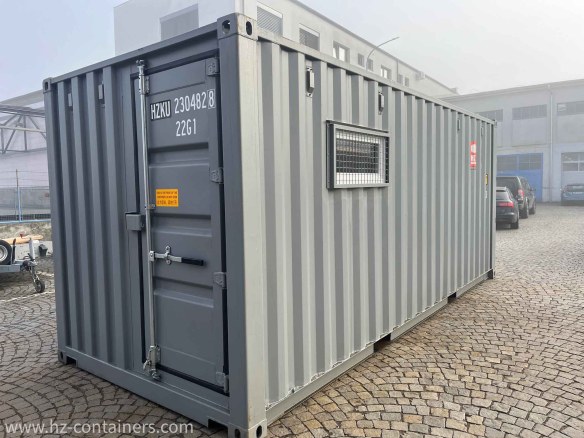
- Custom modifications: Windows, ventilation grilles, air conditioning, or additional segmented or rolling doors for specific industrial applications are often installed.
Practical Use and Applications
The exceptional combination of accessibility and security makes the Tridoor container an ideal solution for many industries.
Typical Applications
- Construction: Mobile facilities, combination of warehouse and administrative section in one area.
- Industrial operations: Material storage with separate sections for different types of goods.
- Logistics and transportation: Efficient handling of multiple shipments without the need to unload the entire contents.
- Workshops and service stations: One section for machines, another for spare parts, third as a changing room or office.
- Agriculture: Feed storage, separate storage of fertilizers, tools, and equipment.
- Trade and events: Pop-up stands, mobile bars, shops with separate storage and customer entrance.
- Modular buildings: Basic element for container homes, offices, schools, or sanitary modules.
Example of Internal Space Division
| Entrance | Recommended Use | Advantage |
|---|---|---|
| Cargo Doors | Palletized goods, machines | Fast loading/unloading |
| Personnel Door | Daily access, inspection | Comfort, safety, insulation |
| Separate section | Valuable goods, documentation | Possibility of separate security |
Comparison with Other Types of Shipping Container Doors
Overview of Available Types
| Door Type | Use | Advantages | Disadvantages |
|---|---|---|---|
| Cargo doors (double-leaf) | Standard transport and storage | Maximum opening, security | Heavy, impractical for frequent access |
| Side doors | Pallet warehouse and large items | Access along entire length, fast handling | Higher price, more complex construction |
| Roll doors | Warehouses, workshops with frequent access | Fast opening, space saving | Lower security, poor insulation |
| Sliding glass doors | Residential and office modules | Natural light, aesthetics | Low security, insulation problems |
| Personnel doors | Offices, workshops, warehouses | Easy access, insulation option, security | Limited passage, requires static modification |
| Multi-door (combination) | Special operations, multi-use | Maximum flexibility | Higher purchase price, more complex service |
Why Choose a 3 Doors (Tridoor) Container?
- Separation of personnel and cargo movement increases operational safety.
- Possibility of individual security of individual sections (ideal for shared warehouses).
- Flexibility of space division according to current needs.
- Possibility of expansion – additional doors, windows, air conditioning, interior equipment.
Advantages and Disadvantages of 3 Doors Container
Advantages
- Extreme flexibility – suitable for combined operations (warehouse + workshop, warehouse + office).
- Increased accessibility from multiple sides saves time and reduces physical effort.
- Work efficiency – easy sorting, fast dispatch, better organization of internal space.
- Safety – separation of personnel access from handling zone minimizes injury risk.
- Possibility of locking individual sections – suitable even for multiple users (e.g., shared warehouses).
Disadvantages
- Higher purchase price – each modification means investment beyond the basic container.
- Complexity of modifications – requires professional execution and experience with container statics.
- Limited warehouse availability – usually manufactured to order, which may extend delivery time.
- Necessary regular maintenance – especially at weld and cut locations there is a higher risk of corrosion.
Safety and Technical Requirements
- Doors should comply with EN 10219 (steel profiles) and EN 1627–1630 (door safety classes) standards.
- All modifications should be performed by a certified supplier who guarantees the preservation of water tightness, statics, and safety.
- Mandatory corrosion protection – all new welds and cuts must be treated with primer and paint.
- Possibility of additional insulation – increases comfort when used year-round, e.g., as an office, workshop, or technical facility.
Frequently Asked Questions (FAQ)
Is a Tridoor container still watertight after modification?
Yes, if the modification is performed professionally and with the use of proper sealing and anti-corrosion paints, the container remains fully watertight.
Can a standard container be subsequently converted to a 3 Doors variant?
Yes, most specialized companies offer this modification “turnkey” including static assessment, reinforcement, and optional painting.
Can I choose the type of personnel doors?
Yes, standard steel doors, glass doors, fire-resistant doors, or special security classes are available.
Is it possible to equip the container with additional modifications?
Yes, ventilation grilles, windows, electrical installation, internal shelves, air conditioning, heating, etc. are common.
What is the lifespan of a 3 Doors container?
With proper maintenance (especially checking seals, paints, hinges, and locks), the lifespan is the same as a standard shipping container – 25 to 40 years.
The 3 Doors (Tridoor) shipping container represents an innovative and highly practical evolution of the standard steel box. It combines robustness and security with maximum accessibility and flexibility of use. Because of this, it is an ideal choice for anyone looking for an efficient and safe solution for modern storage, logistics, construction facilities, and modular architecture. Investment in a Tridoor container pays off in the form of time savings, increased productivity, and operational safety.
 Czech Republic, Třebíč
  WITHOUT SHIPPING