
SHIPPING CONTAINER 20

20-foot (6 meters long) shipping container is the most requested container for purchase due to its wide range of uses. This type of container is very popular for the reason that it can be easily converted into storage space for businesses, a garden shed, a garage made from a shipping container, a promotional stand, or used for short-term storage purposes at events.
Due to its dimensions, it is also easily transportable even with a forklift (commonly known as a “turtle”). A shipping container has a very long lifespan, making it suitable not only for transporting goods but also for both short-term and long-term storage. It is especially popular for its versatility in various sectors. Additionally, all containers of quality IICL 6, IICL 5, CIC, and Cargo Worthy have a valid CSC label for international transport.
Our offer of 20-foot containers: new, used, and decommissioned
- One Way IICL 6 shipping containers
- which are a great choice for prestigious corporate storage, self-storage units, or a garage made from a shipping container that will last a lifetime.
- IICL 5, CIC containers
- that have traveled more than one sea journey, yet are still generally in excellent condition.
- Used Cargo Worthy shipping containers
- that are no longer in such good visual condition, however, still meet their functionality for safe transport and are very popular for conversion into living spaces (shipping container homes, container houses), garden sheds, construction units, insulated garages, or for business purposes. There are countless possibilities for converting shipping containers.
- AS IS decommissioned shipping containers
- that no longer fulfill their function for safe storage of goods during international transport, however, for many people they are suitable for simple garden or workshop storage.
What is a shipping container?
A shipping container is a standardized steel box or crate designed for the storage and transportation of various types of cargo during international freight transport. These containers are predominantly used for transporting goods by sea, land, and air, contributing to the globalization of trade and international logistics. Standard shipping containers most commonly measure 20 feet (i.e., 6.1 meters long), but there are also larger ones such as 40 feet or 45 feet long. All these shipping containers are built according to international standards, such as ISO specifications. This standardized design allows for easy transfer of containers between different modes of transport, simplifying handling and increasing the efficiency of supply chains.
Shipping containers are also typically equipped with double doors for easy access to cargo from the narrower side of the container. These doors may also be located on both sides of the container (known as double-door containers), depending on the type of shipping container. Containers are designed to be weather-resistant, handle the rigors of loading and unloading, and protect cargo from damage during transport. In addition to standard steel shipping containers, there are also special types for transporting sensitive goods like food—refrigerated and cooling containers, hazardous materials, bulk cargo, and so on. All these containers have specific properties and safety requirements corresponding to the nature of the cargo. However, even these specialized containers are produced in the most requested size of 20 feet. You can view their clear categorization on this page: categorization of shipping containers.
Globally, billions of tons of goods are transported in shipping containers each year, underscoring their key role in global trade and logistics. Containers are known for their reliability, versatility, and efficiency and are an indispensable element of modern freight transport.
20-FOOT SHIPPING CONTAINER FOR SALE – COMPLETE OFFER HERE
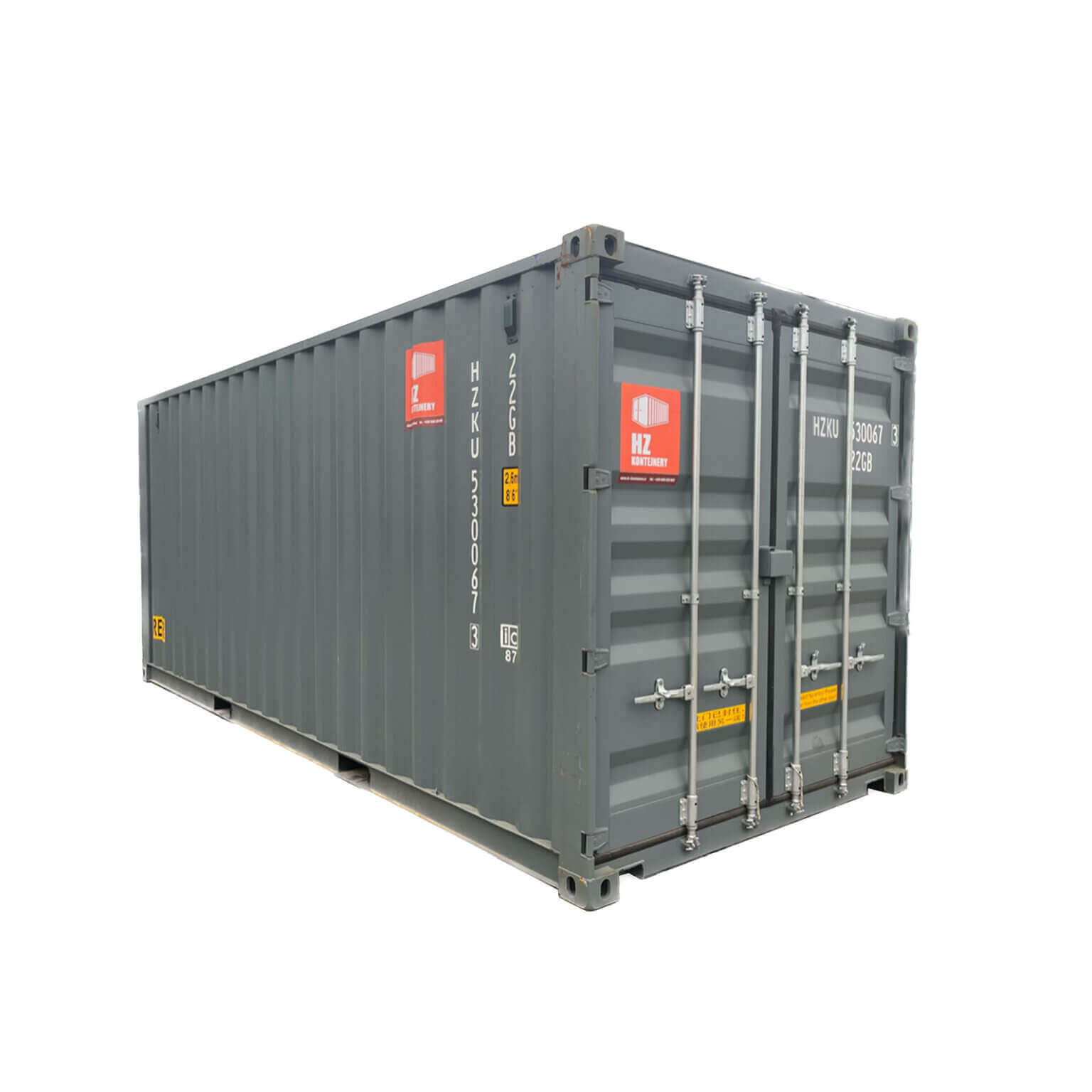 | 20-FOOT SHIPPING CONTAINER – STORAGE CONTAINER | ||||||||||
| External dimensions (m) | Internal dimensions (m) | Door dimensions (m) | Weight kg | Volume | |||||||
| TYPE of container | length | width | height | length | width | height | width | height | container | max payload | m3 |
| 20′ | 6,058 | 2,438 | 2,591 | 5,898 | 2,352 | 2,393 | 2,34 | 2,28 | 2250 | 28260 | 33 |
| 20′ camouflage | 6,058 | 2,438 | 2,591 | 5,898 | 2,352 | 2,393 | 2,34 | 2,28 | 2250 | 28260 | 33 |
TECHNICAL PARAMETERS OF THE SHIPPING CONTAINER
External dimensions of the 20-foot shipping container are: length 6,058m / width 2,438m and height 2,591m with an allowable tolerance of +-5 to 6mm.
Internal dimensions: length 5.898m / width 2.352m / height 2.393m with a possible deviation of +- 5 to 6mm
Dimensions of the doors: width 2.393m / height 2.280m with a possible deviation of +-5mm
Maximum load for a 20-foot shipping container is: 33.2m3 / maximum permissible weight 30,480 kg with a 2% overload tolerance
What to place the container on after its delivery? Your questions will be resolved by concrete footings under the shipping container

What is a 20-foot shipping container made of?
Shipping containers are an essential part of global trade and logistics. Among the most common are 20-foot containers, which are used to transport a wide range of goods. These containers are designed to be durable, secure, and efficient. But what are they actually made of? Let’s take a closer look.
20-foot shipping containers are made of corten steel, which provides high durability and long lifespan. The construction includes robust steel profiles, corrugated steel panels, and wooden floors. Safety features such as high-quality seals and locking systems ensure cargo protection. Standardization and certification guarantee compatibility with various transport means, and special modifications allow for a wide range of uses.
Main materials
Shipping containers, including 20-foot ones, are primarily made from corten steel (sometimes referred to as weathering steel). This material is specifically designed to resist corrosion and weathering effects. Corten steel has the ability to form a protective layer on its surface, preventing further damage and thereby extending the container’s lifespan. As a result, containers are extremely durable and suitable for long-term use in challenging conditions.
Structural elements
The construction of a 20-foot container includes several key elements that ensure its strength and reliability. The frame of the container is made of robust steel profiles that provide stability and load-bearing capacity. The sides and roof are made from corrugated corten steel, which increases structural strength while reducing the weight of the container.
The bottom of the container consists of wooden floors, often made from hardwood, which are treated against fungi and pests. The wood is solid and durable, ensuring safe cargo storage. Additionally, wood has excellent insulation properties, which can be beneficial when transporting more sensitive goods.
Protective elements
To ensure safety and protect the cargo, containers are equipped with several protective elements. The doors of the container are made of steel and equipped with quality seals that minimize the ingress of air and water. The doors are also fitted with locking systems and lockboxes that prevent unauthorized access.
Another protective element is the surface treatment of corten steel. This is often coated with a finish that enhances resistance to corrosion and UV radiation. This coating can also come in various colors, allowing for easy identification of containers and customization of their appearance according to customer needs.
Standardization and certification
20-foot containers must meet international standards to be compatible with various types of transport means. Among these standards are ISO certification, which ensures that containers have uniform dimensions and structural properties. Another important certification is CSC (Container Safety Convention), which confirms that containers meet safety requirements for maritime transport.
Special modifications
In addition to standard 20-foot containers, there are also variants with various special modifications. For example, insulated containers are equipped with insulating materials such as polyurethane foam or fiberglass, which minimize heat transfer and maintain stable temperature conditions inside the container. These containers are ideal for transporting food, pharmaceuticals, or chemicals. Another special variant is container modules, which can be modified for specific purposes, such as storage spaces, offices, or even living units (shipping container homes). These modules can be equipped with electrical wiring, air conditioning, and other features that enhance their utility.

Specifications for 20′ Shipping Container
The container’s construction is made of anti-corrosion steel: Corten A, which is specially designed for corrosion resistance. This material is 100% recyclable and consists of natural utility steel with a blend of special elements that ensure its ability to withstand atmospheric effects.
Due to its nature, Corten steel develops a unique rusty patina after some time, which acts as a protective shield against further oxidation of the material and nearly halts corrosion. Decommissioned containers, which may have had their surface paint removed in the most exposed areas, are often known for their distinctive appearance due to the rusty patina. However, this patina does not mean that the containers are subject to corrosion and are no longer usable, as COR-TEN steel is designed so that such surface changes do not deteriorate its durability.
The shipping container is assembled from vertical corrugated steel sheets – so-called trapezoidal sheet.
The floor is wooden, made from 28mm thick plywood of hardwood. After the completion of the floor, all bottom constructions and the floor are coated with asphalt paint with a dry film thickness of at least 200 microns.
Each container has double-wing doors on the rear frame, and each door can rotate approximately 270 degrees. Each door is made of pressed horizontal corrugated steel sheets with a thickness of 3.0 mm for the top and bottom parts, and the middle side of the door from horizontal corrugated steel sheets with a thickness of 2.0 mm. The side walls of the trapezoidal sheet are made from steel panels with a thickness of 1.6 mm.
Each container has two small plastic ventilation grilles. Each is attached to the upper right part of each side wall with three aluminum screws with a diameter of 5.0 mm and is sealed with sealant to prevent water leakage.
All door hardware is hot-dip galvanized with a thickness of approximately 75 microns. And all fasteners, such as: self-tapping screws, wood screws, nuts, hinges, cam catches, and fastening hardware are electro-galvanized with a thickness of approximately 13 microns.
All steel surfaces including welds are completely blasted prior to application of the epoxy primer. After the base coating has dried, theouter side of the container is again painted with a high-strength topcoat, e.g. RAL 7015and the inside is painted again with a high-strength epoxy-based ;resin cured with polyamide. The dry film thickness of the topcoat is 40 microns for exterior and interior.