
Shipping containers Nuremberg, Germany
Nuremberg (Nürnberg) is among the most significant logistics centers not only of Bavaria, but of all of Germany. This guide was created to summarize everything essential in one place: from an overview through current prices and types of containers to a practical guide on how to transport a container from Nuremberg to the Czech Republic.
Definition: A shipping container (also called an ISO container, a freight container, in German Seecontainer or Frachtcontainer) is a standardized steel transport unit according to ISO standards, designed primarily for maritime, rail, and road transport of goods. Currently, it also serves as storage space, a building module, or the basis for container homes.
What are shipping containers?
The historical significance of Nuremberg as a logistics hub
Nuremberg lies at the crossroads of key European transport routes, and its logistical importance reaches deep into the Middle Ages, when trade routes connecting northern and southern Europe passed through here. Today, the city is home to bayernhafen Nürnberg — one of the most efficient inland ports in Germany — and the TriCon Container Terminal, a trimodal transshipment station that connects water, road, and rail transport.
Bayernhafen Nürnberg spans an area of 337 hectares (roughly equivalent to 470 football fields) and handles over 4.3 million tons of goods annually. The TriCon terminal features nine loading tracks, four gantry cranes, and a capacity of up to 350,000 cargo units per year. It is precisely this infrastructure that makes Nuremberg a natural center for the shipping container trade — containers flow in via the Rhine-Main-Danube waterway, by rail from the ports of Hamburg and Rotterdam, and via the A3 and A9 highways.
For a Czech customer, the important point is that Nuremberg lies only about 80 kilometers from the border with the Czech Republic (the Rozvadov/Waidhaus crossing), making it the closest major German container center.
What shipping container dealers operate in Nuremberg?
Specialized dealer
Not all dealers in Nuremberg are the same. They differ not only in price, but above all in specialization and level of service:
HZ Containers is one of the few dealers that target Czech customers directly — their website is entirely in Czech, prices are listed in Czech crowns, and they offer their own transport to the Czech Republic. Their containers can be picked up directly from the container depot in Nuremberg, which is ideal for anyone who wants to inspect the container in person and take it away with their own carrier.
What types of shipping containers are available in Nuremberg?
Standard sizes: 10′, 20′, 40′ and High Cube
Shipping containers are manufactured in strictly standardized dimensions according to ISO standards. The following table summarizes the most common types you will encounter in Nuremberg depots:
| Type | External dimensions (L × W × H) | Internal volume | Typical use | Availability in Nuremberg |
|---|---|---|---|---|
| 10′ (3 m) | 2.99 × 2.44 × 2.59 m | ~15 m³ | Garden storage, small workshop | Medium |
| 20′ (6 m) | 6.06 × 2.44 × 2.59 m | ~33 m³ | Storage, transport, construction booth | Very high |
| 20′ High Cube | 6.06 × 2.44 × 2.90 m | ~37 m³ | Higher storage spaces | Medium |
| 40′ (12 m) | 12.19 × 2.44 × 2.59 m | ~67 m³ | Large storage, workshop, transport | High |
| 40′ High Cube | 12.19 × 2.44 × 2.90 m | ~76 m³ | Container home, high-volume storage | Very high |
| 45′ High Cube | 13.72 × 2.44 × 2.90 m | ~86 m³ | Special transport, max. volume | Low |
The most sought-after types in Nuremberg are 20′ and 40′ High Cube containers. The twenty-foot model is ideal for a smaller business or private individual — it fits on a standard plot, does not require a building permit (when placed as a mobile structure), and its transport is the simplest. The forty-foot High Cube, on the other hand, forms the basis for container homes and larger commercial projects — a ceiling 30 cm higher than the standard 40′ container means a significantly more comfortable interior space.
Special containers: refrigerated, Open Top, Flat Rack
In addition to standard boxes, Nuremberg dealers also offer special types:
- Refrigerated containers (Reefer) — with an integrated cooling unit, suitable for the transport and storage of food or pharmaceuticals. ContainerCenter24 offers them with PTI certification (Pre-Trip Inspection). Prices for refrigerated containers start significantly higher, typically from €3,500 for a used 20′ Reefer.
- Open Top — a container with a removable tarpaulin instead of a fixed roof, designed for oversized cargo that exceeds the height of a standard box.
- Flat Rack — a container without side walls and a roof, essentially a steel platform with collapsible ends for heavy and oversized goods (machinery, vehicles).
What affects the price of a shipping container?
In addition to obvious factors such as size and age, several less obvious variables play a role:
- Validity of CSC certification — Every container used for international transport must bear a valid CSC (Convention for Safe Containers) plate. Containers with expired CSC lose value, because they cannot be legally transported by sea. For storage purposes, however, this does not matter.
- Depot location — Containers located directly at the terminal (e.g., TriCon in Bayernhafen) are cheaper to pick up, because there is no need for additional relocation.
- Seasonality — In spring and summer, demand for containers rises (construction season, moving), which may be reflected in prices.
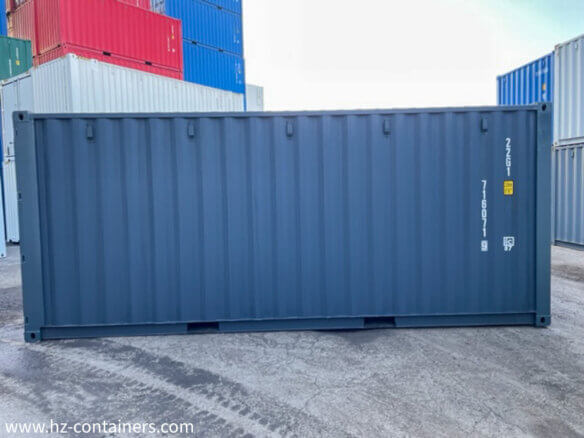
- Color finish — Standard colors (blue RAL 5010, anthracite RAL 7016, brown) are the cheapest. Special color shades made to order increase the price.
- Floor condition — The wooden floor is the weakest point of used containers. Containers with a new or undamaged floor command a higher price.
What are the container condition categories: AS IS, Cargo Worthy and One Way?
Explanation of individual categories
When buying a shipping container, you will come across several standard condition designations. Understanding them is key to making the right choice:
| Category | Meaning | Typical appearance | Suitable for | Indicative price (20′) |
|---|---|---|---|---|
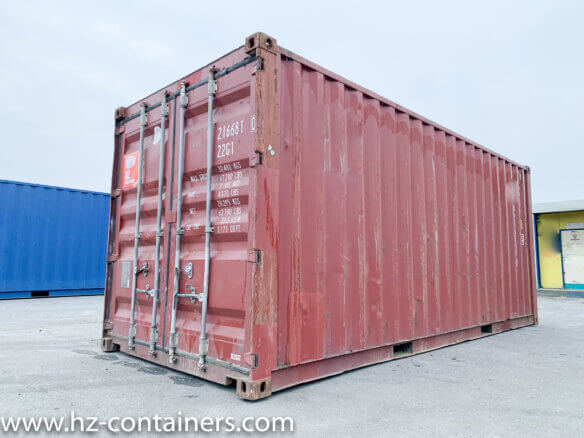
| AS IS | “As it stands” — retired from maritime transport | Visible wear, dents, rust, possible leaks | Garden storage, construction booth | €1,200–1,500 |
| Cargo Worthy (CW) | Fit for transport — valid CSC, watertight, functional | Minor cosmetic defects, functional doors, undamaged floor | Storage, transport, workshop | €2,000–2,500 |
| One Way | After one maritime voyage — almost new | Minimal signs of use, like new | Storage, representative purposes, housing | €2,500–3,000 |
| IICL-5 / IICL-6 | The highest standard of the leasing industry | Essentially flawless condition | Demanding transport, container home | €3,000–3,500 |
| New | Straight from the factory, never used | Perfect, with warranty | All purposes, especially housing | €3,500–4,000 |
Which condition is suitable for which use?
The choice of category depends on what you plan to do with the container:
- Storage of tools, tires, seasonal items → AS IS is entirely sufficient. You will save 40–60 % compared to a new container. Before purchase, check whether the container leaks — AS IS does not automatically mean it has holes, but you do not get a watertightness guarantee.
- Storage of more sensitive material (paper, textiles, electronics) → at least Cargo Worthy. You need assurance that rain does not get inside and that the floor can bear the declared load.
- Conversion to a workshop, office, sales stand → One Way or new. In these projects, you invest additional funds in modifications (insulation, electricity, windows), and it does not pay to start with a container that has hidden defects.
- Container home → exclusively One Way, IICL, or new. Rust, leaks, and deformations are unacceptable in a residential building.
How does the purchase and transport of a container from Nuremberg to the Czech Republic work?
Step-by-step procedure: from inquiry to delivery
The purchase of a shipping container and its transport to the Czech Republic follows a well-established procedure:
- Choosing a container — Select the desired condition and type of container.
- Inquiry — Send an inquiry with a precise specification: type (20′ / 40′ / HC), condition (AS IS / CW / One Way / new), preferred color, pickup date. Do not forget to state that you are a VAT payer (if you are), the delivery address in the Czech Republic, and ideally also your VAT ID.
- Payment — The standard is payment in advance by bank transfer. Prices are typically listed excluding VAT, and the tax is handled via the reverse charge mechanism.
- Transport — See the following subsection.
- Acceptance — Upon delivery, inspect the container before signing the handover protocol.
An important detail: the container requires a hydraulic arm (HIAB) or a crane for unloading. A regular forklift cannot handle a 20′ container (weight approximately 2.2 t empty). Make sure in advance that you have the equipment for unloading at the destination — if not, the carrier must have a vehicle with a hydraulic arm (a so-called “container truck with arm”), which is standard for specialized carriers.
What are the alternative uses of shipping containers?
Storage, transport, modular buildings
A shipping container is no longer just a “tin box for goods.” In Nuremberg — as elsewhere in Europe — demand for alternative uses is growing. Here are the main directions:
- Storage — The most common use. A container offers a dry, lockable, and durable space for a fraction of the cost of a brick building.
- Transport — If you are in the export/import business, owning your own container eliminates the costs of renting transport boxes.
Frequently Asked Questions (FAQ)
Where to buy a shipping container?
Through HZ Containers (Czech language support).
How does the transport of a container from Nuremberg to the Czech Republic work?
Transport can be arranged in three ways: own pickup (you need a vehicle with a hydraulic arm). A hydraulic arm or crane is required for unloading the container at the destination. The transport of one 20′ container from Nuremberg to Prague costs approximately CZK 7,000–12,000.
What is a container depot and how does it work?
A container depot is a storage and transshipment facility where containers are gathered, sorted, repaired, and offered for sale. Containers arrive here by rail (from Hamburg, Rotterdam), by road, and by water (the Rhine-Main-Danube Canal). From the depot, the customer can pick them up in person or order their transport.
What is the difference between AS IS, Cargo Worthy, and One Way condition?
AS IS means “as it stands” — a container retired from maritime transport without a watertightness guarantee, suitable for storage. Cargo Worthy (CW) is a container with valid CSC certification, watertight and fully functional, suitable for transport and storage. One Way is a container after one maritime voyage, almost new, with minimal signs of use — ideal for representative purposes and housing. The price difference between AS IS and One Way for a 20′ container is typically €1,000–1,300.
What are the dimensions of 20′ and 40′ shipping containers?
A standard 20′ container measures 6.06 × 2.44 × 2.59 m (external dimensions) with an internal volume of approximately 33 m³. A standard 40′ container measures 12.19 × 2.44 × 2.59 m with a volume of approximately 67 m³. The High Cube version adds 30 cm in height — a 20′ HC has a height of 2.90 m (volume ~37 m³), a 40′ HC has a height of 2.90 m (volume ~76 m³). The most available variants in Nuremberg are the 20′ and 40′ HC.
 Germany, Nuremberg
 WITHOUT SHIPPING

Other container news...

Contamination of the inner walls of a shipping container: Why this is a normal operating condition and not a reason for a complaint
Dark streaks, scuffs, and marks on the interior walls of a shipping container are a completely normal occurrence during use. They arise naturally during the loading and unloading of goods via handling equipment and have no impact on the container’s watertightness or structural integrity. Find out why these aesthetic marks are not grounds for a complaint and how they can be easily touched up if necessary.

Obligation to Check Tightness When Selling a Reefer Container
Who is responsible for the refrigerant leak check when selling a refrigerated container? Find out what obligations the seller has at the time of handover and why they must provide a PTI report along with the technical data plate. Learn which regulatory requirements and F-gas record-keeping duties become the sole responsibility of the new owner.

New shipping containers
If you are currently considering purchasing a new shipping container, you are not alone. While just twenty years ago containers were used almost exclusively for maritime transport, today they have found their way into construction, storage, business, and even housing. This growing popularity brings with it a host of questions: Which type should you choose? How much does it cost? How do you recognize quality? How can you avoid falling victim to scammers?
New sea shipping containers
If you are currently considering purchasing a new shipping container, you are not alone. While just twenty years ago containers were used almost exclusively for maritime transport, today they have found their way into construction, storage, business, and even housing. This growing popularity brings with it a host of questions: Which type should you choose? How much does it cost? How do you recognize quality? How can you avoid falling victim to scammers?