
Periodic and Continuous Inspection of Shipping Containers in Practice (PES vs. ACEP)
Why is Inspection of Shipping Containers Essential?
In international transport, shipping containers serve as the fundamental building block of global logistics. The safety and operational capability of containers directly affects not only the protection of transported goods, but above all the lives of workers in ports, ship crews and the surrounding population. When transporting dangerous goods (chemicals, gaseous or flammable substances), any structural defect or leak is a potential source of accident with fatal consequences. Therefore, regular and thorough inspection of shipping containers is not only a legal obligation, but also essential prevention.
The rules for container inspection and maintenance are established by the International Convention for Safe Containers (CSC 1972, as amended). It defines two inspection schemes:
- Periodic Examination Scheme (PES)
- Approved Continuous Examination Program (ACEP)
Both approaches have their advantages and are used by different types of operators depending on fleet size and container usage.
Definition of Key Terms
International Convention for Safe Containers (CSC)
- Adopted in 1972 under the auspices of the International Maritime Organization (IMO).
- Ensures uniform safety standards for the manufacture, testing, operation and maintenance of containers.
- Requires that every container used in international transport be regularly inspected.
CSC Plate
- Mandatory permanently attached identification plate on each container (usually on the left doors).
- Must contain:
- The inscription “CSC SAFETY APPROVAL”
- Country of approval and reference number
- Date of manufacture
- Container identification (BIC number)
- Maximum gross weight and stacking load
- Torsion test load value
- Information on inspection regime: date of next inspection (for PES) or ACEP number (for ACEP)
- A valid CSC plate is a prerequisite for legal operation of a container in international transport.
International Maritime Organization (IMO)
- UN agency responsible for safety and prevention of pollution in maritime transport.
- Manages and updates the CSC convention.
- Issues guidelines and recommendations for conducting inspections (e.g. CSC.1/CIRC.138/REV.1).
Global ACEP Database
- Operated by BIC (Bureau International des Containers).
- Contains a list of all approved ACEP programs including validity and relevant operators.
- National authorities are invited by IMO to publish all their ACEP programs in this database.
- Access: BIC ACEP Database
Main Inspection Regimes: PES and ACEP
Periodic Examination Scheme (PES)
Essence:
- Each container must be inspected no later than 5 years from manufacture.
- Subsequent inspections take place at intervals of max. 30 months (2.5 years).
- After each inspection, the “Next Examination Date” (NED) is updated on the CSC plate.
- Inspection is carried out by a qualified inspector/surveyor according to prescribed standards.
- Typically used by smaller companies that do not have their own approved maintenance program.
Advantages of PES:
- Simple administration for small fleets.
- No approval procedure for the program required from the state administration.
Disadvantages:
- Need to physically update the CSC plate after each inspection.
- High risk of “expired” inspection date, which may mean transport ban or fines.
- Limited flexibility – containers must be presented for inspection at a specific time.
Approved Continuous Examination Program (ACEP)
Essence:
- Modern, audited program where inspection is integrated into normal operating cycles of the container (depot, repairs, handover to lessee, etc.).
- The operator must submit their own inspection and maintenance plan for approval by the relevant state authority (in the state of registration).
- The program must ensure that the interval between inspections never exceeds 30 months and the level of safety is not lower than with PES.
- The CSC plate shows a unique ACEP number, not the date of the next inspection.
- The approved program is subject to regular reviews (min. every 10 years) and audits (recommended every 5 years).
- When the lessee changes, the responsibility for inspections is transferred to the new operator (see CSC.1/CIRC.138/REV.1).
Advantages of ACEP:
- Inspections take place efficiently within normal container handling – no need to take it out of service.
- No need to physically change the CSC plate after each inspection.
- Reduces the risk of sanctions for invalid CSC plate.
- Better container condition due to early detection and repair of damage.
- Ideal for large fleets (shipping lines, leasing companies).
Disadvantages:
- Higher demands on documentation, internal processes and regular program audits.
- Approval procedure and obligation to register in the ACEP database.
Comparison of PES and ACEP
| Criterion | PES | ACEP |
|---|---|---|
| Principle | Regular physical inspection intervals | Continuous inspection according to operating cycle |
| First inspection | Within 5 years of manufacture | As part of starting operation in ACEP program |
| Subsequent inspections | Every max. 30 months | With each significant handling, always < 30 months |
| Record on CSC plate | “Next Examination Date” | ACEP number (decal/plate) |
| Approval | Not required | Audit and program approval by state administration required |
| Flexibility | Low | High |
| Risk of “expiration” | High – possibility of missing the date | Low – validity tied to validity of ACEP program |
| Typical user | Small companies, individual owners | Shipping line, leasing companies, large fleet operators |
| Administrative burden | Lower | Higher, including inspection records and regular audits |
Legal Framework and Responsibility
- Who bears responsibility?
- Always the current operator, which may be the owner, leasing company or lessee (according to contractual relationships).
- When renting, the obligation to inspect passes to the lessee, who must ensure inspection in accordance with the applicable regime (PES or own ACEP).
- According to CSC.1/CIRC.138/REV.1, the container must always have current marking of the inspection regime (NED or ACEP number).
- Consequences of invalid inspection:
- Ban on transport in port, rejection of container by shipping company.
- Risk of high fines, costs of cargo transshipment, delays.
- Risk of rejection of insurance payment in case of damage.
- Full legal and financial responsibility of the operator.
Inspection Procedure: 7-Point Container Check
As part of any inspection (PES and ACEP), a comprehensive check is performed according to the following points:
- Undercarriage:
- Inspection of beams, cross-members and floor elements for damage and corrosion.
- Doors:
- Functionality of hinges, locks, seals, any signs of forced entry.
- Right Side:
- Condition of sheets, beams, any dents, repair marks.
- Front Wall:
- Integrity, tightness, condition of corners and ventilation openings.
- Left Side:
- Similarly to the right side – emphasis on structural integrity.
- Floor (inside):
- Looking for cracks, holes, signs of rot or unauthorized intervention.
- Roof:
- Inspection for punctures, dents, water accumulation areas, corrosion.
Each qualified surveyor proceeds according to these points and records the results in an inspection report.
Standards for Inspections and Repairs
IICL (Institute of International Container Lessors Standards)
- The highest and most stringent industry standard for container inspection and repair.
- Typically required by leasing companies and for containers intended for further lease or sale.
- Sets precise tolerances for deformations, corrosion, closure functionality, floor condition, etc.
- IICL Repair Criteria
UCIRC (Unified Container Inspection and Repair Criteria)
- Created by shipping companies for their own needs.
- Defines uniform requirements for inspection and repairs across different operators.
CIC (Common Interchange Criteria)
- Used when transferring containers between different companies (e.g. between shipping line and depot).
- Emphasis on minimizing disputes regarding container condition when changing operator.
Note: CSC does not specify details of how inspection should look – however, the use of the above standards is necessary in practice for inspection recognition and minimization of legal disputes.
Digitalization and Modern Trends in Inspection Records
- Global ACEP database allows online verification of ACEP program validity for a specific container.
- Modern systems (e.g. Container xChange) automatically alert to upcoming inspection dates and maintain digital records of all inspections.
- Electronic records increase transparency, reduce the risk of errors and speed up audits.
- With the development of IoT sensors, it is possible to monitor container condition in real time and detect emerging damage or environmental changes (humidity, temperature).
Impact of Inspections on Container Value and Operation
- Containers with valid CSC certification have higher residual value on the used container market.
- Valid inspection is a prerequisite for leasing and transport by all reputable shipping lines.
- In case of cargo damage, the absence of valid inspection may mean rejection of insurance payment.
- Thorough documentation of inspections is essential for asserting warranties and resolving complaints.
Related Terms and Organizations
- Classification societies: ABS, Lloyd’s Register, Bureau Veritas, DNV GL – conduct technical inspections and approve ACEP programs.
- BIC code: Unique identifier of container owner, recorded on CSC plate.
- ISO standards: Define container dimensions, marking and strength requirements (e.g. ISO 668).

 Czech Republic, Třinec
  FREE SHIPPING


Other container news...

20 Foot shipping container cost
If you are researching the cost of a 20 foot shipping container, you have likely already encountered wildly different prices — from $999 listings online to quotes exceeding $5,500. That range is not a sign of inconsistency. It reflects real differences in container condition, location, delivery logistics, and the seller you are dealing with.
Side Opening container
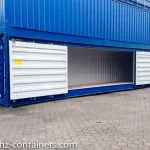
A side opening container is an ISO-compliant intermodal shipping container engineered with full-length bi-fold doors along one of its long side walls, in addition to the standard cargo doors at one end. Unlike conventional containers that restrict access to a single set of rear doors, a side opening container — also widely called an open side container, open-sided shipping container, or side door container — provides unobstructed lateral access across the entire 20-foot or 40-foot length of the unit. This design transforms the container from a narrow tunnel into a wide-open space that forklifts can enter from the side, multiple workers can load simultaneously, and oversized cargo that would never fit through standard end doors can be placed without struggle.
40 Foot High Cube container cost
A 40 foot high cube container — often abbreviated as 40ft HC, 40′ HC, or 40-foot high cube — is one of the most common shipping container sizes sold on the secondary market. But if you are researching what a 40 foot high cube container costs, you have almost certainly noticed that prices are all over the map. One seller quotes $1,500. Another quotes $7,000. Both could be legitimate.
20 Foot container cost
If you have ever searched for a shipping container, you have almost certainly asked one question first: how much does a 20 foot container cost? The answer is not a single number. It is a range that spans from under $1,000 for a weathered, as-is unit to over $5,000 for a pristine, one-trip container — and that is before delivery, site preparation, or modifications enter the picture.