
Opening shipping container doors: How it works, what to do when they stick, and how to open them safely
Opening the doors of a shipping container may look simple at first glance, but in practice it is a mechanism designed for high strength, tightness, and resistance in demanding conditions. That is precisely why container doors do not behave like ordinary warehouse or garage doors. If a person does not know how locking rods, cams, sealing, and the correct order of opening both door leaves work, they may feel that the doors are stuck, even though they are working exactly as they should.
This article explains how opening shipping container doors works, what the correct procedure is, why doors sometimes stick, and when the Easy Open system makes sense. It also covers safety risks, maintenance, and the differences between standard, side, and full-side-opening solutions.
Shipping container doors are a multi-point steel locking system where safety and tightness are more important than ease of movement. The correct opening technique is therefore not a detail, but the foundation of safe operation.
What does opening shipping container doors mean?
When talking about opening shipping container doors, it is not just about pulling the handle. In reality, it is the interaction of several mechanical elements that keep the doors firmly closed during transport, storage, and handling. A standard container must withstand vibrations, temperature changes, rain, wind, and mechanical stress. The doors are therefore designed so that they do not open on their own and so that they seal reliably.

What do standard container doors look like?
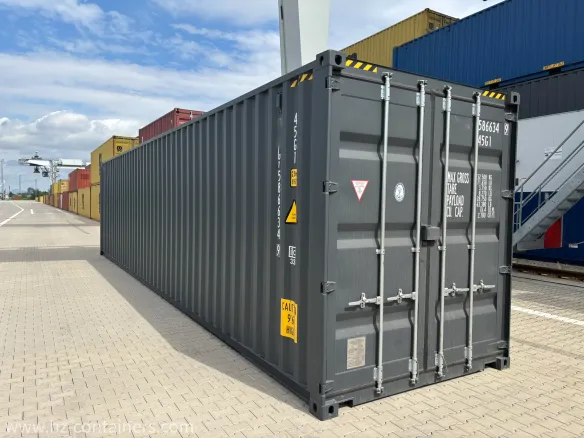
A typical shipping or transport container has two-leaf doors on the front side. Each leaf is mounted on robust hinges and is closed using vertical locking rods. These rods are connected to a handle or grip that the operator turns. The movement of the handle transfers force to the upper and lower cams, which engage into the keepers in the frame.
The result is a multi-point closure. The doors are not held in just one point as with a conventional lock, but in several critical points simultaneously. This increases the strength of the entire front wall and also ensures that the sealing around the door perimeter is evenly pressed against the frame.
Why are container doors not the same as ordinary doors?
The difference is mainly in the purpose. Ordinary doors are meant to provide a comfortable daily passage. Shipping container doors are primarily designed to protect the cargo and withstand extreme handling. This means higher resistance to movement, greater weight, and an emphasis on precise fitting.
That is precisely why doors may feel heavy even when they are not damaged. The strong pressure of the sealing, the steel construction, and the multi-point locking create resistance that is normal for a container. A problem only arises when the resistance increases to the point that opening is unusually difficult or dangerous.
How does the shipping container door opening mechanism work?
In order to open the doors safely and without unnecessary force, it is good to understand their basic mechanics. In most standard containers, the principle is similar, although the details may differ depending on the manufacturer, age, and type of container.
How do the handles, rods, and cams work?
The door handle or grip is connected to the vertical locking rods. When the operator turns the handle, the rods rotate around their axis and the upper and lower cams retract from the keepers in the frame. This unlocks the door leaf. As long as the cams are seated in the keepers, the doors are held firmly closed and the pressure of the sealing presses them against the frame.
After unlocking, the doors still need to be physically pushed open. Sometimes they move smoothly, other times there is resistance caused by the sealing, dirt, corrosion, or a slight distortion of the frame. This is why unlocking alone does not mean the leaf will open immediately.
Why is the right leaf usually opened first?
In most containers, the right door leaf is opened first, because the left one is partially overlapped or structurally tied to the closing order. The right leaf is usually the “active” one, and after it is opened, the left leaf can be released or fully opened.
This order is not a formality. If someone tries to open the wrong leaf first, they will encounter mechanical resistance and may think the system is damaged. In reality, they simply did not follow the logic of the door arrangement.
What role do the sealing and door frame play?
The sealing is essential for the watertightness and dust-tightness of the container. At the same time, however, it creates a pressure that can be felt when opening. In older containers, the problem is often that the sealing hardens over time, sticks, or deforms. In such a case, pulling the door away from the frame is physically more demanding.
The door frame is equally important. If the container is not standing level, is overloaded, or its front is damaged, the frame can become slightly distorted. Even a small deformation is enough to make the container doors significantly harder to open.
| Door system part | Function | Typical problem |
|---|---|---|
| Handle / grip | Transfers hand force to the locking rods | Bending, stiff operation |
| Locking rods | Open and close the multi-point locking | Corrosion, deformation |
| Cams | Secure the doors at the upper and lower points | Wear, jamming |
| Cam keepers | Receive the cams when closed | Dirt, mechanical damage |
| Door sealing | Ensures tightness against water and dust | Hardening, cracking, sticking |
| Hinges | Bear the weight of the door leaf | Misalignment, corrosion |
| Door frame | Maintains the geometry of the opening | Distortion, deformation |
How to open shipping container doors step by step?
The correct opening procedure reduces the risk of injury, damage to the doors, and problems with the mechanics. With an empty container, the process is usually simple, but with a full container or one that has not been used for a long time, more care is needed.
How to prepare before opening?
First, check that the container is standing on the most level surface possible. A crookedly placed container can twist to the point where the doors start to rub or become jammed in the frame. It is also advisable to check the area in front of the doors and make sure that nothing prevents them from opening fully.
With a loaded container, it is important to think about the pressure of the cargo. If the cargo is leaning against the doors, it may push outward after unlocking. In such a case, the problem is not the opening of the shipping container doors itself, but the safety of the person standing in front of them.
What is the correct working procedure?
First, remove the padlock or other security, such as a lockbox with a lock. Then release the handle locks and turn the right leaf handle so that the locking rods rotate and the cams come out of the keepers. If the movement is stiff, proceed smoothly and without jerks, do not force the doors.
Once the right leaf is unlocked, gently push it open. If the resistance is too great, it is better to stop and look for the cause rather than add more force. After opening the right leaf, release the left leaf in the same way. In some containers, the left side may be held differently, but the principle remains similar.
How to properly secure the doors after opening?
Open doors must be secured against movement. Strong wind can move a heavy steel leaf violently and cause injury or damage to the hinges. Ideally, use an integrated door keeper, a mechanical stop, or another professional solution designed for locking.
Makeshift methods, such as tying the doors with rope without a solid point and without assessing the load, sometimes work but are not reliable. In operations where the container is opened frequently, a solid and repeatable securing method is appropriate.
Why do shipping container doors stick or won’t open at all?
This question is one of the most common. In most cases, it is not a single cause, but a combination of age, environment, loading, and the condition of the structure.
Can corrosion, dirt, or deformation be the cause?
Yes, very often. Locking rods and cams are exposed to rain, dust, and temperature changes. If regular lubrication is missing, resistance builds up on the friction surfaces. Corrosion can also significantly impede the mechanism’s movement. Mud, ice, dried dirt, or deposits of old lubricant mixed with dust have a similar effect.
Another common culprit is deformation. A container that is not evenly supported can twist slightly. This then manifests precisely on the doors, which start to rub, fit poorly, or cannot be easily unlocked.
How does overloading or cargo pressure manifest?
If the container is filled so that the cargo rests against the doors, opening can be dangerous. The doors are usually under pressure and may move suddenly after being unlocked. With bulk or poorly secured materials, there is a risk that cargo will start falling out through the partially opened doors.
Here it is necessary to distinguish the mechanical resistance of the doors from the resistance caused by the container’s contents. If the handles are unlocked, but the leaf is still pushing outward or behaving abnormally, it is necessary to assume cargo pressure and not open the doors without securing and a suitable procedure.
When is it no longer normal resistance but a technical problem?
A technical problem is likely when the handle does not turn even after the lock is released, the rods have visible bending, the cams are damaged, or the door sits crookedly in the frame. Extreme resistance only in a certain part of the movement, metallic squeaking, or the inability to close the door correctly after opening are also warning signs.
In such a situation, it is better to stop using brute force. This often does not lead to opening, but to bending the handle, damaging the cam keepers, or tearing out other parts of the mechanism.
| Problem | Likely cause | Recommended solution |
|---|---|---|
| Handle barely moves | Corrosion or seized mechanism | Clean, lubricate, check rods and cams |
| Door does not release from the frame after unlocking | Stuck sealing or pressure in the frame | Carefully release, check geometry and sealing |
| Door rubs at the top or bottom | Distorted frame or poor container placement | Level the container placement, check support |
| One leaf cannot be opened first | Incorrect opening order | Open the active leaf according to the construction |
| Door moves on its own after opening | Wind or missing lock | Use a door keeper or mechanical stop |
| Door pushes outward after unlocking | Cargo leaning against the door | Open with extra caution, secure the area and the person |
What is the Easy Open system and when does it make sense?
The Easy Open system is a designation for modified container door opening that reduces the required force and improves operator ergonomics. It is not a universal standardized name for a single patented part, but rather a commercial and operational designation of a solution designed to make the doors accessible for frequent use.
How does Easy Open differ from standard opening?
The main difference is that standard doors are designed primarily for robustness, while Easy Open places greater emphasis on operator comfort. In practice, this means modified levers, a different mechanism geometry, or a solution that makes handling smoother and requires less physical force.
For operations where the container is opened several times a day, this is a significant advantage. With a classic system, even normal door resistance becomes operational discomfort over time.
Who is Easy Open suitable for?
It makes the most sense for self-storage facilities, companies with frequent material dispatch, mobile warehouses, and all cases where different users access the container. If staff without technical background regularly opens the doors, an easier mechanism reduces the likelihood of errors and damage.
Conversely, for a container that is opened only a few times a year, Easy Open may not be a top priority. There, the overall condition of the doors, proper placement, and maintenance are usually more important.
Does Easy Open have limitations?
Yes. It is not always available as a simple retrofit and may not be economically viable for every container. It depends on the construction, manufacturer, and expected use. In addition, if door problems are caused by frame deformation or poor container placement, Easy Open alone will not solve the underlying structural or service issue.
What is the difference between front, side, and full-side-opening?
Not every container opens only at the front. For some operations, side opening or even a fully openable side wall is more advantageous. The type of door significantly affects the comfort of access to the cargo and handling.
When are classic front doors sufficient?
Classic front doors are suitable where the cargo is stored deep and there is no need to access every item from the side. The advantage is simplicity, robustness, and wide availability. For ordinary storage or transport, this is a standard and economical choice.
When is side opening worth it?
Side opening is practical when quick access to the cargo along the length of the container is needed. This is appreciated by tradesmen, event companies, or warehouses with frequent picking of individual items. Opening the shipping container doors in this case is more comfortable in terms of access, but the construction tends to be more specialized.
When to choose a full-side-opening container?
The full-side-opening variant is suitable where maximum side access is needed, for example when loading pallets with a forklift from the side, with bulky goods, or when temporarily using the container as an operational warehouse. In exchange for excellent access, however, the price usually rises and the demands on choosing the right type of container increase.
| Opening type | Main advantage | Disadvantage | Suitable use |
|---|---|---|---|
| Front doors | Robustness and simplicity | Worse access to cargo in the middle | Ordinary storage and transport |
| Side opening | Better access along the length of the container | Higher specialization and price | Warehouse with frequent picking |
| Full-side-opening | Maximum side access | Higher acquisition costs | Palletized and bulky goods |
Can shipping container doors be opened from the inside and what are the risks?
The topic of opening the doors from the inside is important mainly from a safety point of view. Many people automatically assume that the doors can be opened from both sides, but with standard shipping containers this is often not the case.
Why can’t most standard containers do this?
A standard container is designed primarily for securing the cargo from the outside, not for the comfort of people inside. The locking mechanism is therefore usually oriented to external operation. This means that after closing, opening from the inside may be impossible or very difficult without a special modification.
What situations are dangerous?
The most dangerous is the spontaneous closing of the doors while working inside the container. The risk is increased by wind, uneven terrain, improvised securing, or working alone. If the inside of the container serves as a warehouse, workshop, or technical facility, the absence of emergency opening is a significant safety factor.
How to reduce the risk of being trapped?
The basic rule is never to rely on the fact that open doors will “somehow stay open.” They should always be firmly secured. If the container is used as a working space, it is wise to add suitable internal safety features or choose a solution that already takes the presence of people inside into account in its construction.
How to properly maintain shipping container doors?
Proper maintenance significantly extends the life of the mechanism and reduces the risk that the doors will stick or jam at an inopportune moment.
What to regularly lubricate and check?
The locking rods, moving points of the handles, cams, cam keepers, and hinges deserve regular attention. The condition of the sealing and signs of corrosion should also be checked. Maintenance is not just about lubrication, but also about cleaning. A layer of old dirt and hardened lubricant can be almost as problematic as a dry mechanism.
How to prevent seizing and corrosion?
The best prevention is a dry and clean environment around the mechanism, regular inspection, and timely treatment of beginning rust. If the container stands outdoors for a long time, faster wear should be expected. After winter or after a longer period of non-use, it is advisable to check the doors before starting to open them by force.
How often to do a service check?
It depends on the intensity of use. For a container in daily operation, more frequent visual checks and a regular service interval make sense. For an occasionally used container, a less frequent plan is sufficient, but a thorough inspection before the season or before more demanding use is even more important.
What mistakes do people most often make when opening shipping container doors?
Many problems do not arise from poor construction, but from incorrect handling. This is especially true for containers used by people without experience with their mechanics.
Opening on uneven ground
One of the most common mistakes is ignoring how the container is standing. Even a small unevenness can lead to frame distortion and significant door resistance. The user then often solves the consequence instead of the cause and tries to “overpower” the doors, even though adjusting the placement would be enough.
Forceful ramming without diagnosis
If the doors are stiff, it is understandable that a person will try more force. But that is often the mistake. Without finding out whether the problem is corrosion, cargo, geometry, or a damaged part, brute force can cause a more expensive fault than the original resistance.
Not securing the open leaf against wind
Underestimated, but very dangerous. A steel door leaf has great weight and surface area. In wind, it can slam shut violently or, conversely, hit the stop. This endangers people as well as the doors themselves.
Where are shipping container door opening systems heading?
Development is moving towards better ergonomics, safety, and operational practicality. Especially with containers used as storage boxes or technical facilities, there is growing pressure for doors to not only open reliably, but also comfortably.
Ergonomics and easier operation
That is why systems like Easy Open and various modifications that reduce the force required for handling are expanding. Operators thus solve not only comfort, but also a lower risk of door damage from incorrect operation.
Safety features and locking
In addition to the unlocking itself, more attention is being paid to what happens after opening. Integrated stops, stronger leaf keepers, and better control of door movement are a logical direction of further development.
Special container variants for frequent access
Side opening, doors on both ends, or full-side-opening construction show that users are increasingly looking not just for a “box for transport,” but for working and storage space with specific operational requirements. Door systems are adapting to this.
Frequently asked questions about opening shipping container doors
How to open a stuck container door?
First, find out the cause. It may be corrosion, dirt, stuck sealing, distorted frame, or cargo pressure. It is not appropriate to force the doors without diagnosis. It is safer to check the container’s placement, the condition of the mechanism, and only then carefully release the doors.
Why must one leaf be opened first?
Because the door leaves have a specific opening order based on the closing construction. The active leaf provides access to the second one. If a person tries to start in the opposite order, the doors offer resistance and may seem stuck.
How to secure the doors against closing in the wind?
The best option is to use an integrated door keeper, a mechanical stop, or another solid locking solution. Makeshift tying without a proper point and without assessing wind load is not reliable.
Does Easy Open help with heavy doors too?
Yes, in the sense of reducing the force required for normal handling. However, if the problem is caused by frame deformation, damaged rods, or cargo pressure, Easy Open alone will not fix the underlying fault.
How to tell if the door frame is deformed?
Typical signs are uneven rubbing, difficulty closing completely, varying gaps around the door perimeter, or situations where the doors behave differently depending on what surface the container is standing on.
Can shipping container doors be opened from the inside?
With a standard container, this is often not possible or is not a solution intended for regular use. If the container is to serve as a space for people, safety must be addressed in advance with a suitable modification or by choosing the right type of door.
How often to lubricate the container door mechanism?
It depends on the intensity of use and the environment. For frequently used containers, regular inspection and maintenance is appropriate, for outdoor installations usually more often than for covered operations. It is important not only to lubricate, but also to remove dirt and treat corrosion in time.
 Croatia, Rijeka
 WITHOUT SHIPPING

Other container news...

Contamination of the inner walls of a shipping container: Why this is a normal operating condition and not a reason for a complaint
Dark streaks, scuffs, and marks on the interior walls of a shipping container are a completely normal occurrence during use. They arise naturally during the loading and unloading of goods via handling equipment and have no impact on the container’s watertightness or structural integrity. Find out why these aesthetic marks are not grounds for a complaint and how they can be easily touched up if necessary.

Obligation to Check Tightness When Selling a Reefer Container
Who is responsible for the refrigerant leak check when selling a refrigerated container? Find out what obligations the seller has at the time of handover and why they must provide a PTI report along with the technical data plate. Learn which regulatory requirements and F-gas record-keeping duties become the sole responsibility of the new owner.

New shipping containers
If you are currently considering purchasing a new shipping container, you are not alone. While just twenty years ago containers were used almost exclusively for maritime transport, today they have found their way into construction, storage, business, and even housing. This growing popularity brings with it a host of questions: Which type should you choose? How much does it cost? How do you recognize quality? How can you avoid falling victim to scammers?
New sea shipping containers
If you are currently considering purchasing a new shipping container, you are not alone. While just twenty years ago containers were used almost exclusively for maritime transport, today they have found their way into construction, storage, business, and even housing. This growing popularity brings with it a host of questions: Which type should you choose? How much does it cost? How do you recognize quality? How can you avoid falling victim to scammers?