
Lockbox (Security box) on Shipping Container
What is a Security Box (Lockbox) on a Shipping Container?
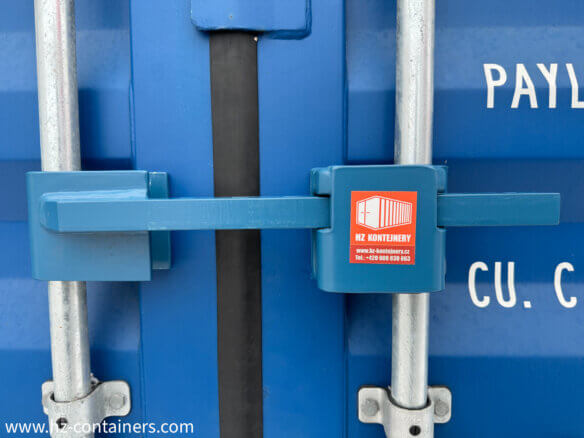
Definition and Principle: A security box, known as a lockbox, is a special robust steel cover mounted on the doors of a shipping container with a single purpose: to protect the lock and prevent its forced opening. In practice, it is a massive metal capsule welded or bolted to the door structure, which mechanically prevents access to the shackle of a padlock using common tools.
Main Functions of Lockbox:
| Function | Description |
|---|---|
| Physical lock protection | Covering the shackle and lock body, eliminating direct access to tools |
| Prevention of quick break-in | Extending the time needed to overcome security – key to deterring thieves |
| Protection against weather effects | Reducing the risk of corrosion and lock freezing |
| Visual deterrent | Demonstrates investment in security, increases psychological barrier |
Technical Note:
Lockboxes are manufactured from steel with a thickness typically 6–8 mm, welds or bolts must meet standards for resistance to mechanical attack. Modern boxes often contain anti-prying structural elements and have anti-corrosion treatment.
Why is Lockbox a Key Element of Container Security?
Lockbox is not only a basic, but in many cases the most important security element. Higher security is provided not only by the barrier, but also by integration with other elements:
Advantages of Lockbox in Practice:
- 100%25 protection against common theft methods:
- Sheet metal shears, pry bars, crowbars – the shackle is not accessible, lockbox withstands common forced opening.
- Resistance to cutting:
- Strong steel shell slows down work with an angle grinder, creates noise and sparks, which increases the chance of detecting the perpetrator.
- Weather protection:
- Lockbox protects the lock from rain, snow, dust and salt, which extends its lifespan and reduces the risk of freezing.
- Visual effect:
- Massive steel capsule attracts attention and deters “random” thieves – they often avoid better protected containers.
Expert Tip:
Lockbox is recommended by professional carriers and insurance companies as a basic condition for insuring container contents.
Types of Lockboxes: Comparative Overview
Each type of lockbox has specific advantages and ideal use. The right choice depends on the purpose, place of use and flexibility requirements.
| Type of Lockbox | Assembly | Resistance | Flexibility | Purpose/Environment | Note |
|---|---|---|---|---|---|
| Welded | Welding | Highest | Low | Permanent security, buildings | Permanent modification, requires experienced welder |
| Bolted | Bolts | High | Medium | Rental, relocatability | Can be removed, theoretically weaker point |
| Tool-free | Installation/lever | Medium | Highest | Quick installation, transport | Lower resistance, suitable for temporary use |
Welded Lockboxes
- Professional solution: Inseparably connected to the door.
- Factory assembly: New “one-trip” containers often have an integrated lockbox.
- Maximum security: Best choice for long-term standing and storage of valuable goods.
Bolted Lockboxes
- Easy DIY assembly: Just a drill, wrench, bolts with washers.
- Ideal for rental: After the rental period ends, the lockbox can be disassembled and used elsewhere.
- Tip: Use security nuts or special bolts with damaged threads.
Tool-free Lockboxes
- Quick installation: No tools required, assembly takes minutes.
- Portable solution: Suitable for transport companies, temporary storage, occasional security.
- Disadvantage: Lower resistance to deliberate attack.
ISO vs. Non-ISO Lockboxes
- ISO lockbox: Fully compatible with standard 20/40/45′ containers (ISO 6346).
- Non-ISO/custom: For special containers (e.g., with atypical doors, roller shutters).
Detailed Guide: Proper Installation of Security Box
Preparation and Selection of Suitable Lockbox
- Measure the exact dimensions of the door and position of the locking bar.
- Clean the surface of rust and old coatings.
- Choose the appropriate type of lockbox according to the environment and purpose (see table above).
Installation of Welded Lockbox:
- Apply the lockbox to the marked location – it must cover the lock location and must not prevent door closing.
- Secure with clamps.
- Perform spot welds at the corners, verify position.
- Complete welds around the entire perimeter.
- After cooling, clean and paint with anti-corrosion paint.
Installation of Bolted Lockbox:
- Apply and mark the position of the holes.
- Drill pilot and then final holes (use steel drill bits).
- Treat edges with anti-corrosion paint.
- Insert bolts, apply washers and nuts, tighten thoroughly.
- For higher security, use self-locking nuts or damage the thread.
Installation of Tool-free Lockbox:
- Slide over the locking bars, secure with a padlock.
- Verify that the lockbox holds firmly and covers the lock shackle.
Lockbox Effectiveness: Analysis of Break-in Resistance
Protection Against Mechanical Attack
- Sheet metal shears, pry bars: The shackle is not accessible, lockbox withstands even large pliers.
- Pry bars/crowbars: In welded versions, there are no prying points. In bolted versions, it depends on the quality of fastening material.
- Angle grinder: Cutting through 6–8mm steel takes significantly longer than cutting through a lock, requires time, causes noise, sparks and attracts attention.
Protection Against Drilling and Lock Picking
- Drilling: The lock body is covered, it is not possible to simply drill out the cylinder.
- Lock picking: If the keyhole is accessible, a quality lock with anti-drilling and bumping protection is essential.
Protection Against Weather
- Corrosion and freezing: Lockbox acts as a roof, protects the lock mechanism from water and dirt, which extends its lifespan.
Lock Selection: What is Really Safe in a Lockbox?
Recommended Lock Types:
| Lock Type | Advantages | Example (Brand) |
|---|---|---|
| Disc Padlocks | Minimally exposed shackle, hardened steel, extreme resistance to cutting and drilling | ABUS Diskus, ABUS 92/80 |
| Locks with Covered Shackle | Steel arms protect the shackle from both sides, high resistance to mechanical attack | Mul-T-Lock, Master Lock |
| Monoblock Locks | Solid steel block, shackle completely covered, highest level of protection | ABUS Monoblock |
Unsuitable Locks:
- Locks with long shackle (easily cut)
- Laminated locks (low resistance to drilling)
- Cheap combination locks without certification
TIP: When selecting a lock, look for a resistance certificate (e.g., EN 12320 level 5 and higher).
Additional Container Security Options
Combination of Multiple Elements:
| Security Element | Description | Suitable Use |
|---|---|---|
| Cross Locks | Secure both door wings against opening, without container modifications | Buildings, short-term storage |
| Hasp Locks | Massive steel hasp, replacement for original mechanism | Long-term standing, farms |
| Alarms and GPS | Wireless sensors, motion detector, GPS location | Storage of valuables, transport |
| Door Reinforcement | Welded door reinforcements, protective plates | Protection against prying |
Expert View on Lockbox Use
Lockbox is a standard not only for new containers, but also for renovations and modifications of older units. In many cases, lockbox installation is required by insurance companies for the possibility of insuring container contents against theft.
Lockbox in Practice: Where and When is it Indispensable?
- New containers (sale): Usually immediately with lockbox from the factory.
- Used containers: Lockbox installation is one of the first modifications to increase security.
- Rental: Bolted or tool-free versions that do not damage the owner’s property.
- Construction sites and farms: Long-standing containers without supervision.
- Container homes and offices: Protection of personal property and sensitive documents.
Frequently Asked Questions (FAQ)
Is lockbox part of every container?
No, only some new (one-trip) containers have lockbox from the factory. For most used ones, it is an optional add-on.
Can I install a lockbox myself?
Bolted and some tool-free types yes. Entrust the welded box to a professional.
What lock is ideal?
Disc or monoblock padlocks made of hardened steel with safety certification.
Does lockbox increase container value?
Yes, especially when selling, a container with lockbox is significantly more attractive.
Can lockbox be used on all containers?
Standard ISO lockboxes fit most containers, for special designs a custom type can be ordered.
 Czech Republic
  WITHOUT SHIPPING


Other container news...

Obligation to Check Tightness When Selling a Reefer Container
Who is responsible for the refrigerant leak check when selling a refrigerated container? Find out what obligations the seller has at the time of handover and why they must provide a PTI report along with the technical data plate. Learn which regulatory requirements and F-gas record-keeping duties become the sole responsibility of the new owner.

New shipping containers
If you are currently considering purchasing a new shipping container, you are not alone. While just twenty years ago containers were used almost exclusively for maritime transport, today they have found their way into construction, storage, business, and even housing. This growing popularity brings with it a host of questions: Which type should you choose? How much does it cost? How do you recognize quality? How can you avoid falling victim to scammers?
New sea shipping containers
If you are currently considering purchasing a new shipping container, you are not alone. While just twenty years ago containers were used almost exclusively for maritime transport, today they have found their way into construction, storage, business, and even housing. This growing popularity brings with it a host of questions: Which type should you choose? How much does it cost? How do you recognize quality? How can you avoid falling victim to scammers?

6m shipping container
Are you thinking about buying a 6-meter shipping container but aren’t sure what to look for? You are not alone—this 20-foot container is the best-selling size on the Czech market, and the differences between various types, conditions, and prices can be significant. In this guide, you will find everything you need to know: from exact dimensions and a comparison of categories (such as “one-way,” refurbished, and “Cargo Worthy”) to current prices and shipping advice.