
How much does a reefer container cost?
If you are exploring refrigerated storage solutions for your business, you have almost certainly asked yourself: how much does a refrigerated container cost? The answer is not a single number. A refrigerated shipping container – commonly called a reefer – can cost you from USD 4,000 for a decommissioned, non-functional unit to over USD 45,000 for a brand-new 40-foot high-cube model with the latest cooling technology. Between these two extremes lies a complex landscape of price tiers, operating costs, hidden expenses, and financing options that can dramatically shift the total cost of ownership over the container’s lifetime.
This guide cuts through the ambiguity. Drawing on market data from leading US suppliers, industry pricing reports, and real-world operating cost analyses, we provide a full breakdown of every dollar you should expect to spend – from the moment you request a quote to the day you retire the container from service. Whether you operate a food distribution business, a pharmaceutical cold chain, a winery, or a seasonal event, understanding the true cost of a refrigerated container is the difference between a smart investment and a costly mistake.

What Is a Refrigerated Container and Why Does Its Price Matter?
A refrigerated container is an insulated shipping container equipped with an integrated cooling unit designed to maintain precise internal temperatures regardless of external weather conditions. Unlike a standard dry shipping container – essentially a steel box – a reefer is a climate-controlled environment capable of maintaining temperatures from -30 °C (-22 °F) to +30 °C (+86 °F). The cooling unit, typically manufactured by Carrier, Thermo King, or Daikin, circulates chilled air through a specialized T-floor system that ensures even air distribution around the cargo.
The price of a refrigerated container matters because it differs substantially from that of a dry container. A standard 20-foot dry container may cost USD 1,500 to 3,500 used. A comparable reefer will cost two to three times as much – and that is just the purchase price. The ongoing electricity bill, maintenance contracts, and compliance costs can match or exceed the purchase price over three to five years of continuous operation. Ignoring these variables leads to budget overruns, operational downtime, and spoiled goods.
Key Insight: A refrigerated container is not a buy-it-and-forget-it product. It is an ongoing operational asset with total cost of ownership that includes the purchase price, electricity, maintenance, delivery, installation, and eventual resale or disposal.
How Much Does a Refrigerated Container Cost to Buy in 2026?
The purchase price of a refrigerated shipping container depends on four main variables: size, condition, age of the cooling unit, and location. The table below summarizes the price ranges you can expect from US suppliers in 2026, based on data collected from major sellers including Conexwest, Cold Storage Containers, Container Alliance, CHS Container Group, and Boxhub.
Refrigerated Container Price Ranges by Size and Condition (2026, USD)
| Container type | Condition | Typical price range (excluding shipping) |
|---|---|---|
| 20-foot reefer | Brand new / one trip | USD 28,000 – 40,000 |
| 20-foot reefer | Used – operational (Class A) | USD 15,000 – 22,000 |
| 20-foot reefer | Used – operational (Class B, 8–12 years) | USD 7,000 – 12,000 |
| 20-foot reefer | Non-functional / insulated only | USD 4,000 – 6,000 |
| 40-foot reefer (standard) | Brand new / one trip | USD 35,000 – 45,000 |
| 40-foot high cube reefer | Brand new / one trip | USD 40,000 – 50,000 |
| 40-foot reefer | Used – operational (Class A) | USD 20,000 – 30,000 |
| 40-foot reefer | Used – operational (Class B, 8–12 years) | USD 10,000 – 18,000 |
| 40-foot reefer | Non-functional / insulated only | USD 5,000 – 9,000 |
What “One Trip,” “Class A,” and “Class B” Actually Mean
The container industry uses a classification system that directly affects what you pay:
- One trip / brand new: The container has made exactly one cargo voyage from the factory (typically in China) to the United States. The cooling unit has fewer than 100 operating hours. These units ship with a manufacturer’s warranty, a valid pre-trip inspection (PTI) certificate, and are essentially in showroom condition. Expect to pay a 40% to 60% premium over a used Class A unit.
- Used Class A (recent fleet): These containers are typically 5 to 8 years old and have been well maintained. The cooling unit is fully functional with a recent PTI. Cosmetic wear is minimal – minor dents, surface rust, and faded paint are acceptable. This is the ideal choice for buyers who need reliability without the new-unit premium.
- Used Class B (8–12 years): These containers are 8 to 12 years old with visible wear but still fully functional. The cooling unit may have a higher number of operating hours and the PTI may be older. Expect some rust, minor door seal wear, and cosmetic damage. These units are popular for less critical refrigerated storage applications.
- Non-functional (insulated only): The cooling unit is either removed or non-functional. The container retains its insulation and can be used for passive temperature-controlled storage or fully converted. This is the cheapest entry point into insulated container ownership.
Why Does a Reefer Cost So Much More Than a Dry Container?
A standard 20-foot dry container costs approximately USD 1,500 to 3,500 used. A comparable used 20-foot reefer costs USD 7,000 to 22,000. The price difference is driven by three main components:
- Cooling unit: The Carrier or Thermo King cooling unit alone represents approximately 40% to 50% of the total container price. These are sophisticated electromechanical systems with compressors, condensers, evaporators, electronic controllers, and temperature dataloggers. Replacing a non-functional unit can cost USD 8,000 to 15,000.
- Insulation and internal construction: Refrigerated containers are built with 60 mm to 100 mm of polyurethane foam insulation sandwiched between stainless steel interior walls and corrosion-resistant exterior panels. The T-floor is made of aluminum with integrated drainage channels. This construction is significantly more expensive than the bare corrugated steel of a dry container.
- Electrical infrastructure: Reefers require three-phase power connections, specialized cabling, and control systems that dry containers do not need at all.
What Are the Ongoing Operating Costs of a Refrigerated Container?
The purchase price is only the beginning. A refrigerated container is an energy-intensive asset, and monthly operating costs can rival a commercial lease payment if you are not prepared.
Electricity Consumption: The Largest Ongoing Cost
A refrigerated container consumes between 3 and 7 kilowatt-hours (kWh) per hour of operation, depending on size, ambient temperature, and set temperature. Over a 24-hour period, that amounts to 70 to 170 kWh per day. At an average US commercial electricity rate of approximately USD 0.12 per kWh, daily electricity costs range from USD 8.40 to 20.40 per day, or USD 250 to 612 per month.
| Container size | Set temperature | Daily kWh consumption | Monthly electricity cost (at USD 0.12/kWh) |
|---|---|---|---|
| 20-foot reefer | +4 °C (refrigeration) | 70 – 100 kWh | USD 252 – 360 |
| 20-foot reefer | -18 °C (freezing) | 100 – 130 kWh | USD 360 – 468 |
| 40-foot reefer | +4 °C (refrigeration) | 100 – 140 kWh | USD 360 – 504 |
| 40-foot reefer | -18 °C (freezing) | 140 – 170 kWh | USD 504 – 612 |
Note: These figures assume mild climate conditions. In hot climates such as Texas, Arizona, or Florida during summer months, consumption can rise by 25% to 40%. In colder climates, the heating element may activate when ambient temperature drops below the setpoint, which also increases energy consumption.
Three-Phase Power Requirement
Most refrigerated containers require 460-volt, three-phase, 60 Hz electrical power at 32 A. If your site does not already have three-phase power available, you will need to budget for one of two solutions:
- Install a three-phase line: Running a new three-phase circuit from the nearest panel typically costs USD 1,500 to 5,000 depending on distance, excavation requirements, and local electrician rates. The connection itself (plug, receptacle, disconnect, and breaker) adds another USD 500 to 1,500.
- Use a phase converter or generator: A phase converter, which converts single-phase to three-phase power, costs USD 2,000 to 6,000. A diesel generator sized for a refrigerated container costs USD 5,000 to 15,000 to purchase, plus fuel costs of USD 30 to 75 per day.
Maintenance and Repair Costs
Refrigerated containers require regular maintenance to stay reliable. The cooling unit is a mechanical system with moving parts that wear out over time. Industry standards recommend:
- Pre-trip inspection (PTI): USD 300 to 600 per inspection, recommended annually or before each critical use.
- Routine service: USD 500 to 1,200 per year for cleaning condenser coils, checking refrigerant levels, replacing filters, and calibrating temperature sensors.
- Major repairs: Compressor replacement can cost USD 3,000 to 7,000. Control board replacement costs USD 1,000 to 2,500. Door seal replacement costs USD 500 to 1,500 per door.
A realistic annual maintenance budget for a continuously operated refrigerated container is USD 1,000 to 2,500 per year for a used unit and USD 500 to 1,000 per year for a new unit still under warranty.
Hidden and Often Overlooked Costs
Beyond electricity and maintenance, several costs often surprise first-time buyers:
- Insurance: Insuring a refrigerated container against damage, theft, and liability typically costs USD 300 to 800 per year depending on unit value and location.
- Site preparation: The container needs a level, well-drained surface. A gravel pad, concrete foundation, or asphalt preparation can cost USD 500 to 3,000.
- Permits: Some municipalities require permits for permanent container placement. Fees range from USD 50 to 500 and the approval process can take weeks.
- Temperature monitoring compliance: If you store food or pharmaceuticals, you may need temperature dataloggers compatible with HACCP. These cost USD 200 to 800 for hardware plus USD 20 to 50 per month for cloud monitoring subscriptions.
How Much Does It Cost to Rent a Refrigerated Container?
Renting a refrigerated container is the default choice for seasonal operations, emergency overflow, event-based needs, and businesses that want to avoid capital expenditures and the maintenance burden of ownership.
Monthly Rental Rates by Size (2026, US Market)
| Container size | Short-term rental (1–3 months) | Mid-term (3–12 months) | Long-term (12+ months) |
|---|---|---|---|
| 20-foot reefer | USD 1,200 – 1,800/month | USD 900 – 1,300/month | USD 700 – 1,000/month |
| 40-foot reefer | USD 1,500 – 2,200/month | USD 1,200 – 1,700/month | USD 900 – 1,400/month |
| 40-foot high cube reefer | USD 1,800 – 2,500/month | USD 1,400 – 2,000/month | USD 1,100 – 1,600/month |
What Is Typically Included in the Rental Price
Most rental contracts include:
- The container and an operational cooling unit
- A service and maintenance contract for the cooling unit
- 24/7 technical support for troubleshooting
- A valid pre-trip inspection at the start of the rental period
Rental rates generally do not include delivery, pickup, electrical hookup, or electricity consumption. Delivery and pickup fees typically range from USD 300 to 1,500 per one-way trip depending on distance. Always request an itemized quote that separates the base rental rate from these ancillary fees.
Rental vs. Purchase Break-Even Point
For dry containers, the break-even point where purchase becomes cheaper than rental is typically around 18 months. For refrigerated containers, the break-even point is 30 to 36 months. The reason for the longer timeframe is that rental contracts include maintenance – a significant cost that ownership shifts to you. If your use is seasonal (less than 6 months per year) or your total need is shorter than 3 years, rental is almost always the more cost-effective choice.
What Factors Affect the Price of a Refrigerated Shipping Container?
Understanding the variables that drive refrigerated container pricing will help you negotiate effectively and avoid overpaying for features you do not need.
Cooling Unit Age
The most important factor. A reefer with a cooling unit younger than 5 years commands a premium of USD 3,000 to 6,000 over a comparable container with a 10+ year-old unit. The cooling unit has a finite lifespan – typically 15 to 20 years with proper maintenance – and the closer it is to the end of that lifespan, the more risk you take on.
Brand: Carrier vs. Thermo King vs. Daikin
The three dominant cooling unit manufacturers each have a distinct reputation:
- Carrier Transicold: Known for excellent energy efficiency and sophisticated electronic controls. Carrier units are often preferred for stationary refrigerated storage applications. The spare parts and service network is extensive across North America.
- Thermo King: The dominant brand in transport refrigeration. Thermo King units are known for their durability and are widely used in trucking and rail transport. Spare parts availability is excellent.
- Daikin: A newer entrant gaining market share with competitive pricing and modern design. Daikin units are often found on newer one-trip containers from Asian manufacturers.
For a stationary refrigerated storage application, brand matters less than unit condition, service history, and the availability of local technicians who can service a specific brand. Price differences between equivalent Carrier and Thermo King units are typically less than 5%.
Container Size and Format
A 40-foot reefer costs approximately 1.5 times more than a 20-foot unit but provides roughly double the internal volume. On a per-cubic-meter basis, the 40-foot container is the more economical choice – but only if you actually need that much space. A 40-foot high cube adds an extra foot of internal height (9’6″ vs. 8’6″) and typically commands a 10% to 15% premium over a standard-height 40-foot unit.
Temperature Range Requirements
The purchase price of the container itself does not change based on the temperature at which you plan to operate it. Total cost of ownership does, however. A container operated continuously at -25 °C (-13 °F) for deep freezing consumes 40% to 60% more electricity than the same container operated at +4 °C (39 °F) for chilled storage. If deep-freeze capability is essential, factor the higher electricity costs into your budget from day one.
ATP Certification
The ATP certificate (Agreement on the International Carriage of Perishable Foodstuffs) is mandatory for any refrigerated container used to transport food products across borders. The certification process costs USD 400 to 800 and must be renewed every six years. A reefer without a valid ATP certificate sells for 15% to 20% less than an equivalent certified unit – a discount that reflects the cost and hassle of obtaining certification.
Delivery Location
The closer you are to a major port or container depot, the less you will pay for delivery. Containers in Los Angeles, Houston, Savannah, New York/New Jersey, and Seattle are typically the cheapest because supply is concentrated in these ports. If you are located in the Midwest, Mountain West, or other inland areas, budget for a USD 500 to 2,000 delivery surcharge due to distance from the nearest depot.
Modifications and Upgrades
Every modification adds cost. Common modifications and their approximate price ranges include:
- Additional shelves or racks: USD 500 – 2,000
- Side access doors: USD 1,000 – 2,500
- Additional interior lighting: USD 300 – 800
- Temperature alarm system: USD 400 – 1,200
- Remote temperature monitoring (IoT): USD 500 – 1,500 for hardware, plus monthly subscription
- Custom paint or branding: USD 500 – 2,000
How Much Does Delivery and Installation Cost?
Delivery and installation are separate from the purchase price and are almost always billed as additional line items. Understanding these costs upfront prevents sticker shock from the final invoice.
Local Delivery (Within 100 Miles of the Depot)
Local delivery typically costs USD 300 to 800. A delivery truck – usually with a tilt bed or flatbed – places the container on your prepared site. If the site has limited access or requires a crane for placement, crane fees add another USD 500 to 1,500.
Long-Distance Delivery (100–500+ Miles)
Long-distance delivery costs USD 2 to 5 per mile, with a minimum fee that varies by supplier. Delivering a 40-foot refrigerated container a distance of 300 miles typically costs USD 1,000 to 2,500. The larger the container, the higher the per-mile rate, because 40-foot containers require specialized trailers and may require escort vehicles depending on state regulations.
Electrical Hookup
As discussed in the operating costs section, electrical hookup is a significant installation cost. A complete three-phase electrical run – including receptacle, disconnect, breaker, and labor – typically costs USD 1,500 to 5,000 depending on distance from the electrical panel and installation complexity. Budget another USD 500 to 1,000 if trenching is required to run conduit from a building to the container site.
Site Preparation
The container must sit on a level, stable surface. A gravel or crushed stone pad costs USD 500 to 1,500. A concrete pad costs USD 1,500 to 4,000. If the site has drainage issues, additional earthwork may be necessary.
How Does a Refrigerated Container Compare to Alternatives?
A refrigerated container is not the only option for refrigerated storage. Understanding how it stacks up against walk-in cold rooms and refrigerated trailers will help you make the right choice for your specific situation.
Refrigerated Container vs. Walk-in Cold Room vs. Refrigerated Trailer
| Feature | Refrigerated container | Walk-in cold room | Refrigerated trailer |
|---|---|---|---|
| Purchase price (20-foot equivalent) | USD 7,000 – 40,000 | USD 15,000 – 35,000 | USD 10,000 – 30,000 |
| Installation cost | USD 2,000 – 7,000 | USD 5,000 – 15,000 | Minimal (mobile) |
| Monthly electricity | USD 250 – 500 | USD 200 – 400 | USD 200 – 400 |
| Portability | Yes (with crane) | No (permanent) | Yes (towable) |
| Lifespan | 15–25 years | 15–30 years | 10–20 years |
| Security | High (steel construction) | Medium | Medium |
| Temperature range | -30 °C to +30 °C | -30 °C to +30 °C | -30 °C to +30 °C |
| Residual value | USD 3,000 – 15,000 | Low | USD 5,000 – 15,000 |
| Maintenance cost (annually) | USD 1,000 – 2,500 | USD 500 – 1,500 | USD 1,000 – 2,000 |
| Best for | Long-term outdoor refrigerated storage, versatility | Permanent indoor/outdoor operations | Mobile operations, events, seasonal use |
Total Cost of Ownership Over 5 Years
Let us compare the total 5-year cost of a 20-foot refrigerated storage solution across the three options, assuming moderate use at +4 °C:
| Cost category | Refrigerated container (used, Class A) | Walk-in cold room | Refrigerated trailer (used) |
|---|---|---|---|
| Purchase price | USD 18,000 | USD 25,000 | USD 20,000 |
| Delivery and installation | USD 4,000 | USD 10,000 | USD 1,500 |
| Electricity (5 years) | USD 18,000 | USD 15,000 | USD 15,000 |
| Maintenance (5 years) | USD 7,500 | USD 5,000 | USD 7,000 |
| Total 5-year cost | USD 47,500 | USD 55,000 | USD 43,500 |
| Estimated residual value | USD 8,000 | USD 2,000 | USD 8,000 |
| Net 5-year cost | USD 39,500 | USD 53,000 | USD 35,500 |
The refrigerated trailer offers the lowest net 5-year cost, but it is not suitable for all applications – it requires ramp-height access, is less secure than a container, and may not comply with local zoning regulations for permanent placement. The refrigerated container offers the best balance of security, versatility, and residual value.
How Can You Finance the Purchase of a Refrigerated Container?
Given the high upfront cost of a refrigerated container, most buyers use some form of financing. Several options are available depending on your credit profile and business structure.
Equipment Financing Loans
Traditional equipment financing through banks or specialized lenders offers terms of 2 to 7 years with interest rates ranging from 6% to 15% depending on creditworthiness. The container itself serves as collateral. Monthly payments on a USD 20,000 loan at 8% over 5 years would be approximately USD 405 per month.
Lease-to-Own and Rent-to-Own Programs
Many container suppliers offer lease-to-own programs where part of each monthly rental payment is applied toward eventual purchase of the container. These programs typically run 36 to 60 months and carry a higher effective interest rate than traditional financing – expect to pay 15% to 25% more over the life of the contract compared to a direct purchase. They do, however, require no down payment and minimal credit qualification.
Depreciation and Tax Benefits
Under IRS guidelines, a refrigerated container used for business purposes is classified as 7-year property under the Modified Accelerated Cost Recovery System (MACRS). This means you can depreciate the full purchase price over 7 years, reducing your taxable income. Section 179 of the tax code allows businesses to deduct the full purchase price of qualifying equipment – including refrigerated containers – in the year of purchase, up to an annual limit (which changes each tax year). Consult a tax advisor to understand how these provisions apply to your specific situation.
Residual Value: What to Expect
A well-maintained refrigerated container retains significant value. A 5-year-old unit that originally cost USD 25,000 new may sell for USD 12,000 to 18,000 on the secondary market, representing a 48% to 72% residual value. A 10-year-old unit retains 25% to 40% of its original value. The key variable is the condition of the cooling unit – a container with a recently replaced or well-maintained cooling unit commands a significant premium over one nearing the end of its service life.
Frequently Asked Questions
How Much Does a New 20-Foot Refrigerated Container Cost?
A new 20-foot refrigerated container costs between USD 28,000 and 40,000 on the US market as of 2026. The price varies depending on the cooling unit brand (Carrier, Thermo King, or Daikin), the container manufacturer, and your proximity to a major port. A one-trip unit – one that has made a single voyage from the factory – typically falls at the lower end of this range.
How Much Does a Used 40-Foot Refrigerated Container Cost?
A used 40-foot operational refrigerated container costs between USD 10,000 and 30,000, depending on the age and condition of the cooling unit. Class A units (5–8 years old, well maintained) range from USD 20,000 to 30,000. Class B units (8–12 years old) range from USD 10,000 to 18,000. Non-functional 40-foot insulated containers start at approximately USD 5,000.
Is It Cheaper to Rent or Buy a Refrigerated Container?
It depends on your usage timeline. The break-even point where purchase becomes cheaper than rental is approximately 30 to 36 months for refrigerated containers. If your need is seasonal or shorter than 3 years, rental is almost always the more cost-effective choice. Rental also includes maintenance, which can be a significant cost when you own the unit.
How Much Electricity Does a Refrigerated Container Use Per Day?
A refrigerated container consumes 70 to 170 kWh per day, depending on size, set temperature, and ambient conditions. A 20-foot unit operated at +4 °C typically consumes 70–100 kWh per day. A 40-foot unit operated at -18 °C (deep freezing) can consume 140–170 kWh per day. At an average US commercial electricity rate of USD 0.12/kWh, daily costs range from USD 8.40 to 20.40.
What Is the Lifespan of a Refrigerated Container?
A well-maintained refrigerated container has a lifespan of 15 to 25 years. The container body itself – made from corrosion-resistant Corten steel and stainless steel interior panels – can last 25 years or more. The cooling unit typically lasts 15 to 20 years before requiring major repair or replacement. Regular maintenance, including annual PTI inspections and condenser coil cleaning, is the most important factor in maximizing lifespan.
Do Refrigerated Containers Hold Their Value?
Yes, significantly better than dry containers. A 5-year-old refrigerated container typically retains 48% to 72% of its original value, compared to 30% to 50% for a dry container. The cooling unit is the main driver of value – a container with a recently replaced or well-maintained cooling unit commands a strong premium. Non-functional units lose value quickly.
Can I Use a Refrigerated Container Without a Working Cooling Unit?
Yes. This is a common and cost-effective approach. A non-functional reefer – sometimes called an “insulated dry container” – retains its polyurethane insulation, stainless steel interior, and T-floor. It can be used for passive temperature-controlled storage of items that are not highly perishable, such as wine, canned foods, or temperature-sensitive equipment. These units cost USD 4,000 to 9,000, making them an affordable alternative to a fully operational refrigerated container.
Which Cooling Unit Brand Is Best?
Carrier and Thermo King are the two dominant brands, and both are excellent. Carrier units are generally considered slightly more energy-efficient and are preferred for stationary refrigerated storage. Thermo King units are known for their exceptional durability and dominate the transport market. Daikin is a newer entrant offering competitive pricing. For most buyers, the most important consideration is not the brand itself, but the availability of local service technicians who can maintain and repair that brand.
Are There Seasonal Price Fluctuations for Refrigerated Containers?
Yes. Prices tend to be 5% to 15% higher during peak harvest seasons (spring through early autumn), when demand from agricultural buyers surges. Winter months typically offer the best deals, especially in northern regions where construction and agricultural activity slows. If your purchase timeline is flexible, buying between November and February can yield significant savings.
How Much Does International Shipping of a Refrigerated Container Cost?
International shipping of a refrigerated container adds USD 2,000 to 8,000 to the total cost, depending on origin and destination ports. The container must be shipped on a vessel equipped with powered reefer slots, and the shipping rate includes a surcharge for electricity to the cooling unit during transit. This is typically only relevant for buyers sourcing containers directly from overseas manufacturers, rather than from domestic dealers.

 Czech Republic
  WITHOUT SHIPPING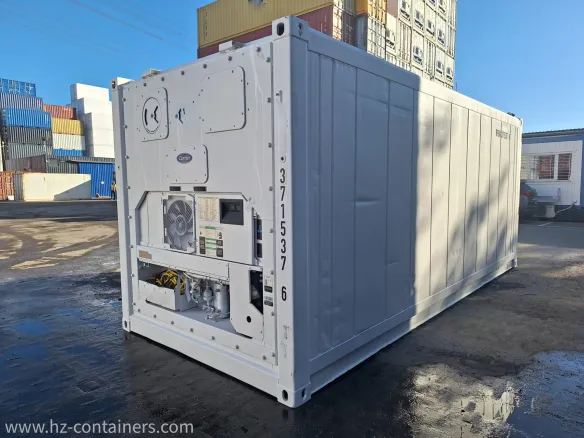

Other container news...

Shipping container types
Roughly 80% of everything you own traveled to you inside a steel box. Shipping containers—also called cargo containers, ISO containers, or “conex” boxes—are the backbone of global trade, carrying about 90% of the world’s non-bulk cargo across oceans, rails, and highways. Yet a “shipping container” is not one single object. It is a family of specialized steel boxes, each engineered for a specific kind of cargo: some vent, some freeze, some open from the top, and some have no walls at all.

40 foot container storage uses
The 40 foot container has moved far beyond its original job of hauling cargo across the ocean. Today, the phrase “40 foot container storage uses” describes an enormous and still-growing field: everything from an extra garage behind a house to a full retail storefront, a mobile office, an indoor farm, or a temporary shelter. Because the 40 foot container is the most common size in global shipping, it is also the most abundant, the most affordable, and the most widely converted for storage and building purposes.

How tall is a 20-Foot shipping container?
A 20-foot shipping container stands 8 feet 6 inches (8′ 6″) tall on the outside, or 2.59 meters. Inside, the usable height is slightly less — roughly 7 feet 9–5/8 inches (2.39 m) — because the floor, roof panels, and corner castings consume several inches of the total height.
That is the short answer. But “how tall” hides important nuance: the number changes depending on whether you are measuring a standard unit or a high cube unit, whether you are measuring the exterior or the interior, and whether you actually need to fit something through the door opening, which is the shortest vertical dimension on the entire box.

Shipping container wheel movement kits
A shipping container wheel movement kit is a bolt-on (or twist-lock) hardware system that lets a single person attach wheels to the corner castings of a 20 ft or 40 ft shipping container and reposition it — often without a crane, forklift, or flatbed truck. Instead of hiring a heavy-haul trucker every time you want to nudge a container a few feet on your property, the right wheel kit turns a 4,000–10,000 lb steel box into something a pickup truck, skid steer, or a couple of strong backs with a come-along can move.