
How do refrigerated containers maintain temperature?
Refrigerated containers maintain temperature through a combination of active cooling, thermal insulation, controlled airflow, and precise regulation via sensors. So it is not just a “cold box” but a technically designed system whose task is to hold stable conditions for sensitive cargo during storage and transport.
The most important thing is to understand one fact: a reefer container usually does not quickly turn warm cargo into cold cargo. It is mainly designed to maintain goods that have already been properly pre-tempered within the required range. This is precisely where the difference between a layman’s view and real-world operation becomes apparent.
What are refrigerated containers and what are they used for?
What does the term reefer container mean?
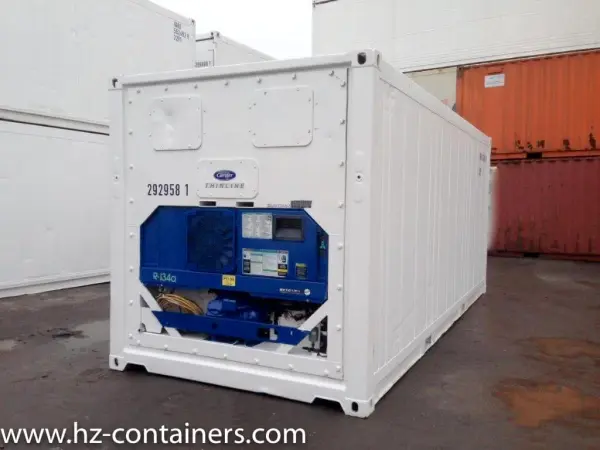
Refrigerated containers, often referred to as reefer containers, are special transport or storage containers equipped with an integrated cooling unit. This makes it possible to maintain a stable internal temperature for goods that are sensitive to heat, frost, or environmental fluctuations.
Unlike a standard shipping container, it is not just a metal casing for transport. A reefer container is a technological device that combines:
- an insulated shell,
- a cooling unit,
- fans,
- temperature sensors,
- a control system,
- and in some applications also monitoring, ventilation, and humidity control.
In practice, you may come across the names refrigerated containers, cooling containers, or freezer containers. They are often the same basic category, just with a different operating mode.
What types of cargo are they used for?
A reefer container is used wherever temperature-controlled transport or stable storage conditions are required. Typical examples include:
- fresh fruit and vegetables,
- meat, fish, and dairy products,
- frozen foods,
- medicines and pharmaceutical products,
- laboratory materials,
- chemical products sensitive to temperature,
- temporary cooled storage for events or seasonal peaks.
The point is not just to “cool” but to maintain an environment that does not degrade the quality, safety, or shelf life of the cargo.
How do refrigerated containers maintain temperature?
How does the cooling circuit and sensors work?
The principle is similar to industrial cooling but adapted for mobile operation. The cooling unit draws air from the cargo space, removes heat from it, and returns it cooled. This creates a continuous circulation cycle that helps maintain the set temperature.
Inside the system, sensors monitor the actual conditions. The operator sets the desired value, the setpoint, and the control unit then adjusts operation to keep the internal climate as stable as possible. With quality systems, it is not just a matter of switching on and off, but of continuously compensating for deviations.
A reefer container does not cool the goods directly. It cools the air, which then, through proper airflow, removes heat from the space and the cargo.
Why does a reefer maintain temperature rather than actively cooling down cargo?
This is one of the most important things that competitors often explain only superficially. Refrigerated containers are primarily designed to maintain temperature, not to quickly cool down warm goods after loading.
The reason is simple. The cooling output of a reefer is designed primarily to:
- compensate for heat penetrating from outside,
- balance heat generated inside,
- and maintain a stable environment around already prepared cargo.
If you place un-precooled goods into the container, the unit will start working, but cooling may be slow, uneven, and risky for certain commodities. For food, this can lead to loss of quality; for pharmaceutical products, it can lead to a breach of the prescribed regime.
What role do the individual parts of the system play?
| Component | Main function | How it helps maintain temperature |
|---|---|---|
| Cooling unit | Removes heat from the air | Actively cools the circulating air |
| Fans | Distribute air through the container | Ensure more even temperature |
| Sensors | Measure internal conditions | Enable precise regulation |
| Insulated walls | Limit heat transfer | Reduce the load on the cooling unit |
| T-floor flooring | Channels air under the cargo | Maintains proper airflow |
| Control system | Controls output and settings | Maintains the set temperature regime |
What role do insulation, airflow, and T-floor flooring play?
Why is insulation alone not enough?
Insulation is often understood as the main reason why refrigerated containers work. In reality, it is only one part of the equation. Insulation does not provide cooling; it only slows the penetration of heat from the outside in.
This means that:
- in hot weather, it limits interior heating,
- in cold weather, it helps with regime stability,
- and reduces energy consumption.
However, without an active unit, even a well-insulated container would not maintain the correct temperature long term. Insulation therefore helps, but on its own it is not enough.
How does airflow work under and around the cargo?
For the proper functioning of a reefer, airflow is essential. Cold air is usually driven from the bottom under the cargo through a specially profiled floor, known as T-floor or T-bar floor. This floor creates air channels through which the cooled air is distributed further into the space.
From there, the air flows:
- under the cargo,
- around pallets or packaging,
- up through the cargo space,
- and then back to the suction of the cooling unit.
This closes the circuit. If the cargo is properly placed, the temperature is held much more evenly. If not, areas with poorer cooling develop.
What happens when airflow is blocked?
When the T-floor is covered, the cargo is pressed against the walls, or the space is overfilled, the air cannot move as the designers intended. At that moment, so-called hot spots appear, i.e., local warmer zones.
This can cause:
- uneven cooling,
- poorer quality of part of the cargo,
- condensation in problematic areas,
- higher energy consumption,
- and the impression that the “container is not cooling,” even though the problem is actually in the loading.
How do ventilation and humidity affect the quality of goods?
When is ventilation important?
For some types of cargo, monitoring temperature alone is not enough. Fresh produce, for example, “breathes,” produces heat, carbon dioxide, and sometimes ethylene. In such cases, ventilation is important, helping to maintain a suitable air composition inside.
Ventilation makes sense especially when there is a need to:
- remove excess CO2,
- limit the accumulation of ripening-accelerating gases,
- help with environmental stability for sensitive commodities.
For other goods, on the other hand, air exchange may not be desirable to a large extent. Therefore, settings vary depending on the type of cargo.
Why is it necessary to monitor humidity and condensation?
Humidity is not an extra detail. It is a practical factor that determines whether goods:
- do not dry out,
- do not become damp,
- do not start to mold,
- or do not have their packaging damaged.
Excessively low humidity can degrade the quality of fresh goods. Excessively high humidity, on the other hand, promotes condensation, sweating, and damage to cartons or labels. In addition, condensate must have a way to drain away, so drainage elements and proper operation also play an important role.
What is the difference between a refrigerated, freezer, and isothermal container?
How do their functions differ?
The difference between these terms is essential in practice. A refrigerated or reefer container uses an active cooling system. A freezer container is usually the same principle, just operated at a lower setpoint. An isothermal container, on the other hand, mostly relies on insulation rather than its own active unit.
When to choose which type?
The choice depends on the type of goods, the length of transport, the required stability, and the budget. If you need precise regulation, active cooling, and monitoring, a reefer is the right choice. If you just want to slow down temperature change for a shorter period, an isothermal solution may suffice in some situations.
| Container type | Active cooling | Typical use | Temperature regime | Limitations |
|---|---|---|---|---|
| Refrigerated / reefer | Yes | Chilled goods | Stable positive and low temperatures | Requires power supply |
| Freezer | Yes | Deep-frozen goods | Usually below freezing point | Higher energy and loading demands |
| Isothermal | No or limited | Short-term limitation of temperature fluctuations | Depends on initial state | Cannot maintain a precise regime long term |
What temperatures can a reefer container maintain and what limits them?
What are the common operating ranges?
Standard reefer containers typically operate in a range from +25 °C to -25 °C, although values may vary depending on the manufacturer and design. With specialized units, significantly lower temperatures can be achieved.
For common practice, this means:
- chilled goods are often transported around 0 to +15 °C,
- frozen goods typically around -18 to -25 °C,
- special applications may have different requirements.
What does actual performance in practice depend on?
The technical specification alone does not mean that the container will always work the same way. Performance is affected by:
- outside temperature,
- intensity of solar load,
- condition of sealing and insulation,
- correctness of loading,
- ventilation and free air passage,
- quality of power supply,
- and the technical condition of the cooling unit.
That is why two containers with the same label range can function differently in practice.
How are refrigerated containers powered and monitored?
Where do they get energy during transport and storage?
Refrigerated containers need electrical power. Without it, the unit does not work and the system relies only on the residual effect of insulation. This is particularly important during transshipment or waiting between individual legs of transport.
Power can come from various sources:
- from a terminal or depot,
- from a ship,
- from fixed infrastructure in a warehouse,
- or from a genset, i.e., an external generator used during road or intermodal transport.
How does temperature monitoring work?
Modern reefer containers are increasingly equipped with continuous monitoring. This makes it possible to track:
- current temperature,
- alarm conditions,
- history of deviations,
- and sometimes other parameters, such as ventilation or humidity.
This is important not only for quality control but also for documenting compliance with internal processes, audits, or customer requirements.
What mistakes most often prevent refrigerated containers from holding the correct temperature?
What mistakes occur during loading?
The most common problems do not arise from unit failure but from human error. Typical examples include:
- inserting un-precooled cargo,
- covering floor channels,
- stacking too tightly against walls and ceiling,
- overfilling beyond the recommended limit,
- or unsuitable packaging that does not allow proper airflow.
What mistakes occur during setup and operation?
The second group of problems is incorrect setting. These include:
- unsuitable setpoint,
- incorrect ventilation for the given commodity,
- ignoring condensation,
- insufficient power supply checks,
- and neglected maintenance.
How to prevent these problems step by step?
The correct procedure has several simple but important steps:
- pre-cool the cargo before loading,
- check the technical condition of the container,
- free airflow under and around the cargo,
- suitable temperature setting and ventilation,
- verify stable power supply,
- continuous monitoring during the journey.
It is precisely this discipline that determines whether temperature-controlled transport will truly be reliable.
Where did reefer containers come from and how are they evolving?
What is the history of refrigerated container transport?
The need to transport perishable goods existed long before modern containerization. Earlier, ice wagons, simple insulated spaces, and later mechanical cooling systems were used. With the development of standardized shipping containers, the need for a cooled variant also arose.
The reefer container became an essential element of the global cold chain. It made it possible to connect the sea, road, and storage phases into a single system with better temperature control and lower risk of cargo damage during transshipment.
What trends determine the future?
The future today mainly rests on three directions:
- better energy efficiency,
- smarter monitoring and remote management,
- lower environmental footprint.
Companies monitor energy consumption, look for more environmentally friendly refrigerants, and at the same time want to have more detailed data on every movement of goods. In practice, this means more sensors, more automation, and higher pressure on operational precision.
Frequently asked questions
How do refrigerated containers work?
Refrigerated containers work by using a cooling unit to cool the circulating air inside an insulated space. Fans then distribute this air around the cargo to keep the temperature as stable as possible.
How do refrigerated containers maintain temperature?
Refrigerated containers maintain temperature through a combination of active cooling, insulation, sensors, and proper airflow. Correct loading of goods and stable power supply are also important.
How low can the temperature be in a refrigerated container?
Common reefer containers often operate roughly from +25 °C to -25 °C. Some specialized units can handle even lower temperatures, depending on the type of equipment and application.
Does a refrigerated container need continuous power?
Yes, if it is to actively cool and precisely maintain the set regime, it needs power. Without power, only the insulation helps, which merely slows down the temperature change.
Can a refrigerated container cool down warm goods?
Technically, it can lower the temperature, but its main task is to maintain already precooled cargo. For quickly cooling down warm goods, a standard reefer is not optimal.
What is the difference between a reefer and an isothermal container?
A reefer container has an active cooling unit and can regulate the temperature. An isothermal container relies mainly on insulation, so it only limits temperature fluctuations but does not hold the regime as precisely.
What most often causes a reefer to fail to hold the correct temperature?
The most common cause is poor loading, blocked airflow, un-precooled cargo, incorrect settings, or a power outage.
 Hamburg, Germany
 WITHOUT SHIPPING


Other container news...

Obligation to Check Tightness When Selling a Reefer Container
Who is responsible for the refrigerant leak check when selling a refrigerated container? Find out what obligations the seller has at the time of handover and why they must provide a PTI report along with the technical data plate. Learn which regulatory requirements and F-gas record-keeping duties become the sole responsibility of the new owner.

New shipping containers
If you are currently considering purchasing a new shipping container, you are not alone. While just twenty years ago containers were used almost exclusively for maritime transport, today they have found their way into construction, storage, business, and even housing. This growing popularity brings with it a host of questions: Which type should you choose? How much does it cost? How do you recognize quality? How can you avoid falling victim to scammers?
New sea shipping containers
If you are currently considering purchasing a new shipping container, you are not alone. While just twenty years ago containers were used almost exclusively for maritime transport, today they have found their way into construction, storage, business, and even housing. This growing popularity brings with it a host of questions: Which type should you choose? How much does it cost? How do you recognize quality? How can you avoid falling victim to scammers?

6m shipping container
Are you thinking about buying a 6-meter shipping container but aren’t sure what to look for? You are not alone—this 20-foot container is the best-selling size on the Czech market, and the differences between various types, conditions, and prices can be significant. In this guide, you will find everything you need to know: from exact dimensions and a comparison of categories (such as “one-way,” refurbished, and “Cargo Worthy”) to current prices and shipping advice.