
Corner Casting Designation CC-1 to CC-4
Corner casting is one of the most important yet least conspicuous structural elements of every ISO shipping container. While the professional public is well acquainted with the standard designations TL, TR, BL, and BR according to ISO 1161, in catalog sheets, orders, and spare parts e-shops we are increasingly encountering the numerical designations CC-1, CC-2, CC-3, and CC-4. This article explains in detail where this numbering originated, how to navigate it, and how it relates to the international standard.
What is a corner casting and what is it used for?
Basic definition of the corner fitting
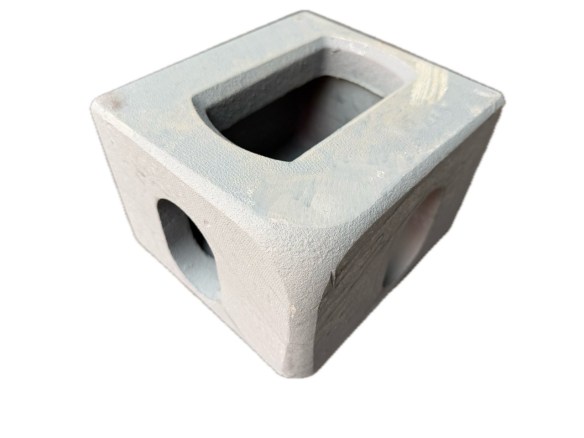
Corner casting is a massive casting made of high-strength cast steel, which forms each of the eight corners of a standardized ISO Series 1 shipping container. Each corner block has three openings – a side oval, a front (shield-shaped or oval, depending on position), and a top/bottom circular one – whose exact dimensions and tolerances are defined by ISO 1161:2016 (Series 1 freight containers – Corner and intermediate fittings – Specifications).
Key function: Corner castings serve as a universal interface for lifting, stacking, securing, and transporting the container across all modes of transport – sea, rail, and road.
Without corner castings, it would not be possible to safely lift containers with cranes, connect them with twist-locks into stacks of 9–10 layers, or anchor them to ship decks or truck chassis. All static and dynamic loads – often exceeding 30 tons per container – pass through exactly these eight points.
Why are corner castings critical for safety
Standardization according to ISO 1161 ensures that a corner casting manufactured in China will fit precisely into a crane spreader in Rotterdam, a twist-lock on a chassis in Germany, and a securing system on a ship sailing under the Panamanian flag. Dimensional tolerances range from 0 to +1.5 mm – with such precise manufacturing, global interoperability is guaranteed.
| Parameter | Value according to ISO 1161 |
|---|---|
| Quantity per container | 8 (4 top, 4 bottom) |
| Dimensions (L × W × H) | 178 × 162 × 118 mm |
| Weight per piece | approx. 10.5–12.5 kg |
| Material | Cast steel (typically Corten, SCW480) |
| Number of openings | 3 (side, front, stacking) |
| Marking on casting | Internal relief TL, TR, BL, BR |

What types of corner castings exist according to ISO 1161?
Four basic positions: TL, TR, BL, BR
ISO 1161 defines four types of corner castings – each of them is used exactly twice on a container:
- TL – Top Left (upper left)
- TR – Top Right (upper right)
- BL – Bottom Left (lower left)
- BR – Bottom Right (lower right)
The designations “left” and “right” always refer to the view of the container from the outside – that is, as you stand in front of the front or door wall of the container. The left and right variants are mirrored relative to each other.
Differences between top and bottom corner castings
The most pronounced difference is between the top and bottom corner casting:
- Top corner casting (TL, TR): The stacking opening faces upward. On the side it has an oval (stadium) opening, and on the front a shield-shaped opening – wider at the top and narrowing downward, which facilitates the attachment of lifting equipment.
- Bottom corner casting (BL, BR): The stacking opening faces downward. On the side it has an oval opening, and on the front a uniform oval opening – not shield-shaped.
| Type | Stacking opening | Side opening | Front opening | Internal relief |
|---|---|---|---|---|
| TL (Top Left) | Up | Oval (left) | Shield-shaped | TL |
| TR (Top Right) | Up | Oval (right) | Shield-shaped | TR |
| BL (Bottom Left) | Down | Oval (left) | Oval | BL |
| BR (Bottom Right) | Down | Oval (right) | Oval | BR |
What does the designation CC-1, CC-2, CC-3, and CC-4 mean?
And here we come to the core of the entire topic. The designation CC-1, CC-2, CC-3, and CC-4 is not part of the ISO 1161 standard – it is an internal catalog numbering of manufacturers and suppliers of corner castings. The ISO standard strictly works only with the marks TL, TR, BL, and BR.
Origin and history of CC-1 to CC-4 numbering
The abbreviation CC stands for Corner Casting. The numbers 1 to 4 serve as a simple way to distinguish the four types of corner castings in a catalog or ordering system. This numbering developed naturally – manufacturers and distributors needed short, unambiguous codes for their product lines.
Important notice: the mapping of CC-1 to CC-4 numbers to specific TL/TR/BL/BR positions is not universally standardized. Each manufacturer or seller can define their own assignment. In practice, therefore, it is always worthwhile to verify what numbering logic a given supplier uses.
Conversion table: CC-1 to CC-4 → TL/TR/BL/BR
The following table shows the most common mapping that can be encountered in the catalogs of European and Asian suppliers. It is based on the practice where CC-1 corresponds to the upper left block and the numbers continue clockwise:
| Catalog designation | Position according to ISO 1161 | Description |
|---|---|---|
| CC-1 | TL – Top Left | Upper left corner casting |
| CC-2 | TR – Top Right | Upper right corner casting |
| CC-3 | BL – Bottom Left | Lower left corner casting |
| CC-4 | BR – Bottom Right | Lower right corner casting |
Beware of alternative numbering! Some manufacturers use a different catalog designation: CCBR, CCBL, CCTR, CCTL, where the letters after “CC” directly copy the ISO position. Other suppliers, in turn, use completely different numerical series – for example, JOST has types CC 299, CC 300, CC 556, etc., which designate specific product variants, not basic positions.
How are CC-1 to CC-4 used in practice?
Sets of corner castings and their packaging
For one complete container, 8 pieces of corner castings are needed – exactly 2 pieces of each type. In practice, they are therefore most often sold in sets:
- Complete set (8 pcs): 2× TL, 2× TR, 2× BL, 2× BR – i.e., 2× CC-1, 2× CC-2, 2× CC-3, 2× CC-4
- Half set (4 pcs): 1× TL, 1× TR, 1× BL, 1× BR – for one end of the container
- Individual pieces: as needed (most often when repairing a damaged corner)
A complete set of 8 pieces weighs approximately 85–100 kg (depending on the exact type and material). In Czech e-shops, the price of a complete set is around 9,000–11,000 CZK excluding VAT.
What to watch out for when ordering
- Always verify exactly what the given code CC-1 (2, 3, 4) means for the specific supplier. There is no shame in asking – on the contrary, it is a sign of professionalism.
- Make sure you order the correct type for the intended container width. Standard ISO corner castings are designed for containers with a width of 8 feet (2,438 mm). For wider US inland containers (8′6″, 2,591 mm) or European swap bodies (2,500 or 2,550 mm), special variants exist.
- Beware of offset – some corner castings have a center opening offset of 28 mm or 55 mm from the standard position. This parameter is critical for proper seating of the twist-lock.
- Material and surface finish: the standard is raw cast steel (better weldability), but variants with an anti-corrosion coating are also available for longer storage.
What are the technical parameters and dimensions of corner castings?
Dimensions according to ISO 1161
All four types CC-1 to CC-4 (TL, TR, BL, BR) share the same external dimensions – they differ only in orientation and location of the openings:
| Dimension | Value |
|---|---|
| Length | 178 mm |
| Width | 162 mm |
| Height | 118 mm |
| Wall thickness (solid wall) | approx. 19 mm (12.5 mm for front/door walls) |
| Diameter of stacking opening | approx. 66 mm (circular) |
| Dimension of side oval opening | approx. 65 × 127 mm |
| Dimension of front shield-shaped opening (top) | variable, according to ISO 1161 Fig. 1–4 |
Material and weight
Corner castings are cast from high-strength steel – most commonly:
- Corten steel (weathering steel resistant to atmospheric corrosion) – e.g., type CNS-SCW49
- S-SCW480 – structural steel with a minimum yield strength of 480 MPa
- Special marine steels approved by classification societies (Lloyd’s Register, Bureau Veritas)
The weight of one corner casting ranges from 10.5 kg to 12.5 kg depending on the exact material and wall thickness. Aluminum variants (used e.g., for tank containers) weigh approximately 4.5 kg.
Strength requirements and certification
ISO 1161 specifies the minimum strength requirements that each corner casting must meet:
- Tensile strength: min. 500 kN in the direction of all three axes
- Shear strength: min. 420 kN
- Compressive strength (stacking): corresponds to the load of at least 9 fully loaded containers
Each batch of corner castings should undergo:
- Chemical analysis of the material
- Mechanical tests (tensile, impact toughness)
- Ultrasonic inspection of internal defects (according to ASTM A609)
- Dimensional control with verification of tolerances
How to recognize and identify individual types of corner castings?
Visual identification – openings and their shapes
The most reliable way to distinguish CC-1 from CC-4 is to look at the shapes of the openings:
- Top blocks (CC-1, CC-2 = TL, TR): On the front side they have a shield-shaped opening – wide at the top, narrow at the bottom, resembling a heraldic shield. The side opening is oval.
- Bottom blocks (CC-3, CC-4 = BL, BR): On the front side they have an oval opening – the same shape as the side opening.
Distinguishing left and right side:
- Stand facing the container.
- The block to your left is CC-1 (top) or CC-3 (bottom).
- The block to your right is CC-2 (top) or CC-4 (bottom).
Internal relief marking
Each corner casting manufactured according to ISO 1161 has a cast marking on the inside – relief letters TL, TR, BL, or BR. This marking is visible when looking through the stacking opening and serves as definitive confirmation of the type. The relief is part of the casting mold, so it cannot be confused or subsequently altered.
Practical tips for field differentiation
- Look for the internal relief: Look through the stacking opening into the block – you will see the letters TL, TR, BL, or BR.
- Check the front opening: Shield-shaped = top block. Oval shape = bottom block.
- Stacking opening direction: Up for top, down for bottom.
- If you buy a set of CC-1 to CC-4: Check that you received exactly 2 pieces of each number – i.e., 8 pieces in total.
- If in doubt: Place two blocks next to each other in a mirror image – you can recognize the left and right variants by the fact that they do not “match” each other – they are mirror images.
Frequently asked questions
Is the designation CC-1 to CC-4 an official part of ISO 1161?
No. ISO 1161 works exclusively with the designations TL (Top Left), TR (Top Right), BL (Bottom Left), and BR (Bottom Right). The numbering CC-1 to CC-4 is a catalog/internal marking of manufacturers and suppliers that is not internationally standardized.
Are CC-1, CC-2, CC-3, and CC-4 the same for all manufacturers?
Not necessarily. Each manufacturer can define their own mapping of numbers to positions. In practice, the most common assignment is CC-1=TL, CC-2=TR, CC-3=BL, CC-4=BR, but it is always worth verifying this with the specific supplier.
What is the difference between a top and bottom corner casting?
The top corner casting (CC-1, CC-2 / TL, TR) has a shield-shaped opening on the front side and the stacking opening faces upward. The bottom corner casting (CC-3, CC-4 / BL, BR) has an oval opening on the front side and the stacking opening faces downward.
How many corner castings do I need for one container?
For one complete container, you need 8 pieces – 2× TL (CC-1), 2× TR (CC-2), 2× BL (CC-3), and 2× BR (CC-4).
Where do I find the type designation on the corner casting?
On the inside of each corner casting there is a cast relief with the letters TL, TR, BL, or BR. This marking is visible when looking through the stacking opening.
Can the left block be used instead of the right one?
The left and right variants (e.g., CC-1 and CC-2) cannot be interchanged, because the openings would not face the correct direction. They are mirror images of each other. However, the opposite corners can be interchanged – for example, CCBR (lower right) can, according to some manufacturers, also be used as CCTL (upper left) and vice versa, because the opposite corner has the same geometry.
What standard must a corner casting meet?
ISO 1161:2016 – Series 1 freight containers – Corner and intermediate fittings – Specifications. This standard specifies the dimensions, functional, and strength requirements.
How do I know that a corner casting is certified?
Reputable manufacturers supply with each batch:
- Inspection certificate from a classification society (Lloyd’s Register, Bureau Veritas)
- Material sheet (chemical composition, mechanical properties)
- Ultrasonic inspection report (ASTM A609)
- Dimensional control report
 Czech Republic
  WITHOUT SHIPPING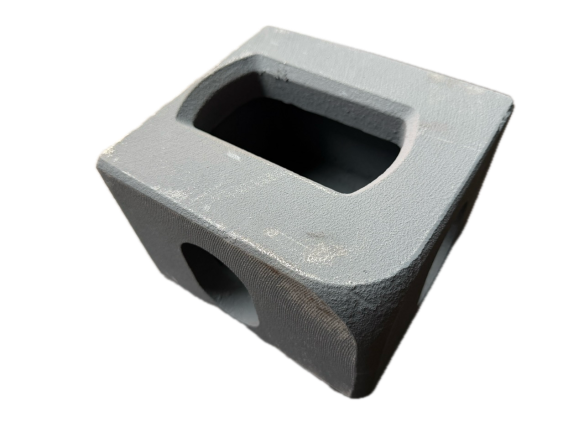


Other container news...

New sea shipping containers
If you are currently considering purchasing a new shipping container, you are not alone. While just twenty years ago containers were used almost exclusively for maritime transport, today they have found their way into construction, storage, business, and even housing. This growing popularity brings with it a host of questions: Which type should you choose? How much does it cost? How do you recognize quality? How can you avoid falling victim to scammers?
New shipping containers
If you are currently considering purchasing a new shipping container, you are not alone. While just twenty years ago containers were used almost exclusively for maritime transport, today they have found their way into construction, storage, business, and even housing. This growing popularity brings with it a host of questions: Which type should you choose? How much does it cost? How do you recognize quality? How can you avoid falling victim to scammers?

6m shipping container
Are you thinking about buying a 6-meter shipping container but aren’t sure what to look for? You are not alone—this 20-foot container is the best-selling size on the Czech market, and the differences between various types, conditions, and prices can be significant. In this guide, you will find everything you need to know: from exact dimensions and a comparison of categories (such as “one-way,” refurbished, and “Cargo Worthy”) to current prices and shipping advice.
Corner casting steel vs aluminum
Every shipping container in the world — all 40 million of them — rests on eight critical components. Corner castings are the load-bearing blocks at each corner of an ISO shipping container, and they are the universal interface between the container and every crane, twistlock, spreader, and chassis on the planet. When you lift a container, stack it nine high on a ship, or lock it to a truck trailer, every ton of force flows through these fittings.