
Comparison of New and Used Containers – Advantages, Lifespan, Investment Aspects
Comparison of used containers is a key decision-making process when acquiring shipping (maritime, ISO) containers for storage, conversion, modular construction, or transport. The differences between so-called “one-trip” new containers and containers that have already served in maritime or railway transport are fundamental from the perspective of condition, lifespan, price, environmental impact, and return on investment. Choosing the right option has a direct impact on long-term operating costs, comfort of use, safety, and value in future resale.
What is a shipping container and what are its basic types?
Shipping container is a standardized transport unit complying with ISO 668 standards, most commonly manufactured from highly durable Corten steel, which is designed for intermodal transport (ship, train, truck). Containers are characterized by:
- High structural strength (resistance to twisting, pressure, wind)
- Resistance to weather and corrosion thanks to the chemical composition of Corten steel, which creates a protective patina
- Standardized dimensions and handling points (most commonly 20′ and 40′ length, height 8’6” or 9’6” for High Cube versions)
- Ability to stack up to 7–9 layers on top of each other (depending on type and load)
- Floor made of hard tropical wood (e.g., bamboo, keruing) with thickness of 28–32 mm
Basic container types:
- Standard (Dry/Freight) ISO container – most common, closed, suitable for storage and transport of dry goods
- High Cube – elevated variant (300 mm higher), suitable for bulky cargo, conversion to housing such as shipping container homes, workshops, offices
- Open Top, Flat Rack, Reefer (refrigerated), Side Door – specialized types for specific types of cargo
Categories by condition:
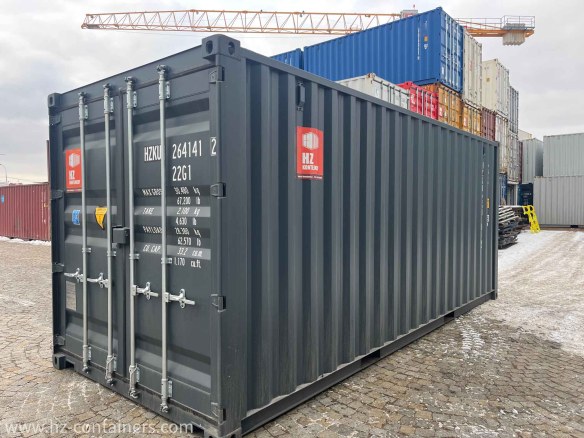
- New (“One-Trip”) container
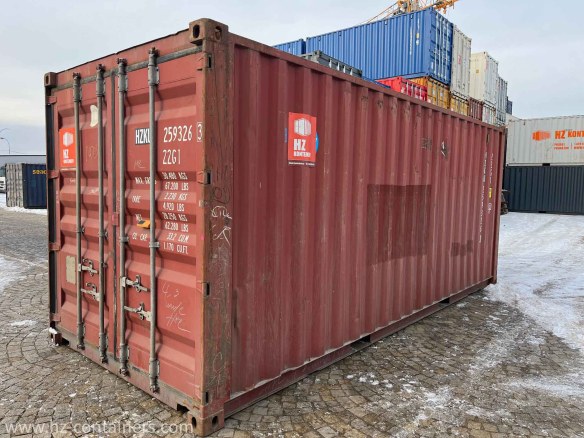
- Used container (As-Is, WWT, Cargo Worthy)
New shipping containers: Analysis of advantages and disadvantages
What does “One-Trip” container mean?
“One-trip” refers to a container that was manufactured (usually in China), used once for transporting goods to Europe/USA, and subsequently sold for further use. During this single journey, there is no significant wear – the container is technically new.
Advantages of purchasing a new container
| Advantage | Detailed explanation |
|---|---|
| Perfect condition | No rust, dents, scratches, clean floor, no contamination. Ideal for projects with emphasis on aesthetics. |
| Maximum lifespan | With static use and minimal maintenance, lifespan of 25–35 years or more. Full structural integrity. |
| Certification and standards | Always valid CSC plate, ISO standards, possibility of immediate use in international transport and construction. |
| Ideal basis for modifications | Flat walls, no deformations – quick and precise installation of windows, doors, insulation, electrical installations. |
| Higher residual value | New containers retain higher value in future resale due to condition and certification. |
Disadvantages of purchasing a new container
| Disadvantage | Detailed explanation |
|---|---|
| Higher purchase price | 30–60% higher price compared to used units (depending on market and season). |
| Limited availability | In some regions or during extreme demand, selection may be smaller, longer delivery times. |
| Higher environmental burden | Requires production of new steel, higher carbon footprint at the beginning of the lifecycle. |
Used shipping containers: Economic and ecological choice
Classification of used container condition
| Category | Description | Use |
|---|---|---|
| As-Is | Cheapest, no warranty, possible holes, corrosion, damaged floor. Watertightness not guaranteed. | Waste storage, less valuable goods |
| WWT | (Wind & Watertight) – guaranteed watertightness, no holes, normal wear, dents, surface rust, scratches. | Common storage, construction site facilities |
| Cargo Worthy | (CW) – structurally suitable for transport, valid CSC plate, minimal deformation, suitable for modifications. | Transport, conversions, long-term storage |
Advantages of purchasing a used container
| Advantage | Detailed explanation |
|---|---|
| Significantly lower price | 30–70% cheaper than new containers, allows savings on modifications and quick return on investment. |
| Ecological benefit | Extension of product lifespan, reduced demand for new production, lower carbon footprint (upcycling). |
| Wide, immediate availability | Large quantity of various sizes, conditions in stock, quick dispatch from logistics hubs. |
Disadvantages of purchasing a used container
| Disadvantage | Detailed explanation |
|---|---|
| Visible wear | Rust, dents, scratches, faded paint, may affect aesthetics and surface preparation for modifications. |
| Limited (unknown) lifespan | Depends on previous use, age (typically 8–14 years in operation), thorough inspection necessary. |
| Need for repairs and maintenance | Higher probability of future costs – seals, floor, rust removal, new painting. |
| Complications during conversions | Deformation and rust may complicate installation of interior elements, higher labor intensity of preparatory grinding and repairs. |
Investment aspects and lifespan: Long-term perspective
Container lifespan
| Container type | Average lifespan (static use) | Lifespan extension factor |
|---|---|---|
| New (“one-trip”) | 25–35 years or more | Regular inspection, painting, minimal maintenance, dry storage |
| Used (WWT/CW) | 10–20 years after decommissioning from service | Repairs, rust treatment, seal replacement, painting |
Note: During intensive logistics operation (maritime transport), lifespan may be 12–15 years; with static storage and regular maintenance, it can be significantly longer.
Return on investment (ROI) and total cost of ownership (TCO)
A new container is worthwhile if:
- You plan long-term use (15+ years)
- You require minimal maintenance, high aesthetic level
- You need a basis for precise conversions (container houses, container homes, offices, showrooms)
- You expect higher residual value upon resale
A used container is suitable if:
- You have a limited budget
- You are solving short-term/medium-term storage or non-demanding conversions
- You don’t mind cosmetic defects or plan complete cladding, covering
- You plan your own repairs and maintenance
Table: Comparison of typical purchase prices (2024, approximate):
| Size | New (One-trip) | Used (WWT) | Used (CW) |
|---|---|---|---|
| 20′ standard | 55,000–95,000 CZK | 30,000–55,000 CZK | 40,000–60,000 CZK |
| 40′ standard/HC | 80,000–155,000 CZK | 55,000–95,000 CZK | 70,000–110,000 CZK |
Caution: Prices are influenced by the steel market, global logistics, seasonality, availability in a given region, and current demand!
Key factors for container selection
When choosing, consider:
- Purpose of use – storage, conversion, transport
- Budget – not only purchase price, but also costs for transport, repairs, modifications, and maintenance
- Aesthetic requirements – will the container be in a visible location, part of corporate presentation?
- Long-term plans – duration of use, possibility of future resale, flexibility for modifications
- Condition and certification – require inspection, verify valid CSC plate for transport containers, assess condition of floor, frame, seals, and doors
Recommendations:
- For conversions to container houses, commercial spaces, and design projects where precision and appearance matter, choose “one-trip” or at least Cargo Worthy.
- For common storage, construction sites, backup warehouses, WWT category is sufficient.
- Always prefer personal inspection, or request detailed photo documentation and inspection protocol.
Environmental impact and recycling
Production of a new container:
- Consumes ~3.5 tons of steel, significant energy (production, transport), high carbon footprint
- New containers are fully recyclable due to steel, but primary production is energy-intensive
Repurposing and upcycling of used container:
- Extension of product lifespan, waste reduction, raw material savings
- Containers can be 100% recycled at end of life (steel, wood, rubber)
- Conversions to shipping container houses, offices, container homes, warehouses, or technical modules are examples of circular economy in practice
Comparison of ecological savings:
- Reuse of a used container saves up to 6–10 tons of CO₂ emissions compared to production of a new one
- The trend is the use of containers in “modular construction” – fast, ecological, economical method with minimal waste
Maintenance, service, and long-term use
- Regular maintenance (every 2–3 years): inspection of paint, rust removal, door seals, floor inspection
- Minor repairs (dents, welds, hinge/seal replacement) are easily performed on containers due to modular construction
- After-sales service – quality sellers offer inspection, service packages, possibility of arranging repairs even after years
- Recycling: at end of life, steel can be handed over for collection (high residual material value)
Glossary of related terms
| Term | Meaning |
|---|---|
| CSC Plate | Certification label (Convention for Safe Containers), necessary for transport, guarantees construction safety |
| Corten steel | Steel with alloys (Cu, Cr, Ni), creates protective patina, high resistance to weather |
| ISO Container | Container meeting international ISO standards (dimensions, handling points, strength, stackability) |
| One-Trip | Container used only for one transport from production, considered new |
| WWT (Wind & Watertight) | Used container guaranteeing watertightness and wind resistance, normal wear |
| CW (Cargo Worthy) | Used container structurally suitable for transport, valid or renewable CSC plate |
| High Cube | Elevated version of container (height 9’6” ~ 2.90 m) compared to standard 8’6” (~2.59 m) |
Frequently Asked Questions (FAQ)
Is every used container watertight?
- No, watertightness warranty is provided only by WWT or CW category containers. “As-Is” may be leaky.
Can I personally inspect the container before purchase?
- Yes, reputable sellers recommend this possibility – inspection is crucial especially for used units.
What are the most common container sizes?
- 20 feet (6.06 × 2.44 × 2.59 m) and 40 feet (12.19 × 2.44 × 2.59 m), or High Cube (height 2.90 m).
What affects container price besides condition?
- Global demand, steel price, transport costs, seasonality, storage location.
How is container recycling performed?
- At end of life, the container is disassembled, steel processed in mills, wooden floor and rubber parts are also recycled.
 Czech Republic, Turnov
  FREE SHIPPING
Other container news...

Obligation to Check Tightness When Selling a Reefer Container
Who is responsible for the refrigerant leak check when selling a refrigerated container? Find out what obligations the seller has at the time of handover and why they must provide a PTI report along with the technical data plate. Learn which regulatory requirements and F-gas record-keeping duties become the sole responsibility of the new owner.

New shipping containers
If you are currently considering purchasing a new shipping container, you are not alone. While just twenty years ago containers were used almost exclusively for maritime transport, today they have found their way into construction, storage, business, and even housing. This growing popularity brings with it a host of questions: Which type should you choose? How much does it cost? How do you recognize quality? How can you avoid falling victim to scammers?
New sea shipping containers
If you are currently considering purchasing a new shipping container, you are not alone. While just twenty years ago containers were used almost exclusively for maritime transport, today they have found their way into construction, storage, business, and even housing. This growing popularity brings with it a host of questions: Which type should you choose? How much does it cost? How do you recognize quality? How can you avoid falling victim to scammers?

6m shipping container
Are you thinking about buying a 6-meter shipping container but aren’t sure what to look for? You are not alone—this 20-foot container is the best-selling size on the Czech market, and the differences between various types, conditions, and prices can be significant. In this guide, you will find everything you need to know: from exact dimensions and a comparison of categories (such as “one-way,” refurbished, and “Cargo Worthy”) to current prices and shipping advice.