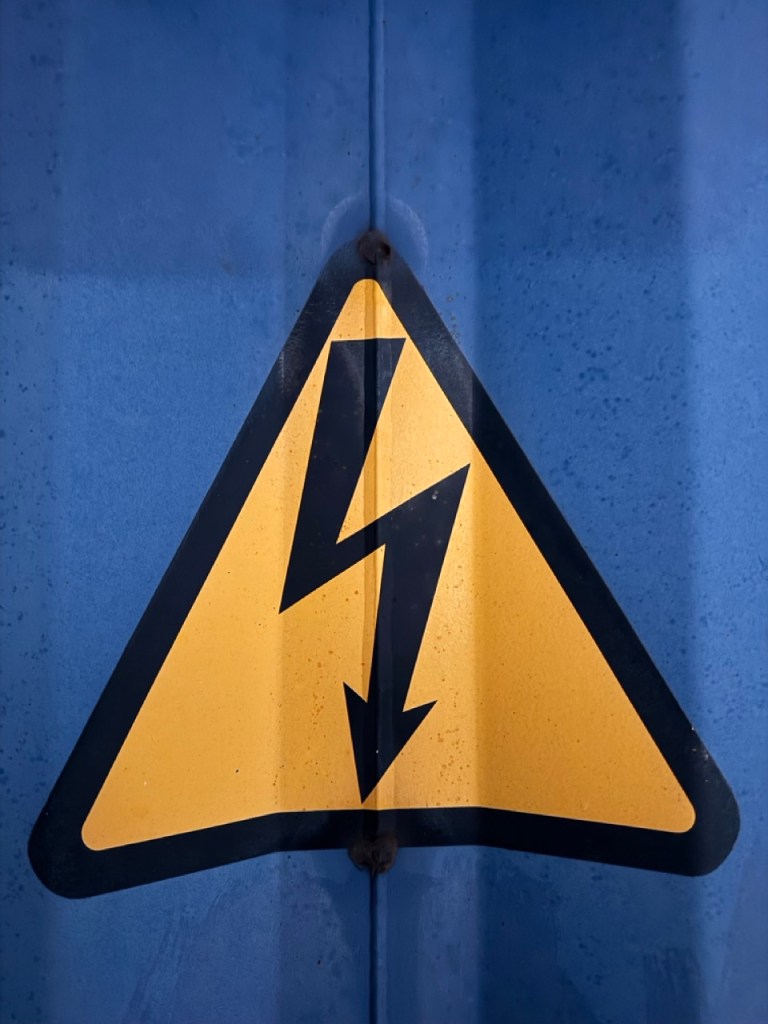
Warning High Voltage – Shipping Container
Warning High Voltage on Shipping Containers represents a key safety communication system, whose core consists of standardized labels, pictograms, warning signs and text information permanently attached to the shipping container. The purpose of this system is to warn workers and all personnel of the presence of life-threatening electrical hazards. Proper and understandable warnings significantly reduce the risk of electric shock, arc flash or fatal electrical accidents.
Given the international nature of transport, warnings are often implemented multilingually and especially using universally understood symbols according to the ISO 7010 standard. The obligation to mark arises from a number of national and international standards and regulations (for example, IMO, OSHA, ISO, ČOS 139801), and applies to all containers that are powered by high voltage or contain high-voltage systems – for example, refrigerated containers (reefers), battery storage (BESS), mobile data centers or generator containers.
Etymology and Terminological Classification
Detailed knowledge of terms is essential for proper understanding of the issue:
| Term | Meaning and Technical Definition |
|---|---|
| Warning | English signaling term according to ANSI Z535 – denotes a hazard that may cause serious injury or death. |
| High Voltage | “High voltage” – according to IEC >1,000 V AC / 1,500 V DC; in practice, systems from 400 V and above are also considered high-voltage (e.g., reefer power supply). |
| Shipping Container | ISO container – standardized steel transport unit intended for multimodal transport (road, rail, sea). |
Basic Principles and Importance of the Warning System
Why are high voltage warnings necessary?
- Immediate hazard identification: Enables both laypersons and professionals to immediately recognize the threat of fatal electrical shock.
- Risk reduction and health protection: Requires workers to use PPE (personal protective equipment), maintain safe distances and follow correct procedures.
- Guiding emergency services: Warnings inform firefighters and rescue personnel of the need for special intervention (e.g., prohibition of water extinguishing, need for power disconnection).
- Regulatory and legal compliance: Required by standards (ISO, IMO, OSHA, ČOS) – incorrect or missing labeling means possible fines, sanctions and decommissioning of the container.
Types of containers requiring high voltage warnings
- Refrigerated containers (reefers): Operation on three-phase voltage 380–480 V AC; warnings at supply lines, control elements and entrance doors to technology.
- Battery storage (BESS): Modern containers with high-voltage batteries (600 to 1,500 V DC); often a combination of warnings for electricity, chemical hazards and explosion risk.
- Container data centers: Mobile IT infrastructure powered by high AC/DC voltage, containing UPS and cooling systems.
- Mobile generators and transformer containers: For generation or transformation of electrical energy in the field.
- Special industrial containers: Equipment for water treatment, mobile workshops, scientific laboratories, etc.
Components of an Effective Warning System
| Component | Description | Example / Standard |
|---|---|---|
| Signal word | DANGER (Fatal hazard), WARNING (Serious risk), CAUTION | ANSI Z535, ISO 3864 |
| Pictogram | Black and yellow triangle with lightning bolt (ISO 7010 W012) | ISO 7010, ČOS 139801 |
| Text description | “High Voltage – Risk of electric shock. Access only for authorized personnel.”, “Explosion hazard” | Prescribed by standards |
| Voltage specification | E.g. “460 V AC”, “1,000 V DC” | ISO/IEC, equipment labeling |
| Location | At entrance doors, at power outlets, on switchboards, on machine covers and control panels | ISO 3864, IMO, ČOS |
| Label durability | Durable UV-stabilized material, resistant to water, salt, abrasion and UV radiation | ISO 3864-1, EN 13501-1 |
Important: Warning labels must be clearly visible and must not be covered by cargo or damaged. Failure to comply with this obligation may be grounds for decommissioning the container.
Standards and Regulations in the Field of Labeling
International and Czech standards
- ISO 7010: International safety symbols, especially W012 (warning – electricity).
- ISO 3864: Graphic rules for safety marking – colors, shapes, text and symbol layout.
- ISO 6346: Container identification, ensuring unambiguous reference when transporting dangerous goods.
- ANSI Z535: American standard for design and hierarchy of safety signs (DANGER/WARNING/CAUTION).
- OSHA 29 CFR 1910.145/335: Requirements for labeling electrical hazards in the workplace.
- IMO SOLAS, CSC: Safety regulations for container transport by sea, including the obligation for proper marking and technical inspections.
- ČOS 139801 (Czech Defense Standard): Specific requirements for the transport of dangerous goods (ammunition, explosives, high-voltage equipment) including detailed description of marking, operator training and inspections.
Selected excerpts from ČOS 139801
- Definition and use of marks: All containers transporting dangerous goods (including high-voltage equipment) must be equipped with permanent and legible warning labels.
- Operator training: Personnel must be trained in recognizing marks, basic handling rules and first aid for electrical injuries.
- Specifics by type of transport: Appendices describe differences in requirements for road, rail, maritime and air transport.
Practical Scenarios and Examples of Use
Port operations
For example, in ports like Hamburg or Rotterdam, thousands of containers are handled daily. A worker (crane operator, warehouse worker) must be able to immediately recognize a container with high-voltage content thanks to a clear black and yellow symbol and the text “WARNING – HIGH VOLTAGE”. Based on this marking:
- Does not open doors or interfere with technology without authorization.
- Checks the condition of labels before handling.
- In case of damage, odor or smoke, immediately reports the incident to a supervisor.
Repairs and maintenance
A technician arrives at a non-functional refrigerated container. The warning “WARNING – 460 V AC” on the control panel guides him to perform a safety procedure:
- Identifies the power source and uses the LOTO (Lockout/Tagout) procedure – disconnection, circuit breaker locking, labeling with date and signature.
- Verifies the de-energized state of the circuit with a measuring device.
- Only then performs the service intervention.
Emergency services intervention
During a fire in a container terminal, firefighters identify a BESS container with a warning “EXPLOSION HAZARD – HIGH VOLTAGE – CHEMICAL HAZARD”. They follow this marking:
- Do not use water jets directly on the container (risk of electrical short circuit and chemical reaction).
- Prioritize cooling of surrounding containers and use of suitable extinguishing agents (class C/D).
- Set a larger safety perimeter due to explosion and toxic fume risks.
Risks and Measures to Reduce Hazards
| Risk | Description | Measures |
|---|---|---|
| Electric shock/electrocution | Current passing through the body – death, burns, cardiac arrest | Quality insulation, protective covers, warning labels, PPE |
| Arc flash | Electrical arc explosion – extreme heat, pressure wave, molten metal splash | Grounding systems, circuit breakers, LOTO, protective clothing |
| Fire/thermal hazard | Short circuit, overheating, battery failure – intense and difficult to extinguish fire | Temperature monitoring, smoke detection, automatic power disconnection |
Additional measures:
- Technical: Grounding, circuit breakers, locking mechanisms, controlled connection.
- Administrative: Training, safety procedures during maintenance, regular inspections.
- PPE: Dielectric gloves, helmets, protective shields, arc-resistant clothing.
Related Terms
- Arc Flash Boundary: Safe distance for arc flash hazard.
- BESS (Battery Energy Storage System): Container system for storing electrical energy.
- Intermodal container: Standardized container for combined transport.
- LOTO (Lockout/Tagout): Procedure for safe power disconnection during service.
- PPE (Personal Protective Equipment): Protective equipment for technicians.
- Reefer: Refrigerated transport container.
- Signal words: Express the level of hazard (DANGER, WARNING, CAUTION).
The “Warning High Voltage – shipping container” is one of the most important elements of modern logistics and workplace safety. Its purpose is not only to label the container, but to create a system of visual communication that is immediately understandable across languages and continents. Compliance with this marking protects workers’ lives, prevents accidents and is a basic condition for legal and safe transport in the global supply chain.
 Czech Republic, Český Krumlov
  FREE SHIPPING