
Super Freezer Shipping Container
Super Freezer shipping container (often also referred to as Ultra-Low Temperature Container, ULT container or ultra-freezing container) is a specialized type of refrigerated (reefer) container, developed for storage and transport of goods that require extremely low temperatures – significantly lower than standard refrigerated containers. While a standard refrigerated container typically reaches temperatures in the range of +25 °C to -25 °C, Super Freezer containers are capable of safely and stably maintaining temperatures in the range of -60 °C to -70 °C (some models up to -80 °C), which expands the possibilities for global transport and storage of highly sensitive commodities.

This type of container is key for the transport of:
- Highly sensitive pharmaceutical products (e.g. vaccines, blood plasma, biotechnology samples)
- Premium food products (e.g. sashimi-grade tuna, seafood, special enzymes)
- Chemicals and semiconductor materials
- Composites for the aerospace and automotive industry
Super Freezer containers thus form the backbone of the so-called ultra cold chain, where they ensure that even the most sensitive products arrive in perfect condition, even during long sea or land transport.
Synonyms and related terms
- ULT (Ultra-Low Temperature) container
- Ultra-low freezer container
- Container -60 °C / -70 °C
- Deep freezer container
- Magnum Plus (specific Thermo King model)
- Ultra refrigerated container
Detailed description and operating principle
Differences between standard reefer container and Super Freezer
| Property | Standard reefer | Super Freezer container |
|---|---|---|
| Typical temperature range | +25 °C to -25 °C | -60 °C to -70 °C (up to -80 °C) |
| Cooling technology | Single-circuit system, standard refrigerant | Cascade system, special refrigerants |
| Insulation | Standard PUR foam | Reinforced PUR foam, vacuum panels |
| Construction | Steel/aluminum, ISO standard | Reinforced walls, multiple seals, internal emergency opening |
| Electrical power | 380-460V, 50/60Hz | Same, plus diesel genset option |
| Monitoring | Basic logging | Advanced logging, GPS, remote access |
Cascade cooling system (Cascade Technology)
Super Freezer container uses a dual-circuit cooling system, which allows achieving and maintaining temperatures deep below freezing point. Principle:
- First circuit (high-temperature): Uses standard refrigerant (e.g. R-134a), cools the condenser of the second circuit.
- Second circuit (low-temperature): Uses special refrigerant for ultra-low temperatures (e.g. R-23 or R-508B). Because its condenser is already pre-cooled, it can reach temperatures up to -70 °C.
- Control: Microprocessor control units (e.g. Thermo King MP-3000) monitor and regulate both circuits in real time with precision of ±1°C.
Key features and construction
Construction elements
- High Cube design: Super Freezer containers are often in the High Cube variant (height 2896 mm), which increases volume and allows storage of bulkier cargo while maintaining temperature stability.
- Cargo Worthy quality: Construction meets requirements for sea transport – robust frame, reinforced corners and floor with high load capacity (often with anti-slip finish).
- Reinforced insulation: Walls consist of several layers – outer steel/aluminum, layers of high-density polyurethane foam, vacuum panels for minimal heat loss and inner stainless steel (INOX) or aluminum lining.
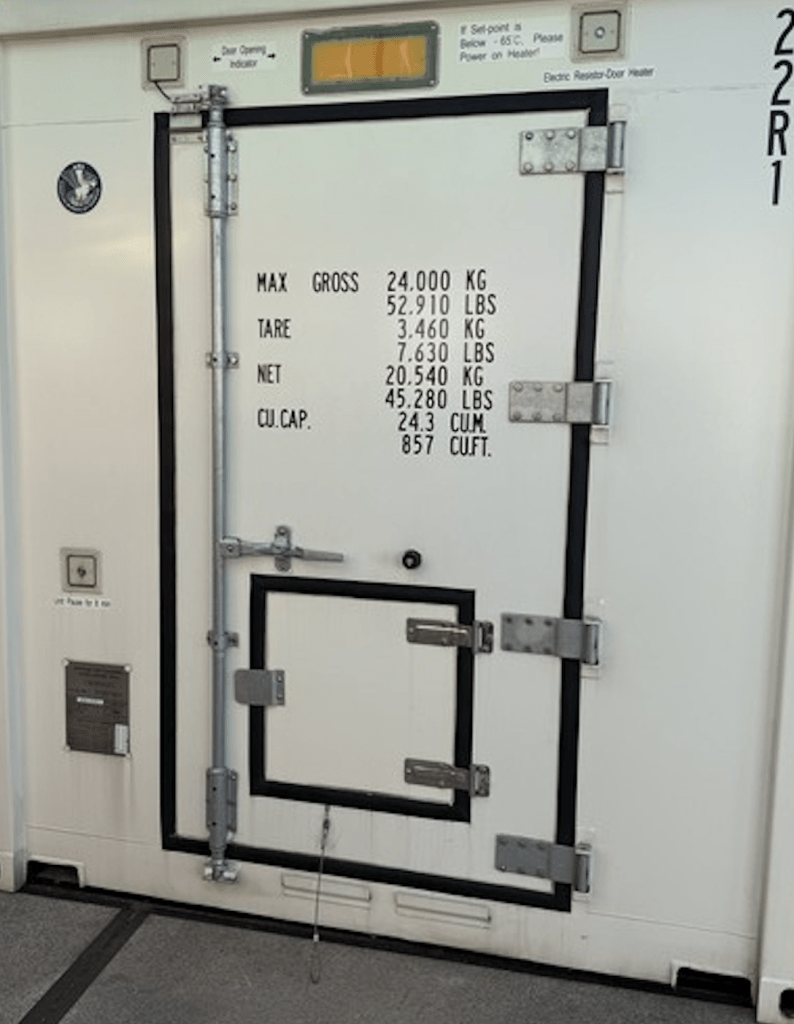
- Multiple door seals: Doors are equipped with multiple rubber seals and special locks for maximum tightness.
- Emergency internal opening: For operator safety.
- Certification: ISO1496-2, CSC plate, GDP Pharma, CE, USDA (depending on purpose).
Technical specification (example 40′ High Cube)
| Parameter | Value |
|---|---|
| Internal dimensions | approx. 11580 x 2290 x 2520 mm |
| External dimensions | 12192 x 2438 x 2896 mm (length x width x height) |
| Volume | approx. 76 m³ |
| Empty weight | approx. 4,800 kg |
| Max. cargo weight | up to 29,000 kg |
| Temperature range | -70 °C to -10 °C (some models up to +50 °C) |
| Control precision | ±1 °C |
| Power supply | 3-phase, 380-460V, 50/60 Hz |
| Genset compatibility | Yes |
Advanced technologies and equipment
- Datalogger: Automatic temperature recording (at multiple locations in the space), recording of outages, error messages and defrost cycles.
- Telematics and GPS: Online location tracking, status monitoring, possibility of remote setting changes, automatic alerts when parameters deviate.
- Internal LED lighting: For safe cargo handling.
- Alarms: Acoustic and visual warnings when doors open, power failure, temperature limits exceeded.
Applications and uses
Pharmaceutical industry and biotechnology
- Vaccines (especially mRNA, e.g. Pfizer/BioNTech): Require storage at up to -70 °C.
- Blood plasma, tissue cultures: Prevention of protein and enzyme degradation, long-term stability.
- API (active pharmaceutical substances): Some components are stable only at ultra-low temperatures.
Food industry
- Sashimi-grade tuna, salmon, crab meat: Stopping microbial decomposition, preserving color, structure and taste for many months.
- Special ingredients: Yeast, enzymes, probiotics.
Science, hi-tech and industry
- Semiconductors, composites, 3D printing: Material stabilization before processing.
- Research laboratories: Storage of biological samples, testing of extreme conditions.
Chemical industry
- Storage of sensitive reagents and substances that are unstable at normal temperatures.
Role in cold chain
Super Freezer containers are absolutely essential in the global ultra-low temperature chain:
- Transport: Safe international transport by sea, rail and road (possibility of power supply from diesel generator – genset outside the electrical grid).
- Storage: Mobile, temporary and long-term warehouses in ports, pharmaceutical plants, hospitals.
- Ensuring continuity: Minimizing the risk of temperature chain interruption – the container can be monitored online and respond promptly to any deviations.
Monitoring, tracking and data recording
| Function | Description |
|---|---|
| Data logging | Temperature recording, outages, error states, defrost cycles |
| Online monitoring | GPS, GPRS, remote access, possibility of parameter changes |
| Alarms and notifications | Automatic warning when deviation, door opening, etc. |
| Audit trail for GDP/GMP | Possibility of providing temperature history for pharmaceutical audits |
When purchasing or renting, it is advisable to verify the scope of services (data backup, remote management, language variants of the interface).
Additional practical details and tips
- Installation and operation: It is necessary to ensure three-phase power supply, possibly a quality diesel generator (for road transport). For larger pharmaceutical deliveries, backup power is often required.
- Service and maintenance: Given the technological complexity, regular service of the cooling unit and inspection of door seals and insulation is key.
- Operating economics: Super Freezer containers have higher operating costs (higher electricity consumption, maintenance costs), but in many cases replace extremely expensive air transport.
- Rental vs. purchase: On the Czech market, containers are available both for sale and for rent – suitable for seasonal needs or extraordinary logistics projects.
Frequently asked questions (FAQ)
1. What are the power supply options for Super Freezer container?
- Standard 3-phase power supply 380-460V. For transport and locations without grid, a diesel generator can be used.
2. Can these containers be used as stationary warehouses?
- Yes, they are commonly used as mobile warehouses in pharmaceutical company facilities, ports or logistics centers.
3. How is operator safety handled?
- All containers have internal emergency door opening and alarms.
4. How is temperature recording and auditing done?
- All parameters are automatically logged and can be exported for audit purposes (GDP, GMP).
5. What are the dimensions and volumes of available models?
- Most commonly 10′, 20′, 40′ High Cube, volumes from approx. 11 m³ to 76 m³.
Summary
Shipping container Super Freezer is a state-of-the-art technological device that combines extreme cooling power, robust construction and advanced monitoring. Its importance in pharmaceutical, food and high-tech logistics is constantly growing and enables safe, efficient and certified transport of even the most sensitive commodities in the world. Without this technology, global distribution of mRNA vaccines, blood derivatives or premium seafood would be practically impossible.