
FT – Means “Foot”
Shipping containers are the backbone of global logistics, enabling efficient and standardized transportation of goods across oceans, railways, and roads. The abbreviation “FT”, indispensable in the maritime industry, denotes “foot”, which is a unit of measurement key to defining the dimensions and capacities of containers. This glossary article addresses the concept of FT in shipping containers, its significance, standardization, and role in international trade.
What Does FT Mean in Shipping Containers?
FT means “foot”, which is a globally recognized unit of measurement in the shipping and logistics industry. This measurement is essential for categorizing shipping containers by length, for example:
- 20FT container: Standard container with a length of 20 feet.
- 40FT container: Double the length of a 20FT container.
- 40FT High Cube (HC): A taller variant of the 40FT container that offers greater vertical space.
These standardized dimensions are necessary to ensure compatibility across intermodal transportation systems, including ships, trucks, and trains. Measurement in FT units also forms the basis of key metrics, such as TEU (Twenty-Foot Equivalent Unit) and FEU (Forty-Foot Equivalent Unit), which simplifies capacity calculations and logistics management.
Significance of FT in Shipping Containers
The use of the FT unit contributes to:
- Global standardization: Compliance with ISO standards enables seamless stacking, loading, and transportation of containers worldwide.
- Logistics efficiency: Standard sizes accelerate handling at ports and intermodal facilities.
- Capacity metrics: Units such as TEU and FEU facilitate planning for cargo ships and port operations.
- Cost estimation: Shipping rates are often based on container size, calculated on TEU or FEU.
Standard Sizes and Dimensions of Shipping Containers
Shipping containers are available in various sizes to accommodate different cargo needs. Here are the most common types:
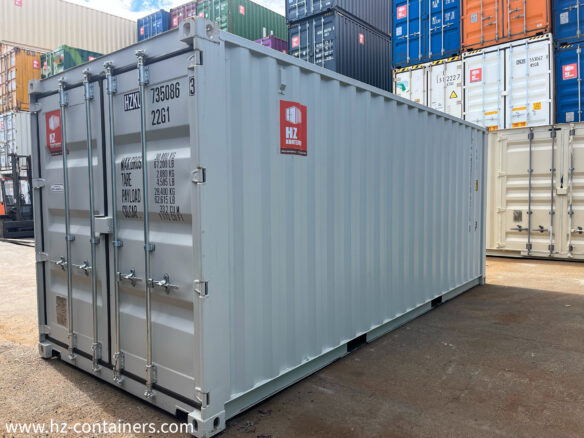
1. 20FT Standard Container (1 TEU)

- External dimensions: 20′ (L) x 8′ (W) x 8’6″ (H)
- Internal dimensions: 19’4″ x 7’9″ x 7’10”
- Usable volume: 33.1 cubic meters (1,172 cubic feet)
- Weight: Empty container weight approximately 2,300 kg; maximum payload 28,000 kg.
2. 40FT Standard Container (2 TEU or 1 FEU)
- External dimensions: 40′ x 8′ x 8’6″
- Internal dimensions: 39’5″ x 7’8″ x 7’10”
- Usable volume: 67.7 cubic meters (2,390 cubic feet)
- Weight: Empty container weight approximately 3,800 kg; maximum payload 28,600 kg.
3. 40FT High Cube (HC) Container
- External dimensions: 40′ x 8′ x 9’6″
- Internal dimensions: 39’6″ x 7’8″ x 8’10”
- Usable volume: 76.4 cubic meters (2,694 cubic feet)
- Weight: Empty container weight approximately 4,000 kg.
4. Specialized Containers
In addition to standard and High Cube variants, there are also specialized containers, such as refrigerated (reefer), open-top, or flat-rack containers, which also comply with FT unit measurements.
Key Metrics Derived from FT
1. TEU (Twenty-Foot Equivalent Unit)
TEU is a standard unit of capacity measurement:
- 1 TEU = capacity of a 20FT container.
- 40FT container = 2 TEU.
2. FEU (Forty-Foot Equivalent Unit)
FEU represents the capacity of a 40FT container (equivalent to 2 TEU).
3. High Cube Containers
High Cube containers, available in 20FT and 40FT sizes, offer one foot greater height for light but voluminous cargo, such as furniture or building materials.
Uses of Shipping Containers Based on FT
Containers measured in FT units are versatile and used in various industries:
- 20FT containers: Transportation of smaller goods, such as consumer goods and machinery.
- 40FT containers: Ideal for high-volume goods and bulk shipments.
- High Cube containers: Suitable for projects requiring greater vertical space, such as modular housing.
ISO Standards and FT
The International Organization for Standardization (ISO) defines container dimensions and specifications:
- ISO 668: Regulates external and internal dimensions, door openings, and stacking limits.
- ISO 1496: Establishes procedures for testing strength and safety.
These standards ensure global compatibility, enabling efficient handling of containers at ports, on ships, trucks, and trains.
Frequently Asked Questions
1. Why is FT measurement used in shipping?
FT is a universally recognized unit that complies with ISO standards, ensuring interoperability in global transportation systems.
2. What is the difference between TEU and FEU?
TEU measures the capacity of a 20FT container, while FEU represents the capacity of a 40FT container (2 TEU).
3. Are High Cube containers more expensive to ship?
Yes, due to their larger volume and height, High Cube containers often have higher shipping costs.
Conclusion
Understanding “FT” is essential for navigating the world of shipping containers. This unit of measurement not only standardizes dimensions but also forms the basis of important logistics metrics, such as TEU and FEU. From standard 20FT containers to specialized High Cube variants, the FT-based sizing system facilitates seamless trade and innovation, including cargo transportation, modular housing, and other areas. Compliance with ISO standards ensures global compatibility and efficiency, reinforcing the importance of this measurement in modern logistics.
 Czech Republic, Třebíč
  FREE SHIPPING

