
Standard Four-Bar Shipping Container Opening
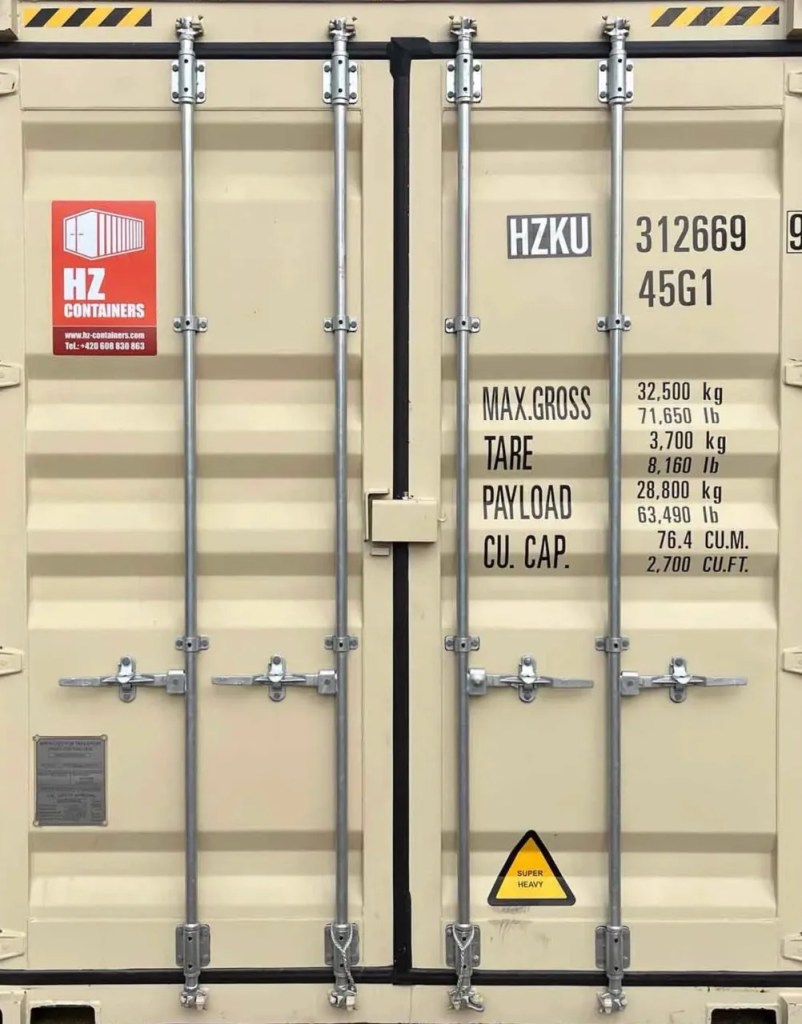
Standard four-bar shipping container opening is an internationally recognized and ISO standardized system for closing and securing double-wing doors of maritime containers. This mechanism, consisting of four massive vertical steel locking bars (locking rods), two on each wing, ensures high structural strength, watertightness, dusttightness, and cargo security.
The system is designed to withstand extreme conditions in international transport – including vibrations, pressures during container stacking, climatic influences, and attempts at forced entry. Worldwide standardization (particularly according to ISO 1496-1) enables efficient handling and guarantees compatibility throughout the logistics chain. The four-bar system is currently the absolute foundation of safety and functionality of ISO containers.
Principle and Functionality of the Four-Bar System
The mechanism utilizes the conversion of rotational motion into displacement and door securing. Each of the four locking rods is operated by a separate handle (handle), which allows rotation of the rod around its own axis. At the top and bottom of each rod is welded a special metal cam, which when rotated engages into a fixed cam keeper attached to the container frame.
This arrangement ensures:
- Four locking points on each side of the door (eight total on the container)
- Even distribution of pressures around the door perimeter – prevents door deformation even when transporting heavy or bulk cargo
- Perfect compression of rubber gasket (door gasket) – achieving watertightness and dusttightness
Anatomy of the System: Key Components and Their Functions
| Component | Function and Description | Material and Treatment |
|---|---|---|
| Locking Rod (Locking Bar) | Massive vertical steel rod, forms the basis of the closing system, transfers forces and ensures strength | S235JR/S355JR, stainless steel; hot-dip galvanizing, powder coating |
| Cam | Curved/protruding segment at the end of the rod, when rotated engages into the cam keeper and forms a lock | Forged steel, reinforced design (SECURA) |
| Cam Keeper | Robust steel holder, firmly welded to the top and bottom frame of the container, catches the cam | Cast or forged steel |
| Door Handles | Levers for manual rotation of locking rods, often with ergonomic grip | Steel, galvanizing, plastic grip |
| Handle Retainers (Handle Catches) | Secure handles in locked position – open/closed | Steel, holes for padlock |
| Rod Guide Brackets | Enable smooth movement of rods, keep them in the axis of the door, transfer force to the frame | Steel |
| Door Gasket | Rubber gasket around the entire door perimeter, ensures watertightness and dust resistance | EPDM, NBR, silicone rubber |
| Hinges | Allow door opening up to 270°, massive design, removable during repairs | Steel, galvanizing |
| Lock Box | Steel cover protecting the padlock from cutting/drilling, key security element | Welded steel, reinforced design |
Technical Requirements and Standards (ISO 1496-1, 1161 and others)
Selection of Materials and Design Parameters
- Rod body : Diameter typically 22–27 mm, length according to door height (2260–2590 mm for standard ISO containers).
- Material : S235JR, S355JR according to EN 10025 or stainless steel AISI 304/316.
- Surface treatment : Hot-dip galvanizing (min. 70 μm), powder coating for increased corrosion resistance, combination possible.
- Cam and cam keeper : Forged, cast or milled steel (reinforced variants: SECURA), material thickness up to 16 mm in security designs.
ISO Standards
- ISO 1496-1 : Defines basic design, strength and testing requirements for doors and locking systems of maritime containers. Includes testing of tightness, door strength during stacking and handling.
- ISO 1161 : Specifies dimensions and requirements for corner fittings, which relate to the compatibility of locking systems.
Reinforced Security Systems (SECURA, reinforced cam/keeper)
For demanding applications and increased protection against forced entry, reinforced mechanisms are available on the market:
- SECURA Cam/Keeper : Made from higher quality steel, reinforced walls, design intended for resistance to prying, cutting and impacts.
- Lock Box : Reinforced security boxes for padlocks with protection against drilling and cutting.
Procedure for Opening and Closing the Container – Step by Step
Opening the Container
- Safety check : Container must stand on a level and compacted surface. Check the area around the door.
- Removal of locks and seals : Remove the padlock and transport/customs seal.
- Start with right door : Left doors overlap right doors – always open the right door first.
- Release catches : Lift the catches on both handles of the right door.
- Rotate handles : Rotate both handles away from the door; cams will disengage from the keepers.
- Open right door : Use the handles as grips, open the door.
- Repeat for left door.
Closing the Container
- Left door first : Close the left door first.
- Secure left door : Rotate handles, cams engage into the keepers, secure the catches.
- Close right door : Then close the right door.
- Secure right door : Rotate handles, secure the catches.
- Lock : Apply padlock to the lock box, if necessary apply transport seal.
Advantages of the Four-Bar System
- Maximum structural integrity : Eight locking points ensure even distribution of forces, protecting both the door and the entire rear wall of the container.
- High security : System is difficult to overcome, special reinforced variants (SECURA) significantly increase protection.
- Perfect watertightness and dusttightness : Compression of rubber gasket around the entire perimeter protects the interior even from seawater and dust.
- Long service life and minimal maintenance : Components made from highly resistant steel, designed for decades of operation.
- Global compatibility : According to ISO standards, known and operable anywhere in the world.
Comparison with Alternative Systems
| System | Locking Rods | Number of Locking Points | Main Use | Advantages | Disadvantages |
|---|---|---|---|---|---|
| Four-Bar (ISO) | 4 | 8 | International transport, warehouse | Highest strength, security, standard | Higher force required to open |
| Three-Bar | 3 | 6 | Stationary warehouses | Faster handling | Less secure, lower structural strength |
| Easy Open | 1 (right door) | 2 | Retail, construction, personal storage | Greatest comfort, quick opening | Unsuitable for heavy cargo, lower security |
Common Problems and Maintenance
| Problem | Cause/Prevention | Solution |
|---|---|---|
| Twisted frame/uneven surface | Container not on level | Move to level and compacted surface |
| Hinge/mechanism corrosion | Moisture, salt, neglected maintenance | Regular lubrication, inspection, cleaning |
| Damaged gasket | Age, mechanical damage, UV radiation | Replace gasket with new (EPDM, NBR) |
| Cargo pressing on door | Poor cargo securing | Proper distribution and fixation of cargo |
Maintenance Tips:
- Regularly apply lubricant to hinges, handles and guide brackets.
- Inspect gasket and replace if damaged.
- After each transport, check the condition of handles and catches.
Security Aspects and Testing According to ISO
- Mechanical door resistance : Tested with loads up to 1.5 times the rated capacity of the container.
- Watertightness : Tested with water jet under pressure min. 1 bar around the door perimeter.
- Resistance to impact and vibrations : Inspection of locking point integrity after simulated transport shocks.
- Possibility of sealing and securing : All handles have holes for seals/padlock, security boxes (lock boxes) on new containers.
Frequently Asked Questions (FAQ)
Why is it necessary to open the right door first?
The right door is “primary” and opening it first releases the overlap of the left door. This design increases tightness and security.
What is the difference between standard and reinforced (SECURA) system?
The reinforced system uses stronger, forged or cast iron parts, plus design modifications against prying and cutting. It is suitable for increased security requirements.
What is the service life of the four-bar system?
With proper maintenance (lubrication, gasket inspection, corrosion prevention), it commonly exceeds 20 years even in demanding conditions.
What is the procedure if the door gets stuck?
Check the surface, condition of the mechanism, apply lubricant. For major damage, contact service or container specialist.
What is the resistance to break-in?
Standard system with lock box and quality padlock is very difficult to overcome without specialized tools and significant noise.
Standard four-bar shipping container opening represents the pinnacle in the field of security, structural integrity and resistance to external influences. Its well-thought-out design, robust materials and global standardization make it an indispensable element of world logistics and storage. Understanding its function, maintenance and security parameters is key for everyone who works with containers – from transporters through warehouse operators to construction companies and users of modified containers.

 Czech Republic, Nová Paka
  FREE SHIPPING

