
Requirements for Connecting Electrical Power to Reefer Shipping Containers
Requirements for connecting electrical power to refrigerated shipping containers are a key element for ensuring proper operation of so-called “reefers,” i.e., cooling or refrigerated containers intended for transport and storage of temperature-sensitive goods. These requirements determine not only safe power supply to compressors and control units, but also the sizing of electrical distribution systems, protective elements, selection of appropriate connectors, and the type of power supply for containers located in ports, on construction sites, in warehouses, and during transport.
Reefer containers (refrigerated/cooling containers) commonly transport food, pharmaceuticals, flowers, or chemicals. The technical correctness and safety of electrical connection is essential not only for maintaining cargo quality, but also for protecting personnel and equipment.
Technical Definitions and Standards
Standard Electrical Installation in Refrigerated Containers
- Three-phase voltage: The international standard is 380–480 V AC, 50/60 Hz, three-phase, which enables efficient operation of powerful compressors and fans.
- Single-phase power supply: Exceptionally for smaller 10-foot containers (220–230 V, 45 A), however in practice most containers require a three-phase source.
- Frequency: Global manufacturers (Carrier, Thermo King) produce units compatible with both frequencies – 50 Hz (Europe, Asia) and 60 Hz (North America).
Overview of Electrical Characteristics (table):
| Container Type | Voltage (V) | Phase | Frequency (Hz) | Circuit Breaker (A) | Connection Type |
|---|---|---|---|---|---|
| 10′ Reefer | 220–230 | 1 | 50/60 | 45 | Plug/Hardwire |
| 20′ Reefer | 208–230/440–480 | 3 | 50/60 | 45–60 | Plug/Hardwire |
| 40′ Reefer High Cube | 380–480 | 3 | 50/60 | 30–32 | Plug/Hardwire |
Source: Maersk, Thermo King, Carrier, HZ Containers
Standardization and Certification:
- All containers are subject to standards ISO 668, ISO 1496/2 and recommendations of classification societies (DNV, Bureau Veritas).
- Manufacturers (e.g., Carrier ThinLINE®, Thermo King Magnum Plus) guarantee compatibility with common connection points in ports, on ships, and in European operations.
Connection Elements and Their Specifics
Types of Connectors and Power Cables
- Standard power cable: Length 15–18 m, cross-section 4–6 mm² (corresponding to current load 30–60 A, depending on length). Material resistant to UV radiation, oils, and mechanical damage.
- Connectors: Industrial, waterproof, so-called “twist-lock” four-pin plugs according to IEC 60309 standard (often blue or red, 32 A, 3P+N+PE).
- Fixed wiring (“hardwire”): Recommended for long-term installations – conductors connected directly to the distribution panel via circuit breaker and main switch.
Connection in Practice:
- Plug & receptacle: Quick handling, safe repeated connection.
- Direct connection: Higher safety, lower risk of contact failure, suitable for permanent placement.
Protective and Safety Elements
Circuit Breakers, Overvoltage Protection, and Grounding
- Circuit breakers: Must correspond to maximum consumption and type of power supply, e.g., 30–32 A for 460 V, 60 A for 220 V.
- Fuses in the unit: Each cooling unit has its own protection against overload and short circuit.
- Overvoltage protection: It is recommended to install external protection in the distribution panel, especially in areas with frequent voltage fluctuations.
- Grounding: Mandatory! The metal structure of the container must be properly grounded according to Czech standards and European regulations. All protective conductors (PE) must be connected to the grounding terminal in the container and in the distribution panel.
Power Sources and Their Correct Selection
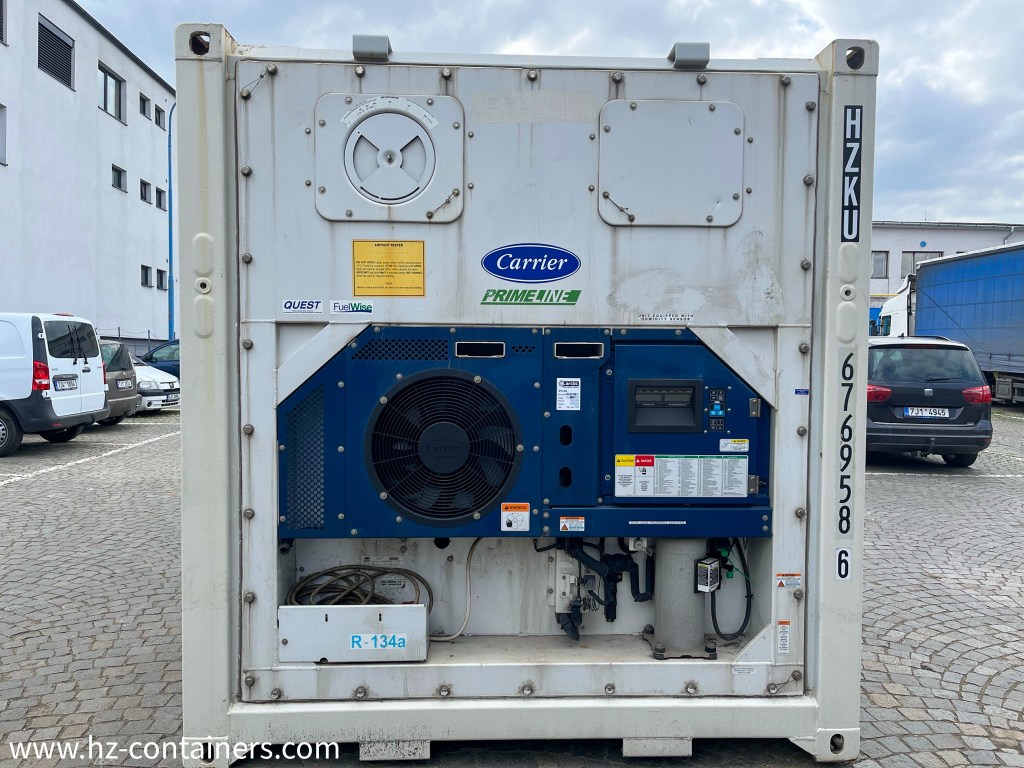
Connection to Network Infrastructure
- Distribution network: The safest and most economical power supply for long-term use. It is necessary to verify the availability of appropriate voltage and capacity.
- Transformer: If the required voltage is not available (e.g., only 230 V instead of 400/460 V), a “step-up” transformer with sufficient power is used (min. 15 kVA per unit).
Generators (Gen-sets)
- Use: During transport, in the field, or as backup power supply.
- Typical power: 15–20 kVA per container (recommendation of Thermo King and Maersk).
- Output stability: The generator must provide stable voltage and frequency, otherwise there is a risk of damage to the cooling electronics.
- Fuel tanks: For longer operation, an external fuel tank is recommended, autonomous operation 24–72 hours depending on consumption and load.
Power Supply on Ships and in Ports
- Reefer points: Special outlets (usually 460 V, 3-phase, 60 Hz) in ship containers and in port terminals; infrastructure sized for hundreds of units simultaneously.
- Automation: Modern ports use consumption monitoring, automatic cooling control, and remote monitoring of unit status.
Practical Recommendations for Installation
Site Preparation and Operating Principles
- Firm, level surface: Ensures proper door operation, condensate drainage, and stable compressor operation.
- Ventilation: Essential free space min. 1–2 m around the evaporator and condenser for efficient heat dissipation.
- Weather protection: It is recommended to cover the unit from direct rain and snow, especially during long-term operation.
- Regular maintenance: Filter cleaning, checking seal integrity, servicing electrical connections.
Professional Installation and Operator Obligations
- Always by a professional: Connection and inspection must be performed exclusively by a qualified electrician according to regulations and applicable European standards.
- Inspection report: After installation, an inspection report on the electrical equipment must be prepared.
- Responsibility: The operator is responsible for maintenance, regular inspections, and operational safety.
Energy Efficiency and Comparison with Diesel Operation
- Operating costs: Electrical power supply is significantly more economical than diesel generator operation (on average 2–4× lower energy costs).
- Ecology: Electric units produce no local emissions, are quiet, and suitable even for residential areas.
- Maintenance: Electrical solution has lower service requirements than diesel generators.
Specifics of Individual Manufacturers and Technological Trends
Thermo King, Carrier, Daikin, Starcool
- Top models: For example, Thermo King Magnum Plus, Carrier ThinLINE, Daikin LXE10E, Starcool – all support standard three-phase power supply, have their own overvoltage protection system, and advanced electronics enabling monitoring and remote management.
- Super Freezer: Special types allow temperatures down to –60 °C, require increased power source capacity, and often water cooling as well.
Modern Digital Technology
- Monitoring: Remote monitoring (IoT, GPS, telematics) enables real-time tracking of consumption, temperature, compressor status, and voltage.
- Automatic diagnostics: Modern units automatically detect incorrect connection, phase failure, overload, etc.
Most Common Errors and Practical Recommendations
- Insufficient circuit breaker rating: Too weak a circuit breaker leads to outages; too strong does not protect the equipment.
- Underestimating cable length and quality: Long or undersized cables cause voltage drop and can overheat insulation.
- Missing grounding: Critical safety deficiency.
- Inappropriate use of extension cords: Must meet at least the same parameters as the original cable, must not be a cable reel.
Final Summary
Proper connection of a Reefer shipping container is a complex professional discipline that requires knowledge of standards, correct selection and sizing of power supplies, protective elements, proven infrastructure, and exclusively professional installation. Compliance with these rules ensures safe and economical operation, long service life of the equipment, and protection of valuable cargo.

 Czech Republic, Prague
  FREE SHIPPING

