
How to Distribute the Weight of Goods in a Shipping Container?
Correct distribution of the weight of goods in a shipping container is one of the most crucial aspects of safe, efficient and cost‑effective transport. This issue is governed by international standards (CTU Code, SOLAS), requirements of carriers, insurers, as well as statutory limits of individual countries. Errors in weight distribution can lead to cargo damage, container overturning, violation of regulations, fines, and environmental disasters.
Key terms and definitions
| Term | Meaning |
|---|---|
| Tare Weight (Tare) | Weight of the empty container (e.g. 20ft: 2,300 kg, 40ft: 3,750 kg) |
| Payload (Useful load) | Maximum weight of cargo that may legally be loaded |
| Gross Weight | Total weight of the container including cargo and packaging |
| Verified Gross Mass (VGM) | Verified gross mass – mandatorily declared before loading on board according to SOLAS |
| Center of Gravity | Point at which the total weight of the cargo is concentrated |
| CTU Code | International code of practice for packing cargo transport units |
Types and dimensions of shipping containers
The most common are:
- 20ft standard container (6.1 m)
- Tare approx. 2,300 kg
- Max. payload: 28,180 kg
- Gross weight: 30,480 kg
- 40ft standard container (12.2 m)
- Tare approx. 3,750 kg
- Max. payload: 26,680 kg
- Gross weight: 30,480 kg There are also 10ft, 45ft, high‑cube, open top, flat rack, tank containers, and others. The choice of the correct type significantly affects the possibilities of weight distribution and the overall safety of transport.
Principles of correct weight distribution
1. Longitudinal and transverse balance
- The weight must be distributed as evenly as possible between the front and rear of the container (longitudinally).
- Likewise between the left and right sides (transversely).
- The cargo must not be concentrated at one end or on one side – risk of overturning, damage to the truck axle, or crane accidents.
2. Low center of gravity
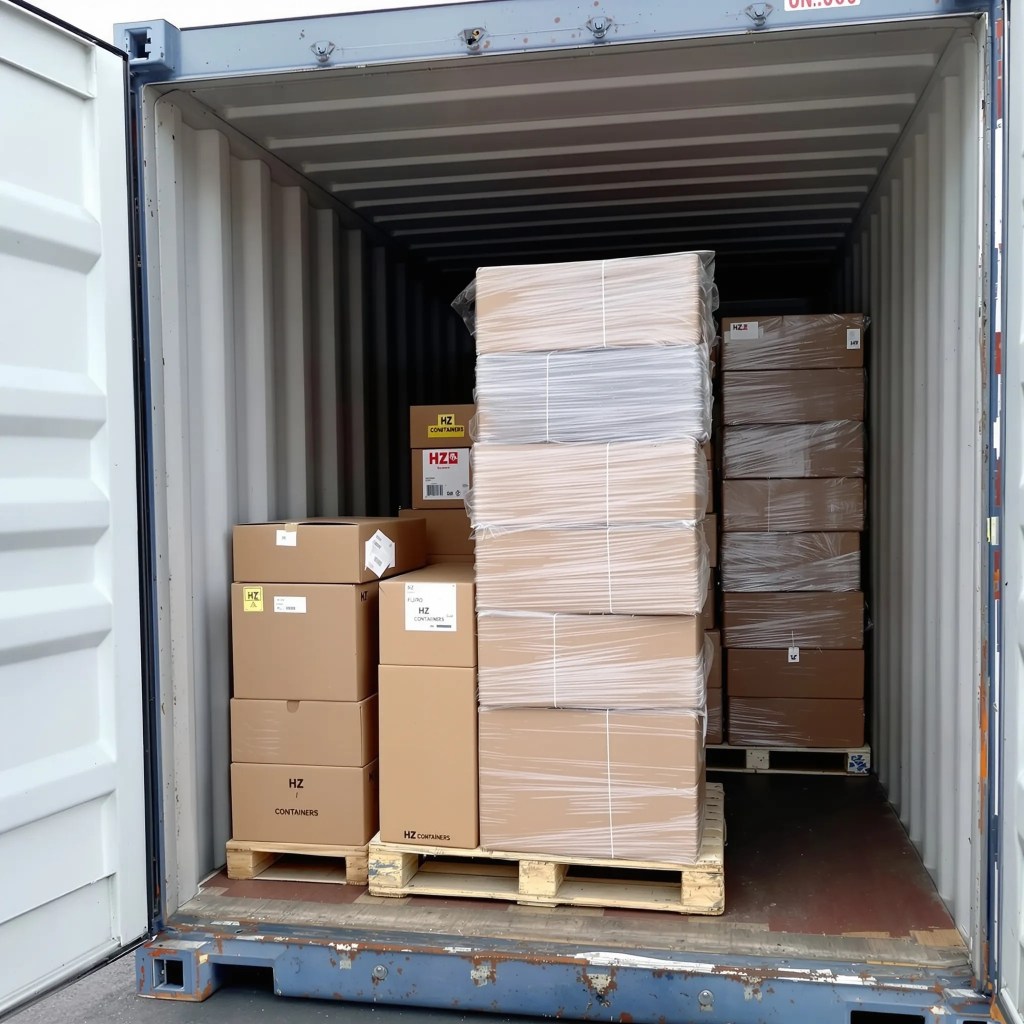
- Always place the heaviest items on the floor of the container.
- Lighter items go on top of heavier ones, or towards the walls or higher up.
- Lowering the center of gravity = higher stability during transport and handling.
3. The 60/50 rule (CTU Code)
- A maximum of 60% of the total cargo weight is allowed on 50% of the container length (from either end).
- This prevents extreme overloading of one half.
4. Even distribution across the entire floor
- Avoid “islands” of heavy cargo and large empty areas.
- If the shipment contains extremely heavy items (machines, steel coils etc.), use timber beams or similar to distribute point loads across multiple cross members under the floor.
Securing and fixing the cargo
Types of securing equipment:
- Dunnage: Inflatable dunnage bags, wooden beams, foam blocks, polystyrene, cardboard.
- Blocking & bracing: Wooden beams, stops, struts.
- Lashing: Polyester or textile straps, chains, ropes, ratchet straps – attached to lashing points in the floor/walls of the container.
- Shoring: Beams braced against the walls, securing heavy machinery.
- Anti‑slip mats: Increase friction between the cargo and the floor, reducing the risk of movement.
Why is securing so important?
- Forces during transport: Sudden braking, side impacts, ship motion in waves, lifting by crane – all this can cause cargo to shift by tens of centimeters if it is not properly secured.
- Statistics: According to logistics experts, up to 65% of cargo damage is caused by incorrect packing or securing.
Procedure for distribution and loading (step by step)
Phase 1: Planning
- Obtain dimensions and weight of all items (detailed packing list).
- Choose the appropriate type and size of container according to the type of goods (for example 20ft for heavy, 40ft for bulky, light goods).
- Technical inspection of the container (full functionality, dry, undamaged floor, intact door seals).
- Create a load/stowage plan – diagram or software (e.g. EasyCargo, Cargo‑Planner), visualize the layout, consider the center of gravity and unloading sequence.
Phase 2: Actual loading
- Follow the plan – do not improvise.
- Correct layering and filling of empty spaces (dunnage bags, blocks, polystyrene).
- Securing and lashing – all heavy items must be secured against movement.
- Regular inspection of distribution and securing during loading.
Phase 3: Inspection and documentation
- Calculation and declaration of VGM (weighing the entire container or summing items + tare).
- Completion of transport documents (including stuffing certificate).
- Sealing the container (seal, record the seal number in the documents).
Technical table: Container capacity and limits
| Container type | Tare (kg) | Max. payload (kg) | Max. gross (kg) | Internal dimensions (L x W x H, mm) |
|---|---|---|---|---|
| 20ft standard | 2,300 | 28,180 | 30,480 | 5,898 x 2,352 x 2,393 |
| 40ft standard | 3,750 | 26,680 | 30,480 | 12,032 x 2,352 x 2,393 |
| 40ft HC | 3,900 | 26,300 | 30,200 | 12,032 x 2,352 x 2,698 |
Note:
Always check the specific container data plate – values vary slightly by manufacturer and age.
Practical tips and common mistakes
- Never exceed the maximum payload or gross weight (check the CSC plate).
- Do not place heavy goods only against one wall or at the doors.
- Always take into account the axle limits of the tractor/trailer.
- For sensitive goods, pay attention to packaging (reinforced boxes, edge protectors, interlayers).
- Use specialized software to optimize loading.
- For heavy machinery always use spread supports across several floor cross members.
Frequently asked questions (FAQ)
Who is responsible for weight distribution?
Primarily the shipper, or the company that carries out the loading (packer/loader).
What are the risks of incorrect distribution/weighing?
Fines, refusal in port, cargo damage, risk of injury, environmental and financial liability.
What is the difference in capacity between a 20ft and 40ft container?
A 40ft has a higher tare weight, so its payload is lower than that of a 20ft, even though its volume is double.
Is it always necessary to create a detailed load plan?
Not for homogeneous palletized cargo; for mixed or heavy cargo a load plan is essential.
Where can I find regulations and standards?
CTU Code, SOLAS, national road transport laws.
Software tools for load planning
- EasyCargo – Czech interface, 3D visualization, Excel data import, center of gravity optimization.
- Cargo‑Planner – advanced algorithm, various container types, option to set unloading sequence.
- LoadCargo.in – free for smaller loadings.
Summary: Safe transport starts with correct weight distribution
Correct weight distribution in a shipping container is not just a matter of logistics, but also of safety, responsibility and economy. Always pay attention to current standards, use modern tools and never underestimate the planning phase!

 Dunajská Streda, Slovakia
  WITHOUT SHIPPING

