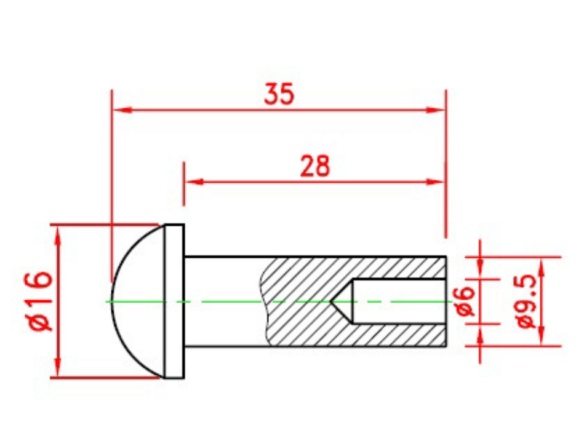
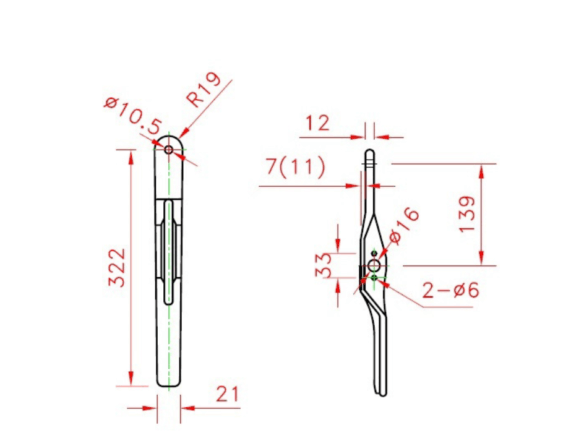
Anti‑Rack Ring
Anti‑rack ring is a small but essential steel component that is integrated into the locking mechanism of a transport container (ISO container). It is a specialized part from the “container door locking hardware” group, whose main function is to resist and eliminate deformation of the door frame – the so‑called “racking”. As a key item among container spare parts, the anti‑rack ring is absolutely necessary to maintain the structural integrity, safety and functionality of the container throughout its service life.
Catalog number: HZ000655
Basic characteristics
- Material: High‑strength structural steel (most commonly SS400, Q235B) or cast steel.
- Surface treatment: Always hot‑dip galvanised (Hot Dip Galvanised) or cold galvanising for maximum corrosion protection.
- Standard dimensions: Inner diameter 11 mm (7/16″), outer diameter according to rod type.
- Weight: 0.05–0.06 kg.
- Placement: 4 rings on each side of the door (total 8 per container), located right next to the bearing housings (brackets) of the locking rods.
- Compatibility: Standard 20′ and 40′ containers, High Cube and special types.
The anti‑rack ring is an integral part of every quality container and its proper function is one of the main signs of a safe and robust container for international transport.
Problem addressed: What is racking?
To appreciate the importance of the anti‑rack ring, it is necessary to understand the phenomenon called “racking”.
Racking – mechanism of container deformation
Racking refers to the deformation of a rectangular structure when the frame, under side or torsional forces, shifts into a parallelogram shape. In a container this effect occurs under dynamic loading, especially during:
- Maritime transport: The greatest risk – ships move in all six axes (roll, pitch, yaw, heave, surge, sway), causing extreme overloads in container corners.
- Crane handling: Uneven lifting distributes forces to the frame corners.
- Road and rail transport: Sharp turns, uneven surfaces and braking transfer forces to door frames.
- Uneven ground: Placing a container on an uneven surface causes permanent frame protrusion.
Consequences of the racking effect
| Problem | Description |
|---|---|
| Structural failure | Door‑frame deformation weakens the whole container, making it unsuitable for stacking and transport. |
| Inability to open doors | A protruding frame prevents opening/closing doors, often requiring destructive intervention. |
| Seal breach | Doors do not press evenly on the seal – gaps form, risking water ingress and cargo damage. |
| Loss of security | Protruding frame compromises locking mechanisms, increasing the risk of theft or opening in transit. |
| Accelerated wear | Repeated stress leads to cracks, material fatigue and reduced container lifespan. |
ISO standards (e.g., ISO 1496/1, ISO 1161) prescribe the maximum allowable deformation under side loading (e.g., 60 kN on corner posts), which the anti‑rack system helps to resist.
Principle of operation of the anti‑rack ring
The anti‑rack ring is a simple yet highly effective technical solution that uses basic mechanical principles.
Integration into the door locking system
- The container door is secured by two vertical locking rods (“rotary locking bars”) that are housed in several bearing brackets.
- Each rod has an anti‑rack ring at every bracket, which is either swaged (cold forged) or welded on.
- When the door is closed, the ring rests on a special seating surface on the bracket.
Operating mechanism
- Racking forces try to shift the door frame into a parallelogram.
- The locking rod with its ring begins to move within the bracket.
- Movement is stopped instantly when the ring hits the bracket’s seating surface.
- The force is transferred to the door panel and then through the hinges to the main corner posts – creating a “shear‑wall” effect.
- Securing both the upper and lower parts of the door completely eliminates the possibility of frame protrusion.
This system turns the door from a simple “lid” into a rigid structural element of the container.
Technical specifications and manufacturing
Materials
| Material | Properties | Use |
|---|---|---|
| SS400 | Construction steel, good weldability | Standard containers |
| Q235B | Excellent toughness, strength | Higher loads, special containers |
| Cast steel | High fatigue and fracture resistance | Special applications, extreme conditions |
Surface treatment
- Hot‑dip galvanising (HDG): 60–100 µm zinc layer, service life 20+ years even in marine environments.
- Cold galvanising: Cheaper, lower protection, suitable for storage containers.
- Special coating options: For extreme corrosion conditions.
Manufacturing technologies
| Method | Advantages | Disadvantages |
|---|---|---|
| Swaging / Cold forging | No thermal deformation, high strength, automatable | Requires special tooling |
| Welding | Easy field repair | Risk of deformation, brittleness |
Dimensional parameters
| Parameter | Value |
|---|---|
| Inner diameter | 11 mm |
| Outer diameter | 28–32 mm |
| Thickness | 7–10 mm |
| Weight | 0.05–0.06 kg |
Packaging and logistics
- Packed in sturdy woven bags, labelled with quantity.
- Parts are protected against moisture and corrosion during storage and transport.
Importance for container maintenance and repairs
The anti‑rack ring is a standard spare part; without it containers cannot pass CSC (Convention for Safe Containers) inspections. It is required on all containers intended for international transport.
- Typical replacement: When damaged, the entire locking rod is removed; the ring is usually welded on (or forged), or semi‑finished rings are used.
- Fault identification: Missing or deformed rings cause door protrusion, seal failure or inability to lock.
- Stock levels: Quality depots keep a full set of rings, brackets, levers, cams and rubber seals on hand.
- Compatibility: Most manufacturers follow ISO standards, making spare parts interchangeable (e.g., Seabox Depot, Esen Parts, Secure A Load).
Comparison with other anti‑rack systems
| Component | Principle | Location | Advantage | Disadvantage |
|---|---|---|---|---|
| Anti‑rack ring | Mechanical stop | All brackets on the rod | Highest efficiency, full integration | Requires precise installation |
| Anti‑rack plate | Heavy steel plate | Mid‑section of the door | Easy install, reinforces centre | Does not protect the whole frame |
| Lock box | Lock cover | Over internal rods | Increases security, sometimes adds rigidity | Primarily lock protection |
Impact on transport safety and container value
- Seal integrity: Doors always press firmly against the seal, protecting valuable or sensitive cargo from water and dust.
- Theft protection: A functioning anti‑rack system ensures all locks work properly – containers remain securely locked.
- Extended service life: Reduces wear on frames, hinges and locking mechanisms, prolonging container life to 25 years or more.
- Higher resale value: A functional anti‑rack system is a hallmark of a “high‑quality shipping container” on the second‑hand market.
Frequently asked questions (FAQ)
How many anti‑rack rings are on a single container?
A standard container has two doors; each door has two locking rods, each rod has two brackets and two rings. Total: 8 anti‑rack rings per container.
Is it safe to use a container with a missing anti‑rack ring?
Absolutely NOT! A missing or damaged ring means a structural defect. The container will fail inspection, may deform, leak and be harder to lock.
What is the difference between an anti‑rack ring and an anti‑rack plate?
The ring is a small mechanical stop on each rod, while the plate is a large steel reinforcement placed in the middle of the door. Both eliminate racking, but the combination offers the best protection.
How is an anti‑rack ring replaced?
The locking rod is removed, the original ring is cut off or swaged out, and a new ring is welded or swaged on. The work must be performed by qualified service personnel.
Overview of technical parameters (table)
| Name | Material | Surface | Inner diameter | Weight | Compatibility | Service life |
|---|---|---|---|---|---|---|
| Anti‑rack ring | SS400/Q235B | HDG | 11 mm | 0.05–0.06 kg | 20′/40′/HC | 20+ years |
Related standards and recommendations
- ISO 1496/1 – Container construction requirements, racking effect tests
- ISO 1161 – Corner pieces and connectors
- CSC (Convention for Safe Containers) – Mandatory inspection and repair records
 Czech Republic
  WITHOUT SHIPPING