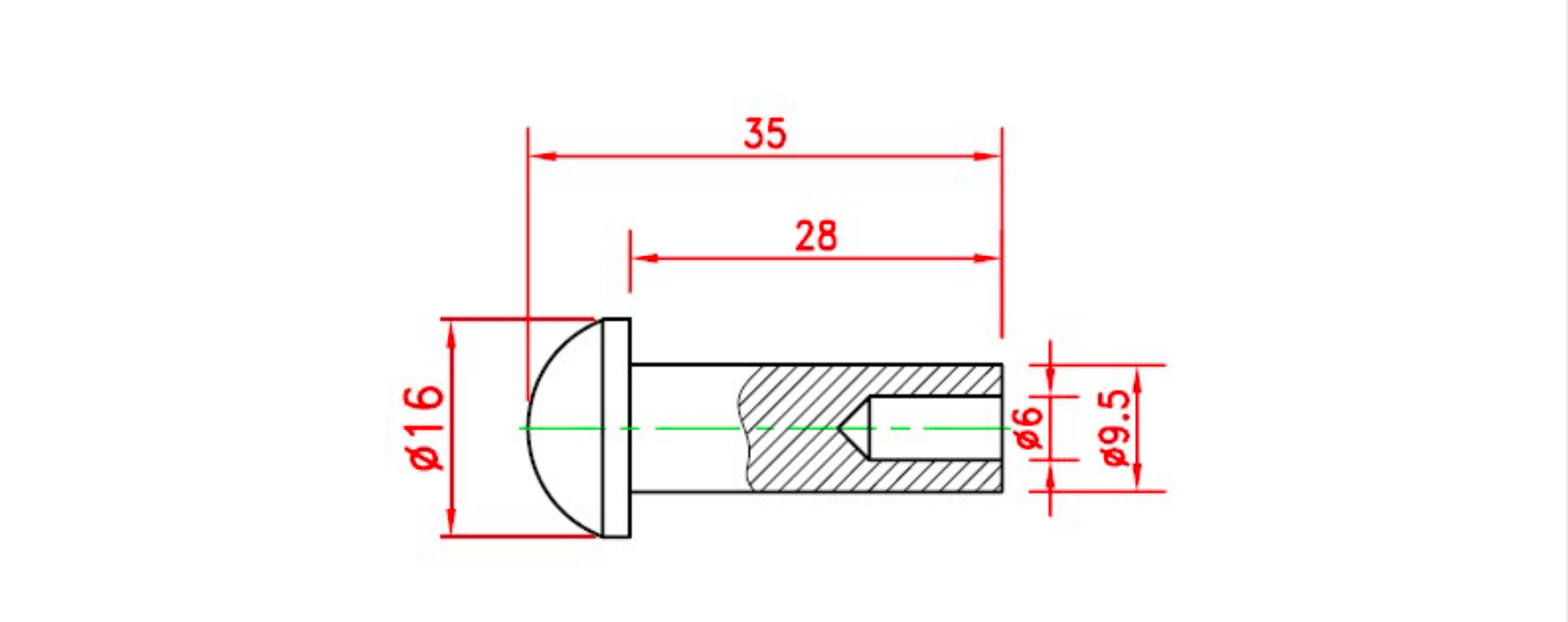
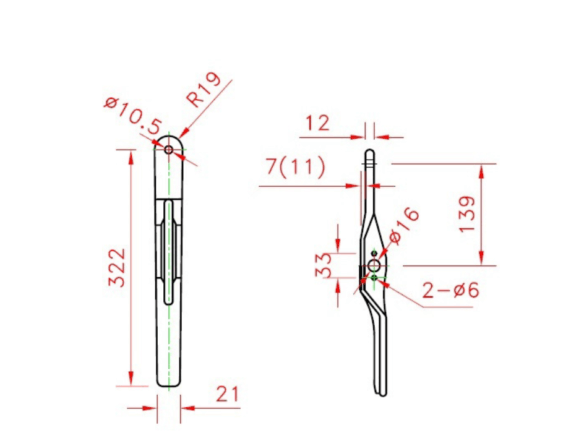
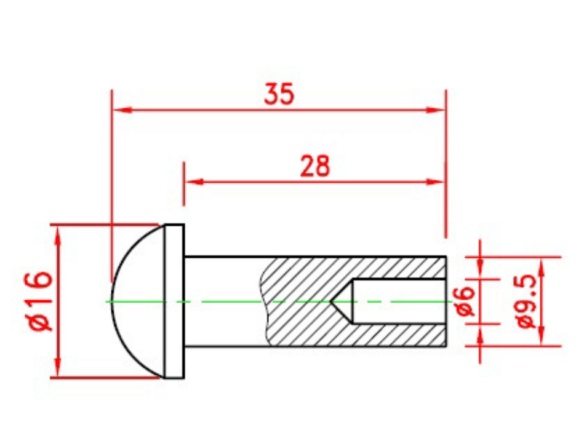
Spare part for the shipping container door No. 11 – Bush & Rivet – door handle bushing
 Czech Republic
  WITHOUT SHIPPING
 Small parts with huge significance for world trade
Transport containers are the cornerstone of global logistics. Their robust construction enables safe transport of goods by sea, rail and road. Although their strength and durability stem from massive steel frames and panels, tiny components also play a key role in ensuring reliable operation in everyday use. Among these indispensable parts is the Bush & Rivet spare part, the silent hero of container‑door mechanisms. Their proper function is essential for safe closing and opening of doors, protecting cargo and meeting strict international transport standards.
What is “Bush & Rivet” in containers? Detailed definition and purpose
Definition
- Bush & Rivet is a set of two components:
- Bush: serves as a sliding bearing in the rotating mechanisms of the door handle and locking rods.
- Rivet: a permanent fastener that secures the bush and other mechanism parts.
Location in the container
- The bush and rivet are located in the rotating joints of the door handle, specifically where the handle operates the locking rod and transmits force to the cams at the top and bottom of the door.
Function
| Component | Main purpose | Reason for use |
|---|---|---|
| Bush | Reduces friction, absorbs wear, defines precise position | Enables smooth movement and long service life |
| Rivet | Permanent and secure connection, high shear strength | Prevents loosening under vibration and handling |
Materials, standards and surface treatments
Materials
- Steel: Almost all original Bush & Rivet parts are made from high‑strength steel. Cast steel is commonly used for bushings, while cold‑formed steel is used for rivets to combine strength and ductility.
Surface treatments
- Galvanizing (zinc coating): The most common corrosion protection, either zinc‑plated or hot‑dip galvanized. The zinc layer shields against salt water, moisture and weather.
- Anti‑corrosion paints: Some manufacturers add protective paint or special coatings to extend service life.
Standards and certifications
- ISO 6346, ISO 1496: Bush & Rivet must meet dimensional and material standards for containers according to ISO.
- Manufacturer certifications: ISO 9001 (quality management), classification society approvals (ABS, BV, CCS).
Dimensions and variants of Bush & Rivet
Typical dimensions
| Container type | Bush diameter (mm) | Bush length (mm) | Rivet diameter (mm) | Surface treatment |
|---|---|---|---|---|
| 20′/40′ Dry | 10–12 | 25–32 | 8–10 | Hot‑dip galvanized |
| Reefer (refrigerated) | 12 | 30 | 10 | Zinc plated |
| Special/Heavy‑duty | 14 | 35 | 12 | Galvanized + paint |
Dimensions are based on common manufacturer catalogs and may vary slightly by maker and container type.
Variants by application
- Standard Bush & Rivet – for ordinary doors of dry and storage containers.
- Reinforced variants – for containers subjected to higher loads, e.g., heavy‑industry or military containers.
- Special coatings – for use in extremely corrosive environments (e.g., chemical containers).
Detailed analysis of function and advantages
Why is correct Bush & Rivet function critical?
- Prevents door jamming, which could make it impossible to open/close the container.
- Reduces vibration and noise during door operation.
- Protects the main handle and locking rod from wear, extending the life of the whole assembly.
- Lowers the risk of play that could compromise sealing, security and cargo protection.
Advantages of rivets over screws
- Rivets create a non‑removable, extremely strong joint.
- They are more resistant to vibration (rail, road, sea transport).
- Blind rivets can be installed from one side, speeding up service in confined spaces.
Installation, replacement and maintenance of Bush & Rivet
Replacement procedure (standard repair)
- Remove the worn part: Drill out the old rivet with a metal drill bit.
- Extract the bush: After the rivet is removed, the bush can be pulled out easily.
- Insert the new bush: Place the new part in position.
- Rivet: Install the new rivet using a rivet gun or professional rivet tool. Blind rivets do not require rear access.
- Function check: Verify smooth operation of the handle and locking rod without excessive play.
Recommended inspection frequency
- At least with every major container repair (door, locking rod, floor).
- Generally every 2–5 years, depending on usage intensity and environmental conditions (frequent exposure to moisture/salt).
Common reasons for replacement
- Wear and ovalisation of the bush (handle wobble).
- Corrosion damage, especially on older containers lacking quality galvanising.
- Damage from improper interventions in the door system.
Production and quality: How to recognise a quality part?
Modern manufacturing technologies
- Precision machining: CNC machines ensure maximum accuracy and minimal tolerances.
- Quality control: Each batch undergoes hardness testing, dimensional verification and adhesion checks of surface treatments.
- Testing: Reputable makers perform shear and tensile tests on rivets and durability tests on bushings under simulated conditions.
Proven brands and suppliers
- CIMC Equilink – one of the world’s largest container‑part suppliers.
- Shanghai Ziyan Container & Parts Co., Ltd. – specialist in locking mechanisms and fasteners.
- Shouguang Esen Wood Co., Ltd. – supplies not only plywood but also complete Bush & Rivet series with FSC and ISO certifications.
- Manufacturers audited by third parties and highly rated by customers (check B2B platforms such as Made‑in‑China, Alibaba).
Identification and purchase: How to choose the right Bush & Rivet
Catalog marking
- Each part has a unique designation (e.g., “ISO Dry Container Bush Rivet 10×25 mm Galvanized”).
- When ordering online, the photo, drawing with dimensions and surface‑treatment note are crucial.
- Buy from suppliers that provide certificates and detailed technical data sheets.
Online buying: What to watch for
- Photographic documentation – clear images from several angles, with scale.
- Technical parameters – explicit dimensions, material, type of zinc coating, possibly a serial number.
- Customer feedback – reviews on B2B platforms.
- Comparison tools – many catalogs let you add several products to a comparison basket.
- Fast supplier contact – instant inquiry or online chat is common on platforms like Made‑in‑China.
Related components of the container door system
| Component | Function and significance |
|---|---|
| Handle | Operates rotation of the locking rod |
| Handle hub | Secures the handle in the door frame |
| Locking bar | Transfers force to the cams, securing the door |
| Cam | Engages the keeper, mechanically locking the door |
| Keeper | Holds the cam in the container frame |
| Plywood flooring (container flooring) | Additional key part for container strength and longevity |
Frequently asked questions (FAQ)
How do I know when the Bush & Rivet needs replacement?
If the door handle feels loose, moves with difficulty, or you hear metal grinding, the bush is likely worn.
Can a universal Bush & Rivet be used for all containers?
Not always. Use parts that are certified and specified for the exact container type according to ISO, as dimensions may differ.
Must the rivet always be zinc‑coated?
Yes, surface treatment is essential for corrosion resistance, especially for containers used in maritime transport.
Can the replacement be done DIY?
The replacement is technically straightforward but requires proper tools (metal drill, rivet gun) and safety precautions.
Conclusion: The indispensability of small Bush & Rivet parts
Without a quality, correctly installed bush and rivet, container door systems would fail quickly. These components are vital for daily reliability, safety and the long service life of transport containers worldwide. When selecting and purchasing them, pay attention to certifications, material, surface treatment and supplier reputation.
Catalog number: HZ000255
Price and shipping
Price is listed per unit, excluding shipping. You can arrange delivery by courier or pick up personally at our facility in Třebíč, Czech Republic. Shipping cost depends on order quantity and destination country. We ship only within Europe.
If interested, please send an inquiry including the desired quantity via the form below.
Always provide a phone number, country, city + ZIP code for delivery so we can calculate shipping costs.
We will send you a complete quotation including transport.
We offer all spare parts for maritime containers. Parts are in stock and can be dispatched immediately. Larger quantities are available on request.
All information, services and prices are subject to change. Prices are indicative; we always charge based on actual costs.
 Czech Republic

Send inquiry
Shipping container colors
RAL 1001 RAL 1003 RAL 1014 RAL 1015 RAL 1018 RAL 1023 RAL 2001 RAL 2008 RAL 2011 RAL 3000 RAL 3001 RAL 3002 RAL 3009 RAL 3013 RAL 3020 RAL 4008 RAL 5003 RAL 5005 RAL 5010 RAL 5011 RAL 5013 RAL 5017 RAL 6005 RAL 6007 RAL 6018 RAL 6029 RAL 6031 RAL 6038 RAL 7000 RAL 7004 RAL 7005 RAL 7012 RAL 7015 RAL 7016 RAL 7021 RAL 7024 RAL 7031 RAL 7032 RAL 7035 RAL 7036 RAL 7037 RAL 7038 RAL 7040 RAL 7042 RAL 8004 RAL 8008 RAL 9003 RAL 9004 RAL 9005 RAL 9010 RAL 9016 CAMOUFLAGEQUESTIONS & ANSWERS TO THE MOST FREQUENTLY ASKED QUESTIONS:
We always guarantee the size, quality, and specific type of container including the pickup location of your choice.
Why is it not possible to access the depot to inspect the container? And for what reason is it not possible to take photos of the container from the depot?
How does the self-pickup of a container from the depot work?
What if the container we came to pick up at the depot does not match the condition and quality we ordered?
Afraid of being scammed and not receiving the container? Many questions are answered in our article container purchase scams.
You can find out how to arrange for the unloading of a shipping container here.
The photos are for illustrative purposes only. Detailed information about the properties of shipping containers can be found here: shipping container quality