
Where is the year of manufacture of a shipping container stamped?
Year of manufacture of a shipping container (in international terminology referred to as YOM – Year of Manufacture) is one of the most important data in the life cycle of every shipping container. This data is a key parameter that affects not only age, but also value, suitability for international transport, planning of mandatory inspections and last but not least the safety and price of the container.
Where exactly will you find this data?
The year of manufacture is always stamped on the safety CSC plate (CSC plate), which is permanently attached to the container – almost always on the outside of the left doors.
Knowledge and correct interpretation of the year of manufacture is key for anyone working with containers:
- logistics managers, carriers, freight forwarders, inspectors
- buyers and traders
- end customers (companies and individuals) looking for reliable solutions for storage, modular construction or other purposes
The date of manufacture determines the schedule of mandatory safety inspections, classification into sales categories (new, used, like-new) and has a direct impact on the market value of the container. At the same time, it is the cornerstone for legal use of the container in international transport.
Detailed guide to the CSC plate – Container birth certificate
What is a CSC plate?
CSC means Convention for Safe Containers – Convention for Safe Containers, adopted in 1972 under the auspices of the International Maritime Organization (IMO) and the UN. The aim is to ensure uniform, internationally recognized safety regulations for the design, testing, inspection and maintenance of containers.
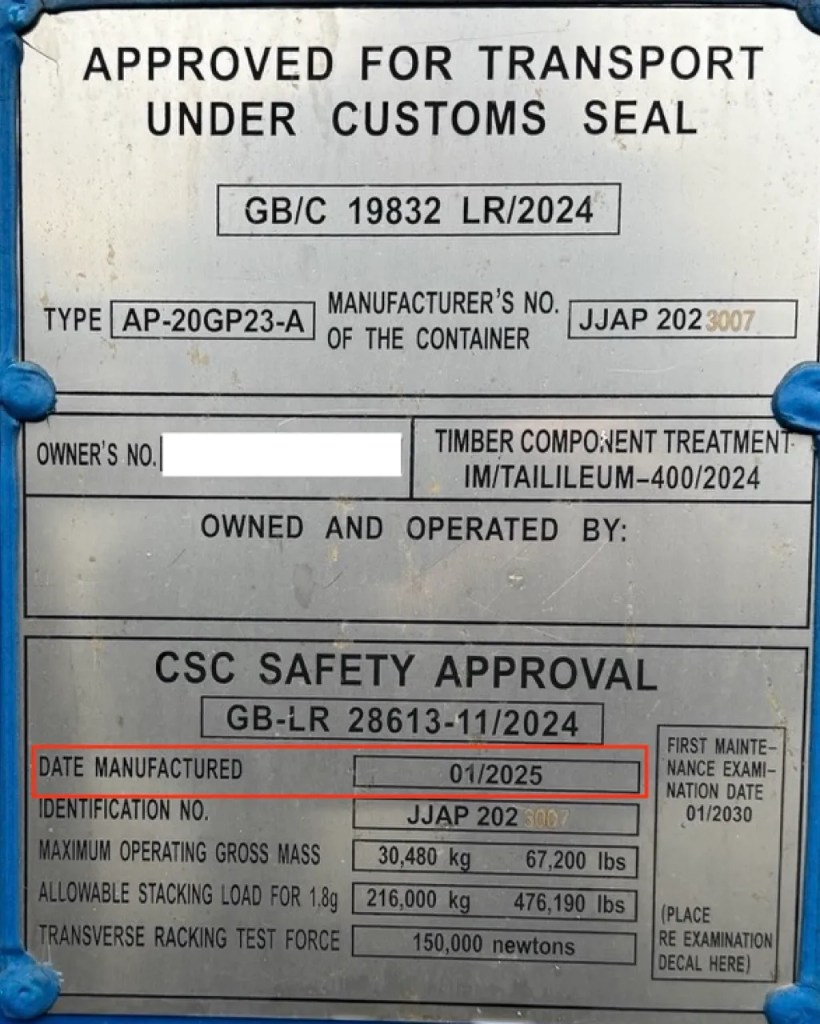
Key functions of the CSC plate:
- Official confirmation of compliance – the container meets strict international (ISO) standards and strength requirements.
- Safety certification – proves that the container has passed mandatory tests and is safe for stacking, handling and transport.
- Legal basis – without a valid CSC plate, the container cannot be loaded onto a ship in international transport.
- Transparent information source – contains all key technical and identification data, including year of manufacture.
CSC plate standards and dimensions:
- Material: permanently durable, non-corroding metal (stainless steel/aluminum)
- Durability: fire-resistant, anti-corrosion
- Location: always on the outside of the left doors
- Size: minimum 200 × 100 mm
- Text: permanently stamped/embossed, minimum font height 8 mm for “CSC SAFETY APPROVAL”, other data min. 5 mm, contrasting color
What does the CSC plate contain?
The layout and content are strictly standardized, although minor variations exist depending on the manufacturer. The CSC plate always contains:
| Field on plate | Meaning and description |
|---|---|
| Header: CSC SAFETY APPROVAL | Identifies the purpose of the plate – approval for safe transport |
| Country of approval & reference number | Country where the type was approved (e.g. GB, USA) + certification authority number (Bureau Veritas, Lloyd’s etc.) |
| Date of manufacture (DATE MANUFACTURED) | Key field! Always in MM/YYYY format (e.g. 05/2024), stamped directly on the plate |
| Manufacturer’s ID | Manufacturer’s serial number, or in case of missing number, operational number according to BIC code |
| Max. gross weight (MAX GROSS) | Highest permitted weight of container including cargo (kg and lbs) |
| Stacking load | Maximum weight that can be loaded from above when stacking (essential for stability at sea) |
| Racking test load value | Resistance of structure to lateral forces (during ship movement, handling) |
| Date of first inspection | Latest deadline for first mandatory safety inspection (max. 5 years from manufacture) |
| Records of further inspections | Dates of regular inspections (interval max. 30 months), confirmed by stamping or sticker |
Photo and example

Combined Data Plate
Modern containers often carry a so-called Combined Data Plate, which integrates:
- CSC plate – safety approval
- Customs plate (CCC) – enables transport under customs seal
- Wood treatment plate (TCT/ISPM 15) – confirmation of floor treatment against pests
- Optionally: Owner plate (BIC code)
How is inspection carried out and what is the validity of the CSC plate?
There are two inspection regimes, both determining the validity of the CSC plate:
- Periodic Examination Scheme (PES):
- First inspection: no later than 5 years from the date of manufacture (stated on the plate)
- Further inspections: at intervals not exceeding 30 months (2.5 years)
- Date of next inspection is always marked on the plate (“NED” – Next Examination Date)
- Approved Continuous Examination Programme (ACEP):
- Regular inspection as part of an approved program, conducted by the owner or operator
Without a valid inspection and CSC plate, the container cannot be used in international transport!
Where exactly on the container will I find the CSC plate?
The CSC plate is always attached to the outside of the left (rear) doors of the container. The plate is rectangular (min. 200 × 100 mm), made of stainless steel or aluminum, riveted or bolted, with permanently stamped data.
Thanks to this position, it is easily accessible to inspectors, port workers and transport workers as well as customers.
How to correctly read the information on the CSC plate?
Example:
| Field on plate | Example value | Meaning |
|---|---|---|
| CSC SAFETY APPROVAL | – | Safety approval |
| GB-LR 12345 | GB = United Kingdom | Reference number |
| DATE MANUFACTURED | 05/2024 | Year and month of manufacture |
| MANUFACTURER’S ID No. | ABCD1234567 | Manufacturer’s serial number |
| MAXIMUM GROSS WEIGHT | 32,500 kg / 71,650 lbs | Max. permitted weight |
| ALLOWABLE STACKING WT | 192,000 kg | Max. stacking load |
| RACKING TEST LOAD VALUE | 15,240 kg | Racking test load |
| FIRST MAINTENANCE EXAM | 05/2029 | First inspection within 5 years |
Context: Why is the year of manufacture so crucial?
Life cycle of a shipping container
- Active transport (approx. 10–15 years):
- Intensive use in international logistics – exposure to extreme conditions (salt, UV, vibration)
- Date of manufacture is the starting point for inspection schedule and CSC validity
- ISO standards guarantee compatibility worldwide
- Second life (another 10–20+ years):
- Static use: storage, building units such as shipping container homes and container houses, offices, modular construction, architecture, emergency facilities
- Older containers (after retirement from transport) are still fully functional for non-transport purposes
Impact on price and container classification
Year of manufacture significantly affects market value and classification into categories:
| Category | Description |
|---|---|
| New/One-Trip | Year of manufacture in current/previous year, one-way trip from factory, perfect condition |
| IICL | Strict standard, typically up to 5 years old, minimal wear, valid CSC |
| Cargo Worthy (CW) | Suitable for transport, valid CSC, often 10–12 years old, possible signs of wear |
| Wind & Watertight | Resistant to wind/water, no valid CSC, suitable for storage |
| As-Is | No warranty, possible defects, heavy wear, lowest price |
Safety and regulatory requirements
The entire CSC system is built on the date of manufacture and regular inspections.
Without a valid plate and inspection, the container cannot be used in international transport!
- Responsibility: Owner/operator is responsible for the condition and inspection of the container
- Accident investigation: CSC validity and inspection history are key in accidents or damage
- Regular checks: First within 5 years, then max. every 30 months (or within ACEP)
Other identification elements on the container
Some data on the container should not be confused:
- Container code (ISO 6346) – capital letters and numbers on sides/doors:
- 3-letter BIC code of owner + U + 6 digits + check digit
- Year of manufacture is NOT part of the main code!
Container manufacturing: Materials, processes, standards
Materials
| Component | Material/description |
|---|---|
| Walls, roof | Corrugated panels made of CORTEN steel (highly weather-resistant steel) |
| Frame | Steel I-profiles, square tubes |
| Corner elements | High-strength steel castings for handling and stacking |
| Floor | Marine plywood (thickness 28 mm), or bamboo |
| Surface finish | Sandblasting, anti-corrosion primer, 2 coats of paint, marine paint |
Manufacturing process:
- Panel manufacturing: cutting, sandblasting, profiling (corrugation) of CORTEN steel
- Frame welding: assembly of base from I-profiles and tubes, welding of walls and roof
- Assembly of corner castings, doors, ventilation
- Floor installation (marine plywood, chemically treated)
- Painting and surface finishing: 2–3 coats (primer + topcoat)
- Quality tests: water tightness, strength, inspection according to ISO and CSC
- Attachment of CSC plate + other data plates
95%25 of world container production comes from China (Shanghai, Shenzhen, Qingdao)
Service life of a quality container: 20–30 years (thanks to CORTEN steel properties and regular maintenance)
Historical context
The modern shipping container is the result of Malcolm McLean’s vision from the 1950s, who revolutionized global transport by standardizing shipping boxes. ISO standards (from 1968) and the CSC Convention (from 1972) enabled unified handling, storage and transport of millions of containers across continents.

 Czech Republic, Hodonín
  FREE SHIPPING


Other container news...

Shipping containers Považská Bystrica Slovakia
Shipping containers in Považská Bystrica represent a key solution for storage, transportation and modern construction projects in Slovakia. This article will provide you with a comprehensive overview of what shipping containers are, how they are used in Považská Bystrica and what services are available in this area.

Shipping containers Nové Zámky Slovakia
Shipping containers in Nové Zámky are a key part of modern logistics and transport in Slovakia. As standardized steel units, shipping containers enable efficient transportation of goods over long distances with minimal costs and maximum protection. Nové Zámky, as an important urban center in western Slovakia, has become a major center for the sale, rental and distribution of shipping containers due to its strategic location and good connections to the transport infrastructure.

Shipping Containers Nové Mesto nad Váhom – Slovakia
Shipping containers in Nové Město nad Váhom represent a modern solution for storage, logistics and transport of goods. As one of the most important transport hubs in Slovakia, Nové Město nad Váhom offers comprehensive services with shipping containers including sales, rental and transport. This guide will provide you with a detailed overview of how shipping containers work, what their advantages are and how to use them effectively in this location.

Shipping Containers Nitra – Slovakia
Shipping containers are an integral part of the global trade network and represent one of the most important innovations in the history of transportation. These standardized shipping units enable the efficient transport of goods around the world and have become the backbone of modern logistics. Whether you are looking for shipping containers in Nitra or elsewhere, understanding their functions and applications is key to any logistics project.