
Shipping containers Dortmund Germany
Dortmund, the industrial heart of Germany’s Ruhr region, has become an increasingly sought-after destination for those interested in shipping containers in recent years. Definition: A shipping container (also called a maritime container, ISO container) is a standardized transport unit made of Corten steel, designed primarily for intermodal transport of goods — that is, by ship, train, and truck. Beyond logistics, it finds wide use as storage space, a construction cabin, a workshop, or as a base for modular architecture.
Why Buy Shipping Containers in Dortmund and the Surrounding Area?
The answer to this question lies in the geography and economy of the region. Dortmund is located in North Rhine-Westphalia (Nordrhein-Westfalen) — Germany’s most populous and economically strongest federal state. This region is home to a dense network of industrial enterprises, logistics centers, and above all, one of the largest inland ports in the world.
The Logistics Significance of the North Rhine-Westphalia Region
The Ruhr area (Ruhrgebiet), of which Dortmund is an integral part, represents one of the most densely populated industrial agglomerations in Europe. The city of Duisburg plays a key role here — its inland port (Duisport) handles over 120 million tons of goods annually and is connected to the seaports in Rotterdam, Antwerp, and Hamburg. Containers that arrive here via the Rhine continue on to warehouses and depots spread throughout the entire region, including Dortmund.
It is precisely this logistics infrastructure that creates an environment where the supply of shipping containers is extraordinarily rich — from nearly new pieces after single voyages (ONE WAY) to used containers in various degrees of wear.
What Types and Sizes of Shipping Containers Can Be Purchased in Dortmund?
The range of containers in Dortmund covers practically the entire spectrum of ISO containers — from compact 10-foot models to massive 45-foot High Cube units. The following overview will help you orient yourself in what each type offers and what use it is suitable for.
Standard Container Types
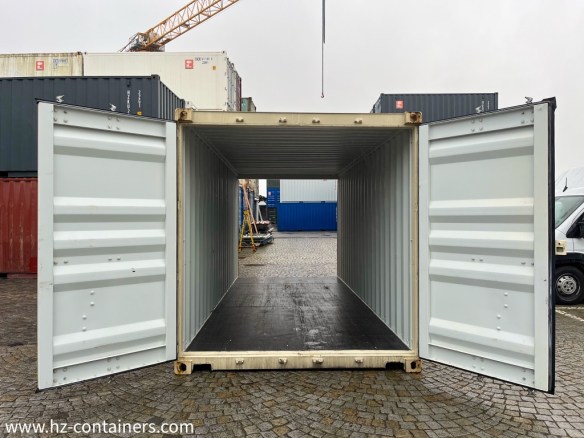
The most common type you will encounter in Dortmund is Dry Van (DV) — an enclosed steel container with double-wing doors on one front side. It forms the backbone of global container transport and at the same time the most frequent choice for storage purposes.
In addition to Dry Van containers, the following special types are also commonly available in Dortmund:
- High Cube (HC) — A standard container with a height increased by 30 cm (2,896 mm instead of 2,591 mm). Ideal for storing bulkier items or for conversion into living space, where you will appreciate every extra centimeter of height.
- Open Top — A container with a removable tarpaulin roof. Allows loading from above by crane — indispensable for oversized cargo.
- Flat Rack — A container without side walls and roof, only with solid front walls and a floor. Designed for heavy and oversized goods.
- Reefer (refrigerated container) — A thermally insulated container with an integrated cooling unit. Available in Dortmund both new and used — often used as an air-conditioned warehouse.
Sizes and Dimensions – from 10′ to 45′ HC
The following table summarizes the basic parameters of the most commonly offered sizes:
| Container Type | External Length (mm) | External Width (mm) | External Height (mm) | Internal Volume (m³) | Max. Load Capacity (kg) |
|---|---|---|---|---|---|
| 10′ Standard | 2,991 | 2,438 | 2,591 | ~14 | ~10,000 |
| 20′ Standard (DV) | 6,058 | 2,438 | 2,591 | ~33 | ~28,000 |
| 20′ High Cube | 6,058 | 2,438 | 2,896 | ~37 | ~28,000 |
| 40′ Standard (DV) | 12,192 | 2,438 | 2,591 | ~67 | ~26,500 |
| 40′ High Cube | 12,192 | 2,438 | 2,896 | ~76 | ~26,500 |
| 45′ High Cube | 13,716 | 2,438 | 2,896 | ~86 | ~28,000 |
The most sought-after sizes in Dortmund are the 20′ Standard (for smaller businesses and individuals) and the 40′ High Cube (for large-volume storage). The 40′ HC precisely offers the best price ratio per cubic meter of usable space.
Condition Categories – New, ONE WAY, Used, AS IS
When buying in Dortmund, you will encounter several condition categories that fundamentally affect both the price and the lifespan of the container:
- NEW (New / One-Trip) — A container that has completed only one voyage from the Chinese factory to Europe. Practically no signs of wear, no corrosion, with intact sealing and a smooth surface. Price highest, lifespan 15–25 years.
- ONE WAY (CWO — Cargo Worthy) — A container after one sea voyage with cargo. Very good condition, minimal cosmetic defects. Certified as fit for transport. Best price/performance ratio.
- IICL — A used container meeting the strict standards of the Institute of International Container Lessors. Repaired, but fully functional, leak-free, with a valid CSC certification.
- AS IS (WWT — Wind and Water Tight) — A used container sold “as is.” It may have surface rust, small dents, but must be waterproof and wind-resistant. Suitable for undemanding storage.
- UNSUITABLE FOR TRANSPORT — A significantly worn container without valid certification. Lowest price, suitable only for static storage at your own risk.
Practical tip: For most customers, the ideal choice is the ONE WAY or IICL category. You get a container in very good condition at a price significantly lower than a new piece, while a lifespan of 10–15 years is more than sufficient for storage purposes.
How Much Do Shipping Containers Cost in Dortmund?
The prices of shipping containers in Dortmund depend on a combination of three main factors: size, condition category, and the current market situation. At the time of writing this guide (June 2026), prices are within the following ranges. The amounts given are exclusive of VAT — German sellers standardly quote prices excluding tax (net), and VAT at 19% is only added when the invoice is issued.
Approximate Price List by Type and Condition
| Container Type | Condition | Price (EUR, excl. VAT) | Approximate Price (CZK, excl. VAT) |
|---|---|---|---|
| 10′ Standard | New / ONE WAY | 3,000–3,500 € | ~73,000–85,000 CZK |
| 10′ Standard | Used (AS IS) | 1,800–2,500 € | ~44,000–61,000 CZK |
| 20′ Standard | New | 3,500–4,500 € | ~85,000–110,000 CZK |
| 20′ Standard | ONE WAY / IICL | 2,200–3,000 € | ~54,000–73,000 CZK |
| 20′ Standard | Used (AS IS) | 1,200–1,800 € | ~29,000–44,000 CZK |
| 40′ Standard | New | 5,000–6,500 € | ~122,000–159,000 CZK |
| 40′ Standard | ONE WAY / IICL | 3,000–4,500 € | ~73,000–110,000 CZK |
| 40′ Standard | Used (AS IS) | 1,800–2,800 € | ~44,000–68,000 CZK |
| 40′ High Cube | New / ONE WAY | 4,000–5,500 € | ~97,000–134,000 CZK |
| 40′ High Cube | Used (AS IS) | 2,000–3,200 € | ~49,000–78,000 CZK |
The conversion to Czech crowns is approximate (exchange rate ~24.40 CZK/EUR, June 2026). The actual price in Czech crowns depends on the current exchange rate and your bank’s conditions for SEPA payments.
How Does the Transport of a Shipping Container from Dortmund to the Czech Republic Work?
Transporting a container over a distance of approximately 650 kilometers (Dortmund–Prague) is not complicated, but it does require some preparation. Several transport scenarios are available.
Transport Options
- Self-pickup — If you have a truck with a load capacity corresponding to the weight of the container (an empty 20′ container weighs ~2,200 kg, 40′ ~3,800 kg), you can pick up the container yourself. Most depots in Dortmund have a crane or forklift for loading. This option is the cheapest, but it requires your own equipment and time.
- Freight service with a hydraulic arm — The most common choice for customers. A specialized carrier will come to the depot in Dortmund, load the container using a hydraulic arm (HA), and deliver it directly to your address in the Czech Republic. The advantage is that there is no need to arrange a crane at the destination — the hydraulic arm unloads the container itself.
- Container flatbed trailer with an external crane — For larger orders (multiple containers at once), flatbed transport can be used. However, it requires arranging a crane or forklift at the unloading site.
Approximate Prices and Time Frame for Transport
The transport prices of a container from Dortmund to the Czech Republic vary depending on the carrier, container type, and exact location:
| Type of Transport | Approximate Price (excl. VAT) | Transport Time |
|---|---|---|
| 20′ container, HA vehicle | 8,000–12,000 CZK | 1–2 days |
| 40′ container, HA vehicle | 10,000–15,000 CZK | 1–2 days |
| 2× 20′ at once | 14,000–19,000 CZK | 1–2 days |
| Express transport | +30–50% | Within 24 hours |
The actual Dortmund–Prague route can be covered in 6–7 hours of pure driving, but realistically count on 1–2 days depending on the carrier’s workload and the loading time at the depot. Most German depots require prior arrangement of a loading appointment — do not go without notice.
Alternatives to Dortmund – Other German Cities for Purchasing Containers
Dortmund represents an excellent starting point, but it is not the only place in Germany where shipping containers can be purchased. If you cannot find the required type in Dortmund or want to compare more offers, consider the following locations.
Düsseldorf, Essen, Duisburg, Cologne
All these cities lie within a radius of 30–80 km from Dortmund and form a continuous Rhine-Ruhr metropolitan area. Each of them hosts several container depots and sellers:
- Duisburg — Thanks to the largest inland port in Europe, the concentration of container terminals here is the highest. Ideal for finding ONE WAY containers freshly unloaded from ships.
- Düsseldorf — The state capital, with numerous industrial zones and depots.
- Essen — An industrial center of the Ruhr area, excellent for used containers at lower prices.
- Cologne (Köln) — A logistics hub with a railway transshipment point, good availability of all types.
Hamburg, Bremen – Port Cities
If you are looking for maximum selection and are willing to accept a longer transport distance, the North German ports are worth considering:
- Hamburg — Germany’s largest seaport, with an endless number of container depots. Prices here are usually the lowest in all of Germany. However, the transport distance to the Czech Republic is approximately 650–700 km.
- Bremen/Bremerhaven — Germany’s second largest port, specialized among other things in automotive logistics. The selection of containers here is enormous.
Frequently Asked Questions (FAQ)
Do I Have to Pay Customs Duty When Importing a Container from Germany?
No. Both Germany and the Czech Republic are members of the European Union, so the movement of goods between them is not subject to customs duty or customs procedures. You do not need a customs declarant, no export or import documents beyond a standard invoice. This is the free movement of goods within the EU single market.
How Long Does Container Delivery from Dortmund to the Czech Republic Take?
For standard transport, count on 5–7 working days from loading at the depot. The actual Dortmund–Prague journey takes approximately 6–7 hours of driving, but the total time is affected by the availability of appointments at the depot, the carrier’s workload, and any queues at the borders. We recommend scheduling a loading appointment at least 3–5 days in advance.
How Do I Recognize a Quality Used Container?
A quality used container should meet the following criteria: (1) No leaks — the floor is dry, with no signs of water ingress in the corners. (2) Functional doors — both wings open and close without excessive force, the sealing is intact. (3) Level floor — no rotten or broken-through spots. (4) Intact corner castings — the eight corner castings are absolutely essential for handling. (5) A valid CSC plate — confirming that the container has passed regular inspection. Surface rust on the walls is common in used containers and does not represent a fundamental problem if it is not accompanied by sheet metal breakage.

 Mannheim, Germany
  WITHOUT SHIPPING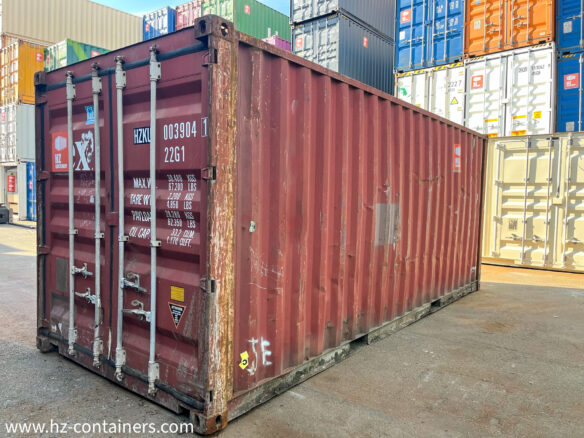

Other container news...
Corner casting steel vs aluminum
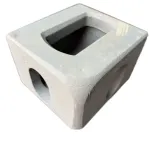
Every shipping container in the world — all 40 million of them — rests on eight critical components. Corner castings are the load-bearing blocks at each corner of an ISO shipping container, and they are the universal interface between the container and every crane, twistlock, spreader, and chassis on the planet. When you lift a container, stack it nine high on a ship, or lock it to a truck trailer, every ton of force flows through these fittings.

Construction cabin – selection, tips, dimensions and prices
Every construction project – whether a family house, a development project or a reconstruction – starts with the infrastructure. No construction manager, craftsman or investor who needs an on-site office, a changing room for workers or a safe storage for tools can do without a quality construction cell. But navigating the offer is not easy: residential containers, sanitary cells, storage modules, rental, purchase, refurbished pieces… This guide will give you answers to all the essential questions in one place.
Storage container
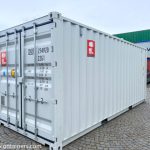
A storage container is a lockable steel box designed for the safe and dry storage of materials, tools, goods or equipment. Originally created as a shipping container for maritime transport, its durability and versatility have found their way onto construction sites, corporate premises and private land.
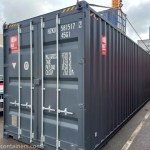
Shipping container 12m (40 ft)
A 12m shipping container is an investment that, if properly selected and cared for, will pay off in decades of trouble-free use. Whether you plan to use it as a warehouse, workshop, garage or the basis for a residential module — the key is careful selection of the condition, a thorough inspection before purchase and high-quality preparation of the base for placement. Take the time to compare offers, check the seller’s references and do not hesitate to personally inspect the container before buying. A properly selected 40-foot container will serve you reliably for many years.