
How many kg can be on a EUR pallet in a shipping container?
In modern logistics and global goods transportation, EUR pallets (EPAL pallets) and shipping containersplay an absolutely crucial role. Proper understanding of their combined possibilities – that is, how many kilograms can be on a EUR pallet inside a shipping container – is essential for safety, efficiency, and economics of transportation.
This article is a detailed technical guide that explains all related standards, physical limits, safety aspects, real scenarios, and optimization strategies. Everything is processed based on current data from pallet manufacturers, renowned shipping companies, and applicable European and international standards.
What is a EUR pallet (EPAL pallet)?
Definition, history, standards
EUR pallet (also referred to as EPAL pallet) is the most commonly used type of standardized wooden pallet in European logistics. Its creation is connected to the need to speed up and reduce the cost of goods handling, particularly in rail and subsequently road and maritime transport.
Key standards and marking:
- Standard UIC 435-2: Historical standard establishing basic parameters, now replaced by EPAL standards.
- EPAL (European Pallet Association): Organization guaranteeing production and repairability only by licensed entities. Each pallet bears burned-in marks EPAL and EUR.
- ISO 445: International standard for pallet dimensions and types.
- ISPM 15: International standard for phytosanitary treatment of wooden packaging in international trade (required heat treatment, HT mark).
Recognition of original pallet:
- Mark EPAL on the right corner block, mark EUR on the left, manufacturer code on the middle, and HT mark.
- 78 special nails driven in precisely according to standard.
- Four-way construction for easy handling from all sides.
EUR/EPAL pallet variants and their dimensions
| Pallet Type | Dimensions (mm) | Area (m²) | Weight (kg) | Typical Use |
|---|---|---|---|---|
| EUR 1 | 1200 x 800 | 0.96 | 20–24 | Standard, universal |
| EUR 2 | 1200 x 1000 | 1.20 | 30 | Heavy industry, warehouse |
| EUR 3 | 1000 x 1200 | 1.20 | 30 | Warehouses, non-standard packaging |
| EUR 6 | 800 x 600 | 0.48 | 9 | Smaller shipments, retail |
The most widespread is EUR 1 (1200×800 mm) – hereinafter referred to in the text as EUR pallet.
Load capacity of EUR pallet
Dynamic vs. static load capacity
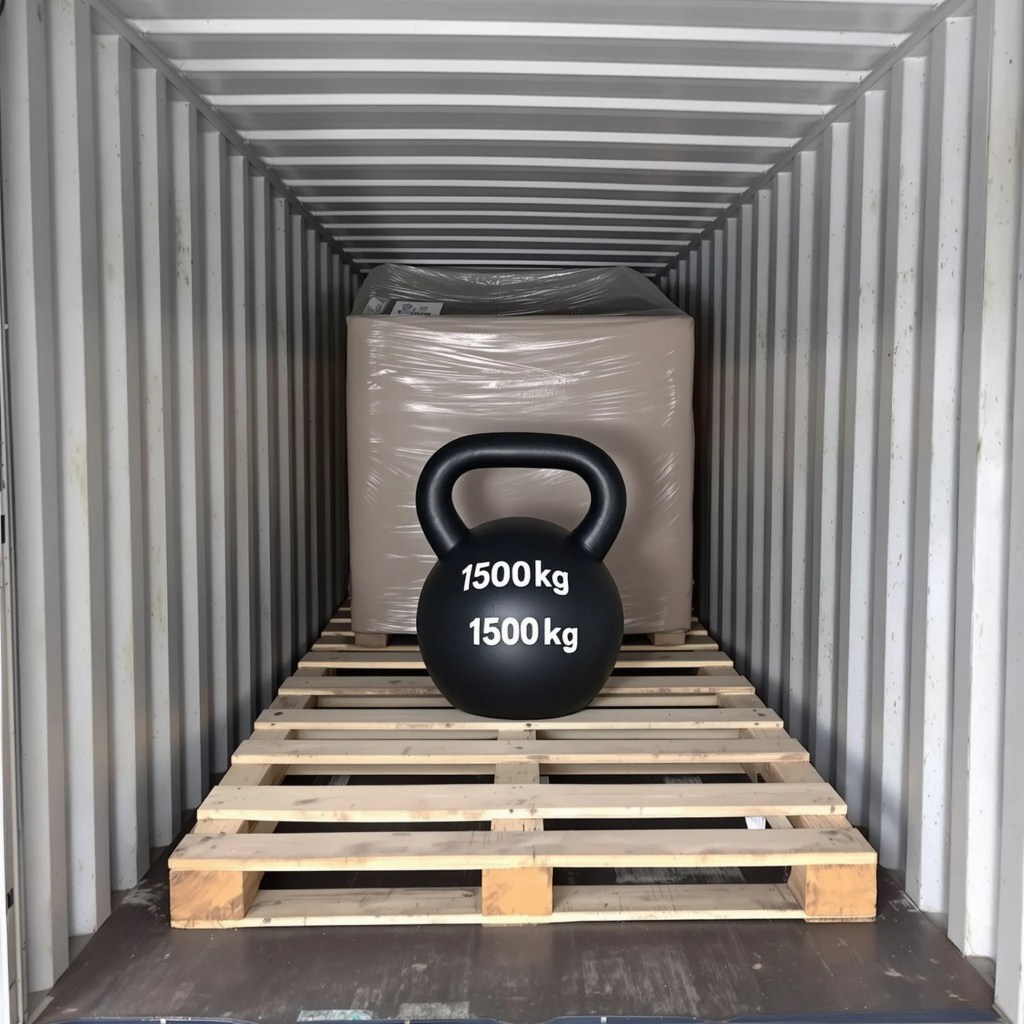
- Dynamic load capacity: Maximum weight that can be handled with a pallet (lifting, transporting) – 1,500 kg (commonly stated, some sources cite up to 2,000 kg with ideal distribution).
- Applies to evenly distributed load across the entire pallet surface.
- Critical during container loading and unloading – forklift handling, pallet truck operation.
- Static load capacity: Weight that a pallet can bear at rest on a solid surface (in warehouse, when stacking) – up to 4,000 kg.
- Stacked load capacity: If pallets are stacked on top of each other (double stacking), the bottom pallet can be loaded up to 4 tons, but depends on the type of goods and packaging.
Caution: The lowest (most stringent) limit always applies – for most shipments, this is dynamic load capacity of 1,500 kg per pallet.
Other factors affecting load capacity:
- Quality and age of wood, moisture, condition of nails.
- Damaged or non-certified pallet has lower load capacity and must not be used for export!
Shipping container – types, dimensions, load capacities
| Container Type | Internal Length (mm) | Width (mm) | Height (mm) | Volume (m³) | Load Capacity (kg) | Number of EUR Pallets (1 layer) |
|---|---|---|---|---|---|---|
| 20′ DC | 5,900 | 2,350 | 2,395 | 33.2 | 28,000–30,480 | 11 |
| 40′ DC | 12,032 | 2,350 | 2,395 | 67.7 | 26,000–28,470 | 24–25 |
| 40′ HC | 12,032 | 2,350 | 2,700 | 76.3 | 28,490 | 24–25 |
| 45′ HC PW | 13,556 | 2,444 | 2,693 | 89.2 | 29,500 | 33 |
| 20’/40′ Reefer | 5,535/11,580 | 2,284 | 2,224/2,402 | 28.1/63.5 | 27,538/29,400 | 10/23 |
Notes:
- 20’DC (Dry Cargo): Most common for heavy, dense goods. 11 EUR pallets in one layer.
- 40’DC: Suitable for bulkier, lighter goods. 24 EUR pallets in one layer (max 25 with “pinwheel” stacking).
- 40’HC (High Cube): Greater height, suitable for stacking or taller goods.
- 45′ HC Pallet Wide (PW): Special extended container for 33 EUR pallets, common in Western Europe.
- Reefer containers (refrigerated): Smaller internal width and height – fewer pallets.
Number of EUR pallets in individual containers
Table: Number of EUR pallets in container (in one layer, without stacking)
| Container Type | EUR Pallets (1 layer) | EUR Pallets (2 layers – if stackable) |
|---|---|---|
| 20′ DC | 11 | 22 |
| 40′ DC | 24–25 | 48–50 |
| 40′ HC | 24–25 | 48–50 |
| 45′ HC PW | 33 | 66 |
| 20′ Reefer | 10 | 20 |
| 40′ Reefer | 23 | 46 |
Notes:
- Actual number may depend on the type of packaging, whether stacking is allowed (nature of goods, packaging) and whether space is needed for securing, weight distribution, etc.
- “Pinwheel pattern”: Allows in some cases to increase the number of pallets by 1–2 units in the container.
Calculation: How many kg can be on a EUR pallet in a container?
Step 1: Determine limits
- Pallet load capacity (dynamic): max. 1,500 kg/pallet (commonly used safe limit)
- Container load capacity (payload): e.g., 28,000 kg for 20′ DC, 26,730 kg for 40′ DC (varies by manufacturer, carrier, applicable legislation)
- Number of pallets: see above (usually 11 for 20′ DC, 24–25 for 40′ DC)
- Weight of empty pallet: approx. 23 kg (count for each unit of cargo)
Step 2: Practical example for 20′ container
- Maximum useful load (payload): 28,000 kg
- Number of pallets: 11
- Total weight of empty pallets: 11 × 23 = 253 kg
- Remaining for goods: 28,000 – 253 = 27,747 kg
- Maximum average weight per pallet: 27,747 / 11 = 2,522 kg
BUT! Dynamic load capacity of pallet is 1,500 kg → no more than 1,500 kg can be placed on one pallet(even if the container could bear more).
- Total maximum weight of goods in container: 11 × 1,500 = 16,500 kg (plus weight of empty pallets)
- In this case, the pallet is the limiting factor, not the container.
Step 3: Practical example for 40′ container
- Maximum useful load (payload): 26,730 kg
- Number of pallets: 24
- Total weight of empty pallets: 24 × 23 = 552 kg
- Remaining for goods: 26,730 – 552 = 26,178 kg
- Maximum average weight per pallet: 26,178 / 24 ≈ 1,090 kg
Here the container’s useful load is the limiting factor: a maximum of 1,090 kg of goods can be loaded on each pallet.
- Total maximum weight of goods in container: 24 × 1,090 = 26,160 kg (plus weight of pallets)
When does volume decide and when does weight?
- “Weighing out” – you exceed the weight limit before filling the container volume. Typically with very heavy goods (metals, granulates, chemicals).
- “Cubing out” – you fill the container volume before reaching the weight limit. With light, bulky goods (polystyrene, textiles, paper).
- Optimization: For most common commodities, the real limit is either EUR pallet load capacity or container useful load.
Safety, legislation, standards
Obligations and recommendations
- VGM (Verified Gross Mass): Verified gross weight of the container must be documented before loading. An overloaded container will not be loaded.
- ISPM 15: Obligation of heat treatment of wooden packaging in international trade. EUR pallets must be marked HT.
- Even weight distribution: Weight must always be distributed evenly in the container to prevent tipping or floor damage.
- Cargo securing: Pallets must be secured against movement (straps, bags, wedges), especially in maritime transport.
- Stacking: Permitted only for goods that allow it – risk of damage to lower layer.
Loading optimization, pallet arrangement
Techniques:
- Standard arrangement: Pallets flat, longer side to longer container wall.
- Pinwheel stacking (“pinwheel”): Alternating pallet rotation for best space utilization – allows fitting 1–2 more pallets in a 40′ container.
- Double stacking: Double stacking in higher containers (High Cube), if pallet construction and nature of goods allow.
- Cargo securing: Use of shrink wrap, tension straps, air bags between pallets, wooden wedges, and fillers.
Practical tips:
- Always check that the pallet is not damaged; for international transport only certified EUR/EPAL pallets!
- When stacking, verify the load capacity of the goods packaging and upper limits of the container (height, floor loading).
- With reefer containers, account for smaller internal width and height – fewer pallets and lower weight limit.
Frequently Asked Questions (FAQ)
Can I load more than 1,500 kg on one EUR pallet if the container can bear it?
No! The pallet may break during handling, damage your goods and other cargo, or endanger personnel.
What happens if I exceed the maximum payload of the container?
The container will not be loaded on the ship, or will be held, or you may face a fine and need to reload the goods. Overloading is a serious safety risk.

 Czech Republic, Třebíč
  WITHOUT SHIPPING


Other container news...


How much does a reefer container cost?
If you are researching cold storage solutions for your business, you have almost certainly asked the question: how much does a reefer container cost? The answer is not a single number. A refrigerated shipping container — commonly called a reefer — can set you back anywhere from $4,000 for a decommissioned, non-operational unit to more than $45,000 for a brand-new, high-cube 40-foot model with the latest refrigeration technology. Between those two extremes lies a complex landscape of pricing tiers, operating expenses, hidden costs, and financing options that can dramatically shift the total cost of ownership over the life of the container.