
Customs Regimes in the EU
The entry or exit of goods across the borders of the European Union is governed by a set of procedures, regulations and legal instruments, which are collectively referred to as customs regimes. These regimes form the backbone of international trade, protect the economy, security, health of the population and financial interests of the Member States and the Union itself. In this glossary you will find detailed definitions of the main customs regimes, explanations of the legal framework, technical requirements and practical aspects of customs procedures in the EU.
Basic Legal Framework for Customs Procedures in the EU
Union Customs Code (Union Customs Code – UCC)
- Main legislative instrument: Regulation (EU) No 952/2013, the so-called Union Customs Code (UCC).
- Purpose: Modernization, harmonization and digitalization of customs rules across the EU.
- Implementation: Commission Implementing Regulation (EU) 2015/2447 and other delegated acts establish specific rules and ensure uniform application of the code.
- Currency: Regularly updated, the last significant change 2024/635 (e.g. evidence of customs status of Union goods, amendments to transit regimes).
- Objective: Transition to a paperless, fully electronic customs environment by 2025 at the latest.
Key principles:
| Principle | Meaning |
|---|---|
| Legal certainty and uniformity | Customs rules apply equally in all Member States. |
| Electronization | Transition from paper documents to electronic systems. |
| Simplification | Uniform and clear procedures for businesses and customs officials. |
| Protection | Emphasis on security, market protection, consumer protection and EU budget protection. |
| Preferential treatment | Faster procedures and benefits for trusted companies (AEO). |
Key Concepts: Customs Union, Customs Territory, EORI
EU Customs Union
- Definition: A single commercial territory without internal tariffs, with a uniform tariff schedule towards third countries.
- Exceptions: Specific territories (e.g. Monaco, special regime for Northern Ireland after Brexit).
- Objective: To facilitate trade, ensure equal conditions, protect consumers and the environment, contribute to the EU budget.
Customs Territory of the Union
- Scope: Territory of all Member States + some associated territories.
- Exceptions: E.g. Canary Islands, special agreements with some micro-states (Andorra, San Marino).
- Consequence: UCC rules and the common tariff schedule apply in the customs territory.
EORI (Economic Operators Registration and Identification number)
- Significance: Mandatory registration for anyone wishing to submit customs declarations in the EU.
- Assigned by: Customs authority of the Member State where the entity is established or has a place of business.
- Use: Identification in electronic systems, required for importers, exporters, carriers and intermediaries.
Overview and Detailed Description of Main Customs Regimes
Each item of goods entering the EU customs territory must be assigned to one of the official customs regimes. The decision on the choice of regime affects the obligations to pay duties, VAT, the use of goods, the possibility of its storage, processing, transport or re-export.
1. Release for Free Circulation
Definition and main purpose
- Standard regime for importing goods from third countries to the EU market.
- Goods acquire the status of “Union goods” and can move freely within the internal market.
Key steps
| Step | Description |
|---|---|
| Customs declaration | Electronic submission of declaration via the appropriate system (in the Czech Republic Customs Administration of the Czech Republic – e-CELNÍK). |
| Duty assessment | According to tariff classification, origin and value of goods. The combined nomenclature (CN codes) is used. |
| Payment of duty and VAT | Obligation to pay the appropriate duties before the goods are released. |
| Document control | Certificate of origin required, possibly license or security documents. |
| Application of other measures | E.g. health, veterinary, phytosanitary, environmental requirements. |
Practical aspects
- Documents: Single Administrative Document (SAD), invoice, transport documents, proof of origin (preferential/non-preferential).
- Registration: Obligation to have EORI.
- Specifics: After all conditions are met, the goods are “released” and can be further sold, processed or re-exported without further customs restrictions.
2. Export
Definition and purpose
- Goods with Union status permanently leave the EU customs territory.
- Allows control of exports, collection of statistical data, proper application of fiscal measures (VAT refund, export licenses, etc.).
Process
| Step | Description |
|---|---|
| Export customs declaration | Electronic submission in the country where the exporter is established or where the goods are prepared for export. |
| Document control | Ensuring compliance with any restrictions (dual-use goods, cultural assets, etc.). |
| Export license | Required for some commodities (e.g. military material, waste). |
| Physical inspection | Selective inspection by customs authority according to risk profile. |
Result
- After all formalities are completed, goods may leave the EU. The exporter may request a VAT refund.
3. Special Procedures
These regimes serve to support economic activities and maximize flexibility for businesses in the EU.
Main categories of special procedures:
| Regime | Characteristic | Typical use |
|---|---|---|
| Transit (T1, T2) | Transport of goods under customs supervision without payment of duty to the destination. | Long-distance imports, transport between warehouses, transport across EU territory. |
| Storage | Storage of non-Union goods in customs warehouses or free zones without duty and VAT. | Deferral of duty, cash flow optimization, re-export. |
| Temporary admission | Short-term use of goods with the condition of its re-export. | Exhibitions, trade fairs, testing, sporting events. |
| End-use | Release for free circulation with conditional or reduced duty for specific purposes. | Import of machinery for a specific investment (e.g. aviation, defense). |
| Inward and outward processing | Processing, repair or modification of goods in the EU, or outside the EU, with tax benefits. | Manufacturing, assembly, repairs, textile sewing, machinery refurbishment. |
Transit (Customs Transit)
- External transit (T1): Non-Union goods transported through the EU without payment of duty (goods under customs supervision).
- Internal transit (T2): Union goods transported through third countries, Union goods status retained.
- Systems: New transit system (NCTS) – electronic recording and tracking of shipments.
Practical examples
| Situation | Regime | Description |
|---|---|---|
| Goods from China enter the EU in Hamburg, are to be cleared in Prague | T1 | Customs guarantee, supervision, clearance at destination. |
| Czech company sends goods to Spain via Switzerland | T2 | Retention of Union status across non-member territory. |
Storage (Customs Warehousing, Free Zones)
- Customs warehouses: Allow storage of non-Union goods without immediate clearance, goods can also be further sold, divided, packaged, or re-exported.
- Free zones: Special zones (e.g. major ports, airports), where non-Union goods can be freely handled.
- Benefits: Deferral of duty, possibility of inventory optimization, combination with other regimes.
Practical aspects
| Benefit | Description |
|---|---|
| Deferral of duty payment | Goods can be stored and cleared only at the time of actual consumption/sale. |
| Possibility of change of owner | Sale of goods in warehouse without need for clearance, new owner decides on further regime. |
| Storage period | In principle unlimited, if the conditions of the regime are met. |
Temporary Admission
- Characteristic: Short-term import of non-Union goods with full or partial exemption from duty.
- Conditions: Goods must not be modified (only normal wear and tear), must be re-exported within the specified period.
- Use: Exhibitions, trade fairs, professional tools, sports equipment, testing equipment.
Examples:
- Film equipment brought for filming and subsequently re-exported.
- Racing motorcycles for European Championship.
End-Use
- Purpose: Possibility to clear goods at a reduced or zero rate if intended for specific use (e.g. aviation industry, defense, healthcare).
- Control: Customs authorities monitor the actual use of goods for the declared purpose.
Inward Processing
- Principle: Non-Union goods are temporarily imported into the EU for the purpose of processing, assembly, repair, etc., without payment of duty and VAT.
- Result: Final products are either re-exported (without duty), or may be released on the EU market after payment of duty (depending on the regime used).
- Benefit: Support for export manufacturing, savings on duties and VAT.
Practical example:
- A German car manufacturer imports parts from Japan, assembles cars and exports them to the USA – no duty is paid on Japanese parts.
Outward Processing
- Principle: Union goods are temporarily exported outside the EU for processing, repair, modification, etc. Upon return, duty is paid only on the added value.
- Benefit: Cost savings, possibility of using third countries for partial manufacturing operations.
Practical example:
- A Czech textile company sends fabrics to Serbia for sewing, upon return duty is paid only on the price of labor in Serbia.
Permits and Applications for Special Procedures
- Permit: Always requires prior authorization from customs authorities (see Article 85 UCC and implementing regulation).
- Application: Submitted to the appropriate customs office on the basis of a template (e.g. Annex 67 of the implementing regulation).
- Conditions: The applicant must provide economic justification, description of operations, place of performance, responsibility for compliance with conditions.
- Control: Customs office may require additional documents and security (e.g. customs guarantee).
Documents Required for Customs Clearance
| Document | Purpose | Note |
|---|---|---|
| Single Administrative Document (SAD) | Main customs declaration | Mandatory for import and export, electronic form. |
| Invoice | Proof of value of goods | Must contain accurate information about goods. |
| Transport documents | Document the movement of goods | E.g. CMR, bill of lading, air waybill. |
| Certificate of origin | Determination of duty rate, preferential treatment | Preferential (e.g. EUR.1, REX), non-preferential (chambers of commerce). |
| Other licenses | Depending on type of goods | E.g. veterinary, phytosanitary, military licenses. |
Customs Controls, Risk Management, Sanctions
- Customs controls: Conducted on the basis of risk analysis, include document control, physical inspection of goods, laboratory analysis, subsequent audits.
- Risk management: Each Member State is obliged to implement a risk management system; however, harmonization is not always perfect.
- Sanctions: Vary in individual states – from administrative fines to criminal penalties; the EU is striving for greater harmonization.
Authorized Economic Operator (AEO)
- Definition: Status of “Authorised Economic Operator”; granted to trusted companies that meet strict criteria (compliance with regulations, accounting, security).
- Benefits: Simplified customs procedures, fewer controls, faster clearance, better relations with customs authorities.
- Significance: Key component of modernization and digitalization of customs processes; support for safe and efficient trade.
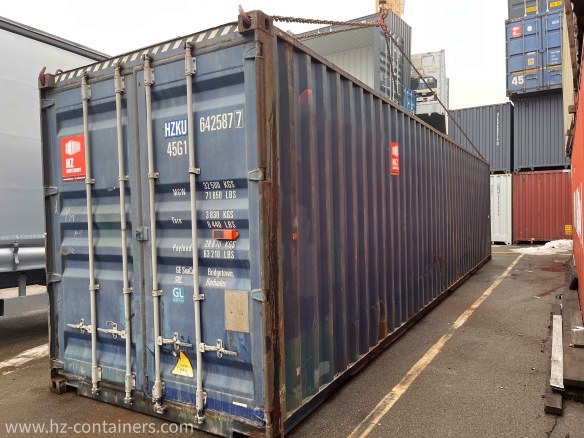
 Czech Republic, Litoměřice
  FREE SHIPPING
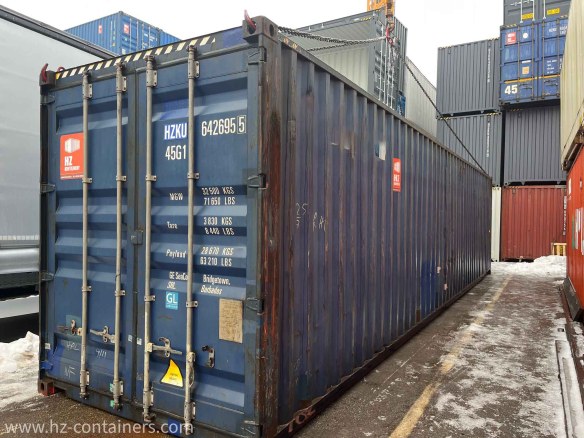
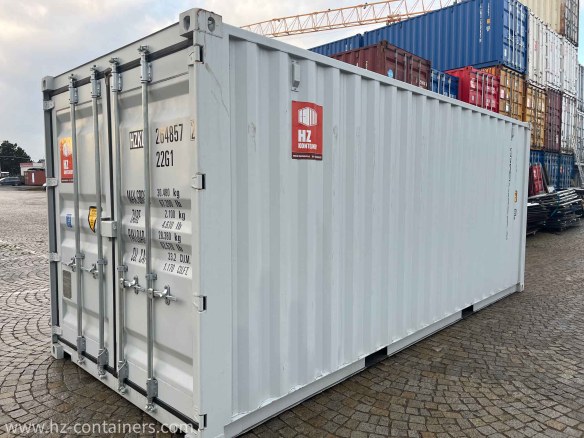
Other container news...

High Cube container specifications
A high cube container — also referred to as an HC container, HQ container, or high-cube — is an intermodal shipping container that stands one foot taller than the standard ISO container. While a standard general-purpose container measures 8 feet 6 inches (2.59 m) in external height, a high cube container extends to 9 feet 6 inches (2.89 m). This extra 12 inches of vertical clearance translates into approximately 10–15% more cubic capacity without altering the container’s footprint — the same length and width are maintained, meaning the container occupies the same floor space on a vessel, chassis, or storage yard.
Shipping container parts
A shipping container looks like a simple steel box from the outside, but it is an assembly of dozens of precisely engineered shipping container parts — each governed by international standards, each designed to survive decades of ocean transit, crane lifts, and stacking loads that would crush an ordinary structure. Whether you are buying a used container, planning a container home, troubleshooting a repair, or simply building your logistics vocabulary, understanding every individual component is the difference between making an informed decision and an expensive mistake.

40 Foot Container Dimensions
If you have ever booked ocean freight, planned a warehouse layout, or designed a modular building project, you have asked the same question: what are the exact 40 foot container dimensions — and what do they mean for what you can actually load? The numbers are standardized worldwide, but the practical implications of those numbers are surprisingly nuanced. A 40-foot container is not simply 40 feet of usable space, and its weight limits are not what most people assume. This guide covers every measurement, every weight rating, and every loading consideration you need to make informed decisions about the world’s most common shipping container.
Quick Answer: A standard ISO 40-foot shipping container measures 12.19 m (40 ft) long × 2.44 m (8 ft) wide × 2.59 m (8 ft 6 in) high externally and provides approximately 67.7 m³ (2,390 ft³) of usable internal volume. The maximum gross weight is 30,480 kg (67,200 lbs), with a typical payload capacity of approximately 26,700–26,800 kg (58,900–59,000 lbs).

Cargo worthy container
If you have ever shopped for a used shipping container, you have almost certainly encountered the term cargo worthy — often abbreviated as CW or CWO (Cargo Worthy Only). It is one of the most important classifications in the container industry, yet it is also one of the most misunderstood. A cargo worthy container is not a container that looks new. It is not necessarily a container that has a valid CSC plate. And it is definitely not the same as a wind and watertight container. This guide explains what cargo worthy really means — from its technical definition and historical origins to the precise structural criteria, inspection process, cost implications, and common misconceptions that trip up even experienced buyers.