
Building permit and legal aspects of container placement in the Czech Republic
In recent years, the Czech Republic has been experiencing a boom in alternative housing. Among the most prominent trends are shipping container homes, which represent an innovative and often more economically advantageous alternative to traditional construction. These container houses attract with their modularity, speed of implementation and strong element of sustainability. However, their placement on the land is not a legally simple matter and requires a thorough knowledge of building law and related regulations.
This comprehensive glossary aims to explain in detail the key concepts you will encounter when planning the placement of a residential or other container in the Czech Republic. It provides a comprehensive overview of legal and technical aspects, from the basic definition of a shipping container house to the final building approval. The information is current as of 2024 and reflects the fundamental changes brought about by the new building act No. 283/2021 Coll. The aim is to answer the basic question: “What is it?” and guide you through the whole process to avoid potential problems and sanctions.
Container House
Definition and basic properties
is a building intended for residential or commercial purposes, the supporting structure of which consists of one or more modified shipping containers. These containers, originally designed for transporting goods in extreme conditions, are made of highly durable Corten steel, which ensures exceptional strength, durability and corrosion resistance when used as shipping container homes.
Advantages of container houses
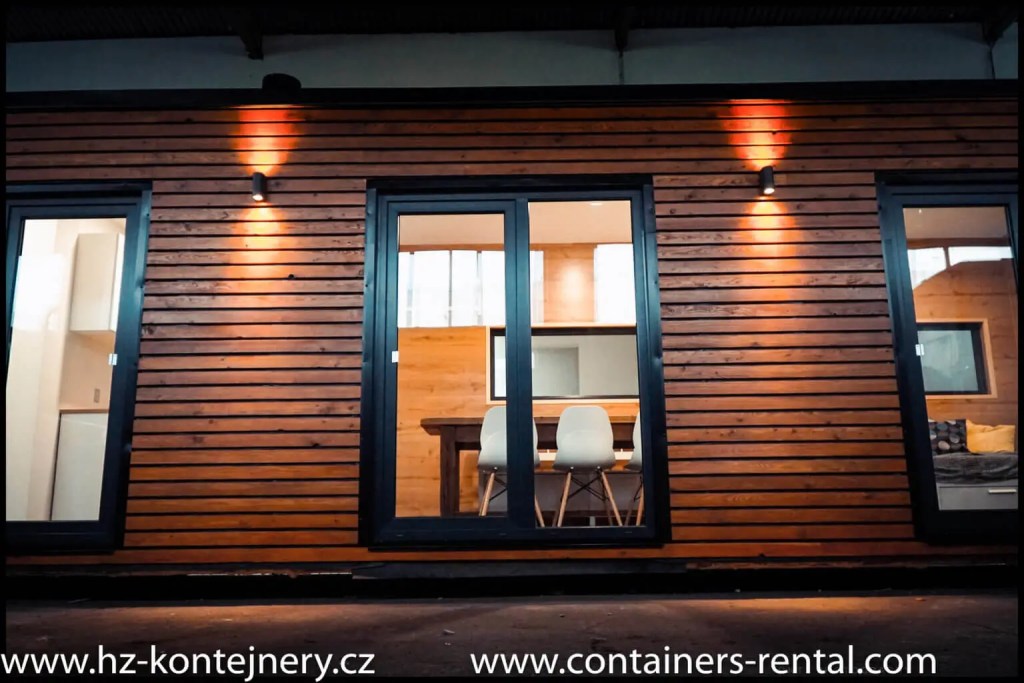
- Modularity: The ability to stack containers side by side and on top of each other, creating flexible layouts and easily expanding the shipping container house as needed.
- Speed of construction: The basic structure is ready, assembly on site takes only a few days. Production in the workshop can take place in parallel with the preparation of the foundations on the land.
- Sustainability: Upcycling used containers is environmentally friendly, reduces the consumption of new materials and the ecological footprint.
- Design: Industrial aesthetics that can be combined with wood, glass or other materials, resulting in unique and architecturally interesting projects.
Disadvantages and challenges
- Insulation: Steel conducts heat well, so high-quality and properly designed insulation is necessary (e.g. PUR/PIR foam, mineral wool).
- Condensation: The need to address ventilation and vapor-tight layers.
- Statics: Cutouts for windows, doors and joining modules affect strength, requiring assessment by a structural engineer.
- Legislation: From a legal point of view, a container house is a “building” like any other and is subject to the Building Act.
Interesting fact: Shipping containers are manufactured in standardized dimensions (most often 20′ and 40′) and meet ISO standards. In the Czech Republic, new and used containers of various types (standard, high-cube, open-top, side door, etc.) are commonly available.
Building Act
Building Act No. 183/2006 Coll. (as amended by Act No. 283/2021 Coll. from 2024) is the key legal regulation that governs the placement, permitting, execution, use and removal of buildings in the Czech Republic.
Basic principles
- Every building, including container must be in accordance with the zoning plan, the character of the area, the infrastructure, and the requirements of the authorities concerned.
- A product fulfilling the function of a building is also considered a building – i.e. a shipping container intended for housing, recreation or business, as well as a construction module.
- The approval process is the same as for ordinary buildings – regardless of the technology or material used.
Types of buildings according to the law
| Building category | Typical use | Permit / regime |
|---|---|---|
| Minor building | Warehouse, workshop, garden house, up to 40 m² | Notification or without permit (if conditions are met) |
| Simple building | Smaller recreational building, up to 150 m², max. 2 floors | Notification |
| Residential building (family house) | Permanent housing, larger buildings | Building permit |
A fundamental new feature since July 2024 is the extension of the possibilities for minor buildings up to 40 m² without a building permit, if they are not intended for housing or business.
Placement of a Structure
The first phase of the permitting process determines whether it is even possible to build on the land. The key document is the zoning plan of the municipality.
Procedure
- Verification of the zoning plan
- Each plot has a designated use in the zoning plan (housing, recreation, production, etc.).
- It is necessary to verify whether the construction of a container house is permitted in the given location.
- Regulatory plans and decrees
- Some municipalities have regulatory plans that set further conditions (roof shape, facade color, distances from property boundaries).
- The industrial appearance of the container may be unsuitable/rejected in some locations.
- Zoning decision or zoning consent
- For most buildings, one of these permits is required.
- Zoning consent is a simplified option for minor buildings that meet specific conditions (e.g. consent of neighbors, simple connection to networks).
Attention: Placing a container without complying with the zoning plan is a common reason for rejection of the application!
Building Permit
When is a building permit required?
- For all shipping container houses intended for permanent housing, business or recreation exceeding the parameters of a minor building.
- If the container is connected to utilities (electricity, water, sewage, gas).
- If an environmental impact assessment is required or the building is in a protection zone.
What needs to be submitted?
- Complete project documentation prepared by an authorized person.
- Binding opinions of the authorities concerned (fire brigade, hygiene, environment, network administrators).
- Proof of ownership of the land.
- Proof of compliance with the zoning plan.
- PENB (Energy Performance Certificate of the Building), unless it is a building up to 50 m².
Course of the permitting procedure
- Submission of the application and documentation to the building authority.
- The building authority checks the completeness of the application and requests opinions from the authorities concerned.
- After obtaining all consents, it issues a building permit with a validity of usually 2 years.
Building Notification
For which buildings can the notification regime be used?
- Simple buildings for housing or recreation up to 150 m², max. 2 above-ground floors and attic.
- Buildings that do not interfere with the rights of neighbors (their consent is required).
Advantages
- Faster and simpler administration than with a building permit.
- No public hearing is required.
What needs to be submitted?
- Project documentation.
- Consents of neighbors (if the building affects them).
- Proof of ownership of the land.
- Opinions of the authorities concerned.
Tip: Always verify whether notification is sufficient at the local building authority – the interpretation may vary!
Buildings without permit and notification
When can a container be built without a permit/notification?
According to the Building Act, a minor building can be built without a permit and notification if it meets all of these criteria:
| Criterion | Condition |
|---|---|
| Built-up area | max. 40 m² |
| Height | max. 5 meters |
| Location | On the land of a family house or recreational building |
| Distance from the property boundary | min. 2 meters |
| Purpose | Not for permanent housing or business |
Example:
Garden house, warehouse, workshop.
Warning: Even in this case, the building authority may require zoning consent. Placing “illegally” is strongly discouraged – fines and removal orders are possible.
Project Documentation
What must it contain?
- Technical drawings (floor plans, sections, views)
- Technical report (description of structures, technologies, insulation solutions, fire safety, etc.)
- Static assessment
- Calculation of heat losses, insulation design
- Plans of electrical, water, sewage, heating distribution
- PENB (unless there is an exception)
Specifics for container houses
- Statics: Cutouts for windows, doors and joining multiple containers requires a thorough static assessment.
- Thermal technology: The steel structure is thermally conductive – high-quality insulation is necessary. PUR/PIR foam, mineral wool or a combination with a ventilated facade is recommended.
- Fire safety: Design of escape routes, use of non-flammable materials, fire resistance of the structure.
- Technical equipment: Distribution systems must be routed in such a way as to avoid thermal bridges and condensation.
Recommendation: The project should always be prepared by an authorized designer or architect with experience in container buildings.
Energy Performance Certificate of the Building (PENB)
PENB is mandatory for all new residential buildings and larger reconstructions with the exception of buildings with an energy area of up to 50 m².
What does it evaluate?
- Energy consumption for heating, cooling, water heating, ventilation, lighting.
- Classification into energy class (A – extremely energy-efficient to G – extremely uneconomical).
Specifics for containers
- The steel structure is difficult to meet the standards for almost zero energy consumption.
- Strong and seamless insulation is necessary (PUR foam, PIR boards, etc.).
- The installation of modern technologies (heat pump, recuperation, photovoltaics) is recommended.
- An exception can be used for smaller buildings up to 50 m².
Attention: PENB is also necessary for building approval and for the sale/rental of the shipping container house.
Affected Authorities
When permitting a container house, it is necessary to obtain opinions from these authorities:
- Fire Rescue Service: Assessment of fire safety.
- Regional Hygiene Station: Compliance with hygiene requirements (lighting, noise, microclimate).
- Department of the Environment: Assessment of the impact on the landscape, water resources, protected areas.
- Utility network administrators: Consents for connection to electricity, water, gas, sewage.
- Road administration authority: If the building is near a public road.
- Heritage authority: If the building is in a heritage zone.
Practical advice: Early communication with the authorities concerned will speed up the whole process and prevent rejection of the application.
Final Building Approval
Building approval is the final phase – the building authority verifies that the building complies with the project documentation and is safe for use.
Procedure
- Submission of the application for building approval.
- Inspection of the building by an official.
- If the building meets all requirements, the authority issues a building approval.
Only after building approval is it possible to use the building, register for permanent residence, assign a house number and register it in the land registry!
Technical and practical aspects
Insulation and thermal comfort
- The steel structure is an excellent conductor of heat and cold!
- External insulation (e.g. PUR/PIR foam) is most often used to avoid reducing the interior space and creating thermal bridges.
- It is important to address vapor-tight layers and ventilation, otherwise there is a risk of condensation and mold growth.
Environmental Sustainability
- In addition to upcycling, green roofs, solar panels, rainwater retention tanks can be used.
- Ecological materials are also recommended in the interior – natural coatings, floors from renewable sources.
Fast Construction
- The module is produced in a hall under supervision, it is installed on the land within a few days.
- Preparation of foundations and connections takes place in parallel, which significantly shortens the whole process.
Modularity and design
- Containers can be connected into larger units, stacked, connected at different angles.
- Suitable for small cottages, family houses, offices, cafes, shops, showrooms.
- Easy possibility of future expansion or reconstruction of your shipping container home.

 Czech Republic, Havířov
  FREE SHIPPING


Other container news...

Hörmann garage doors as a great addition to a shipping container
Hörmann garage doors as an addition to a shipping container are a comprehensive solution that brings users maximum comfort, safety and aesthetic level. Their installation is an investment in the long-term value, functionality and representative appearance of the container space. The combination of the robustness of the container and the top technology of Hörmann is the ideal choice for anyone who wants to get the most out of their container.

What are the widths of a shipping container
The width of a shipping container – 2.438 m – is one of the pillars of global logistics. Thanks to its standardized size, it is possible to transport goods across continents efficiently, safely and without any problems, stack containers high and optimize handling. When choosing a container, it is necessary to take into account not only the width, but also the length, height, type (standard vs. High Cube) and any special requirements – for example, Pallet Wide or Reefer.

What are the tolerances for unevenness of a shipping container?
Shipping container unevenness tolerances are the basis for safe, efficient and standardized transportation and storage. Each container must meet precisely defined limits for deformation, dents and structural damage. These limits protect not only the value of the cargo, but also the lives of logistics workers and the stability of the entire logistics chain. Keeping containers within tolerances is an investment in the safety, longevity and reliability of your transportation solutions.

Side opening container for rent
A side-opening container for rent from HZ KONTEJNERY s.r.o. is a technically advanced, versatile and highly accessible storage space, available without the need for ownership and with complete service. It is the ideal choice for companies and individuals who need to quickly and flexibly solve storage, transportation or special projects without investment costs and maintenance worries.