
Anatomy of Shipping Container Colors
Anatomy of Shipping Container Colors refers to a complex system of meanings, functions, standards and norms that determine the selection and use of colors for shipping containers. Container color is not merely a matter of aesthetics – it is a deliberate visual language that communicates information about ownership, purpose, contents, technical condition and safety aspects. This color coding system is essential for the efficiency, safety and organization of global logistics and maritime transport.
When looking at a container ship full of colorful containers, it may seem like random chaos. In reality, however, colors serve these key functions:
- Container Identification: Immediate visual distinguishability of container type, owner, or condition.
- Brand Identification: Strengthening corporate identity and marketing of shipping or leasing companies.
- Safety and Regulatory Compliance: Warnings and information about special handling or transport of hazardous materials.
- Protection and Lifespan: Physical protection of the container against corrosion, solar radiation and weather effects.
- Temperature Regulation: Influencing the internal temperature of the container and protecting sensitive cargo.
Understanding this system is key for anyone working in logistics, maritime transport, storage, as well as architecture and construction using containers.
History and Development of Container Color Marking
Standardization and Beginnings
Modern container transport emerged in the 1950s with visionary Malcolm McLean. Standardization of containers revolutionized the speed and safety of transport. As the number of containers grew, the need arose for their rapid identification in ports. Before digital tracking systems became widespread, color was an efficient and inexpensive way to identify a container from a distance.
Initial Colors and Their Meaning
Initially, containers were painted in practical dark shades that masked dirt and rust well. Gradually, shipping and leasing companies began using corporate colors for better identification and marketing.
Functional Meaning and Technical Aspects of Colors
Container Identification
- Ownership: The world’s largest leasing companies choose dark colors (brown, chestnut) for easy identification of their fleet and minimization of maintenance costs.
- Type of Cargo: Specific colors (white, light gray) indicate refrigerated containers; yellow and red signal increased caution.
- Condition: New “one-trip” containers are often gray or light gray (RAL 7035), which is a neutral and modern shade.
Brand Identification
The largest shipping companies invest in recognizable corporate colors:
| Company | Color | RAL Code |
|---|---|---|
| Maersk | Light Blue | RAL 5015 |
| Hapag-Lloyd | Orange | RAL 2008 |
| Evergreen | Green | RAL 6029 |
| CMA CGM | Dark Blue | RAL 5013 |
Color thus serves as a “mobile billboard” and reinforces brand identity on all continents.
Safety and Regulatory Compliance
Color marking increases safety when working with containers:
- Yellow, Orange and Red: Warning signals (e.g., containers with hazardous goods, chemicals or explosives).
- White: Standard for refrigerated containers, where it is necessary to minimize heat gain.
- International Standards: Colors are often accompanied by safety pictograms and labels according to IMDG (International Maritime Dangerous Goods) and other regulations.
Protection Against Corrosion and Weather Effects
Container Materials
- COR-TEN Steel: Standard for container manufacturing, notable for high resistance to weather effects and corrosion.
- Coatings: Polyurethane and epoxy paints with high resistance to abrasion, UV radiation and seawater.
Technological Layers of Coating
| Layer | Function |
|---|---|
| Basic Anti-Corrosion | Protection against corrosion, adhesion |
| Intermediate Coat | Increases overall durability |
| Top Color Layer | Final color, UV resistance, aesthetics |
Expert Recommendation:
For renovation of old containers, it is advisable to use paints such as Hostagrund 3in1 or polyurethane coatings with hardener. These paints provide long-term protection without the need for a separate base layer.
Temperature Regulation
Color fundamentally affects the temperature inside the container:
- Light Shades (white, light gray, cream): Maximum reflection of sunlight, lower internal temperature – ideal for food, medicine, electronics.
- Dark Shades (black, dark blue, brown): Higher heat absorption, suitable for temperature-insensitive goods or cooler regions.
Overview of Common Colors and Their Meaning
| Color | Primary Use | RAL Code |
|---|---|---|
| White | Refrigerated containers, “one-trip” containers | RAL 9010 |
| Light Gray | New containers, modern design, military and government shipments | RAL 7035 |
| Blue | Standard “dry cargo”, corporate branding (Maersk, CMA CGM) | RAL 5010, 5013 |
| Green | Standard containers, branding (Evergreen), storage in nature | RAL 6029, 6005 |
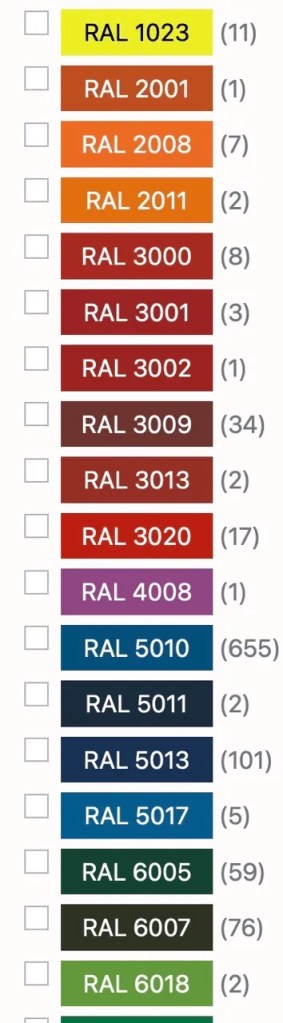
| Red | Common cargo, emphasis, special equipment, hazardous cargo | RAL 3000, 3009 |
| Orange | Branding, warning containers | RAL 2008 |
| Yellow | Warning containers, special handling, hazardous materials | RAL 1023 |
| Brown/Chestnut | Leasing companies, practical color for masking wear | RAL 8007, 8017 |
| Anthracite | Modern design, architecture, “one-trip” | RAL 7016 |
| Black | Striking appearance, limited use | RAL 9005 |
RAL Color System: Industrial Standard
Advantages of the RAL System
- Unambiguity: Each shade has a unique four-digit code.
- International Compatibility: Facilitates ordering, manufacturing and maintenance across continents.
- Repeatability: Large fleets can be consistently painted in exactly the same shade.
Most Commonly Used RAL Shades for Containers
| RAL Code | Name (EN) | Typical Use |
|---|---|---|
| 5010 | Gentian Blue | Standard containers |
| 5013 | Cobalt Blue | Branding (CMA CGM) |
| 6029 | Mint Green | Branding (Evergreen) |
| 6005 | Moss Green | Landscape storage, gardens |
| 7035 | Light Gray | New containers, architecture |
| 7016 | Anthracite | Modern design, “one-trip” |
| 9005 | Black | Striking, unconventional projects |
| 3000 | Flame Red | Warning, hazardous cargo |
| 3009 | Oxide Red | Masking wear |
| 2008 | Orange | Branding (Hapag-Lloyd) |
| 9010 | White | Refrigerated containers |
| 8007/8017 | Brown/Chestnut | Leasing companies |
Technological Aspects of Container Coatings
Layers and Types of Coating Systems
- Basic Anti-Corrosion Coating: Most often epoxy-based, applied directly to COR-TEN steel.
- Intermediate Layer: Increases coating thickness and improves mechanical resistance.
- Top Color Layer: Polyurethane or acrylate paints with high UV resistance.
The best coatings meet ISO standards for marine environments and ensure container lifespan of over 20 years. In practice, paints labeled “3in1” (base, intermediate layer, top coat in one step) are often used, which reduces maintenance costs.
Maintenance and Renovation of Coatings
- Surface Preparation: Thorough cleaning of rust, dust and grease is key to long coating life.
- Color Selection: For renovations, two-component polyurethane paints with hardener or epoxy base coats are recommended.
- Service Life: Quality coating lasts 7–15 years (depending on environment and handling frequency).
Color Trends, Innovations and Future
Modern Trends
- Corporate Customization: More and more companies are investing in unique shades and special logos, often with metallic effects or special surface finishes.
- Ecology: Growing demand for ecological water-based coatings that meet strict emission limits.
- Functional Coatings: Development of thermoregulatory, self-cleaning and anti-graffiti surfaces.
Future of Container Colors
- Smart Colors: First tests of colors that change shade depending on temperature or UV exposure.
- Condition Monitoring: Colors with damage or wear indicators for automated inspections in ports.
Practical Examples from the Czech Market
From the current offer of Czech sellers:
| Container Model | Color (RAL) | Steel | Note |
|---|---|---|---|
| 20′ DV “one way” | RAL 7016 | COR-TEN | Anthracite, new condition |
| 20′ DV “one way” | RAL 5010 | COR-TEN | Blue, new condition |
| 20′ DV “one way” | RAL 7035 | COR-TEN | Light gray, new |
| 20′ DV “one way” | RAL 9010 | COR-TEN | White, refrigerated |
Table: Overview of the Meaning of Most Common Colors
| Color | Most Common Use | Advantages / Specifics |
|---|---|---|
| White | Refrigerated, sensitive goods | Maximum heat reflection |
| Blue | Standard transport, branding | Universal, well visible |
| Green | Branding, natural storage | Blends with surroundings, ecology image |
| Red | Warning, hazardous cargo | High visibility, heat absorption |
| Yellow | Warning, hazardous materials | Attracts attention, safety |
| Brown | Leasing, masking wear | Hides dirt, abrasion, rust |
| Gray | New containers, architecture | Modern appearance, universality |
| Anthracite | Modern design, “one-trip” | High aesthetic value |
| Black | Special projects, striking appearance | High heat absorption, limited use |
Frequently Asked Questions
What coating should I choose for container renovation?
- The most suitable are two-component polyurethane paints or epoxy systems with increased resistance to corrosion and UV radiation.
- For home maintenance, paints such as Hostagrund 3in1 can also be used.
What colors are most resistant to weather effects?
- Polyurethane and epoxy coatings with high UV resistance.
- Proper composition of base and top layers is important.
Are there international standards for container colors?
- There is no single mandatory international standard for colors, but in practice the dominant RAL system and ISO standards for coating durability are used.

 Czech Republic, Hradec Králové
  FREE SHIPPING


Other container news...


Detention Fee and Its Significance
Demurrage, known in English as “demurrage” or “detention fee”, is one of the most important and frequently discussed items in shipping and container transport. It is a fee that must be paid by the person responsible for returning a rented shipping container if it is not returned at the agreed time. This fee is calculated for each day of delay and is intended to motivate all participants in the logistics chain to return containers to their original location or designated return location on time.

What is Demurrage in Sea Container Shipping?
Demurrage is a penalty fee charged by ports, shipping lines or port terminal operators when a loaded shipping container remains in a port or port terminal longer than the free time allowed in the contract of carriage or bill of lading.

CSC Certificate for a Converted Shipping Container
The CSC (Convention for Safe Containers) certificate is one of the most important documents in international container transport. Established by the International Maritime Organization (IMO) in 1972, the CSC is a binding international agreement that sets uniform safety standards for shipping containers used in global trade.