
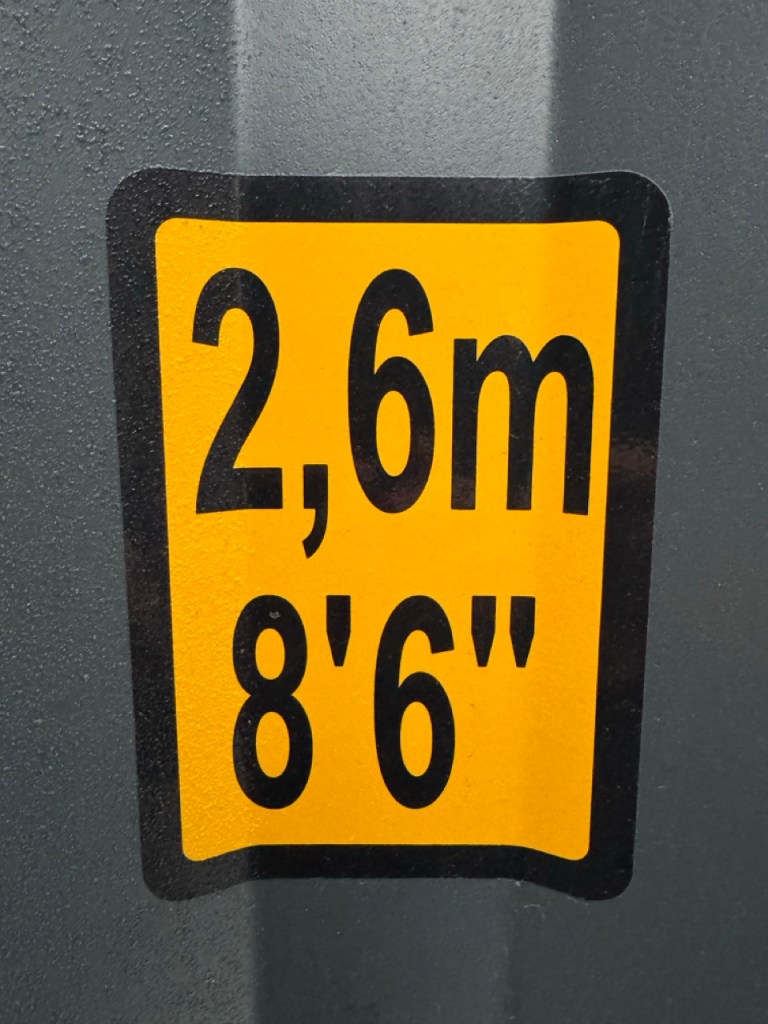
Height 2.6 m – 8’6″ of a Shipping Container
What is “Shipping Container Height 2.6 m – 8’6″”?
Height 2.6 m (8’6″) of a shipping container refers to the standardized external dimension of a shipping container used in international transport and storage. This height corresponds to 2,591 mm and is defined by the international standard ISO 668. Thanks to this standard, shipping containers are compatible worldwide – they can be efficiently stacked, transported by ships, trains, and trucks, as dimensions are strictly adhered to by all manufacturers.
This dimension forms the basis of intermodal transport – thanks to the uniform height, containers can be easily moved between different modes of transport without the need to unload the cargo itself. The standard height of 2.6 m is thus the backbone of global logistics and the daily functioning of international trade.
Detailed Definition and Context
Standard Height in the Shipping Container Dimension System
Shipping container dimensions are not random – each part is precisely designed for maximum efficiency, safety, and compatibility. All common containers (so-called General Purpose – GP) have an external height of 2,591 m (8’6″), which is a parameter that enables their universal use and easy stacking.
Key Dimensions of a Standard Container
| Parameter | 20′ Standard (GP) | 40′ Standard (GP) |
|---|---|---|
| Length (external) | 6,058 m (20′) | 12,192 m (40′) |
| Width (external) | 2,438 m (8′) | 2,438 m (8′) |
| Height (external) | 2,591 m (8’6″) | 2,591 m (8’6″) |
| Length (internal) | 5,898 m | 12,032 m |
| Width (internal) | 2,352 m | 2,352 m |
| Height (internal) | ~2,390 m | ~2,390 m |
| Volume | ~33 m³ | ~67 m³ |
Note: Internal dimensions may vary slightly depending on the manufacturer and construction.
Explanation of the Difference Between External and Internal Height
The difference between external and internal height is due to the floor construction (usually plywood 28–30 mm on steel supports) and the roof frame. Internal height is crucial for logistics planning – it determines how high a load can be safely loaded.
High Cube (HC) Container – Alternative for Greater Volume
In addition to standard containers, there are so-called High Cube containers (HC), which are 305 mm (1 foot) higher:
| Container Type | Height (external) | Height (internal) | Volume |
|---|---|---|---|
| 40′ High Cube (HC) | 2,896 m (9’6″) | ~2,698 m | ~76 m³ |
| 45′ High Cube (HC) | 2,896 m (9’6″) | ~2,698 m | ~86 m³ |
High Cube containers are easily recognizable by the yellow-black warning markings on the upper part. Due to their greater height, they are suitable for light but voluminous cargo (furniture, textiles, insulation materials) or for goods that would not fit in a standard container.
Importance of Height Standardization
Advantages of Uniform Height 2.6 m
- Stacking: On ships and in ports, containers are stacked on top of each other. Standard height allows for the creation of stable and safe blocks. Stacking containers is essential for maximizing ship and warehouse capacity – typically up to 8–9 containers are stacked on top of each other.
- Road and Rail Transport: Standard height (in combination with the chassis) ensures that the entire vehicle does not exceed the maximum permitted height for passage under bridges and through tunnels in Europe and the USA (usually up to 4.0–4.2 m).
- Handling Equipment: All gantry cranes, reach stackers, handling trucks, and automated warehouse systems are designed specifically for standard dimensions.
Intermodal Transport
Thanks to standardized dimensions, a container can be transferred directly from a ship to a railway wagon or road chassis without the need to handle the cargo. This saves time, minimizes cargo damage, and reduces costs.
Specifications and Markings on the Container
Each container has mandatory markings according to international standards:
| Marking / Label | Meaning |
|---|---|
| CSC Label | “Convention for Safe Containers” – indicates that the container meets international safety standards, contains information about the manufacturer, year of manufacture, inspections, and technical limits. |
| Identification Number | A code consisting of 4 letters (owner), 6 numbers (serial number), 1 digit (check digit). For example, MSKU1234567. |
| Size and Type Code | For example, “22G1” designates a 20′ GP container, 8’6″ high. |
| Weight Data | Tare weight (own weight), Max. gross (maximum total weight), Payload (cargo capacity). |
Proper marking is essential for transport, storage, and customs inspections.
Practical Implications and Recommendations for Users
Selecting the Right Container Type Based on Cargo
- Standard container 2.6 m (8’6″) is suitable for most common goods – pallets, boxes, drums, machinery, equipment.
- High Cube container is ideal for light, voluminous, or tall cargo – you save costs on a second container and minimize the risk of cargo damage.
Transport and Placement on Site
When ordering transport, consider the total height of the unit:
- Standard container on chassis: 2.6 m (container) + approx. 1.3–1.5 m (chassis) = 3.9–4.1 m
- High Cube container on chassis: 2.9 m + 1.3–1.5 m = 4.2–4.4 m
Always verify the passability of the route (bridges, power lines, trees, entrances). For tall HC containers, special permits may be required.
Optimal Space Utilization
When planning loading, it is crucial to know the internal height of the container. The 30 cm difference between a standard and HC container can mean that instead of two layers of pallets, you can load three, which significantly increases efficiency and reduces costs.
Safety and Cargo Securing
Excessive free space above cargo can lead to cargo shifting and damage during transport. It is recommended to use fillers or bracing elements, especially when not utilizing the full height.
Various Types and Variants of Shipping Containers
In addition to basic GP and HC containers, there are other specialized types:
| Container Type | Height (external) | Specification and Use |
|---|---|---|
| Half Height | 1.29 m | For heavy bulk materials (ore, coal) |
| Open Top | 2.59 m/2.90 m | Open roof for oversized cargo |
| Flat Rack | No walls/roof | For machinery, vehicles, construction equipment |
| Reefer (refrigerated) | 2.59 m/2.90 m | For food, medicines – with cooling unit |
Related Terms and Abbreviations
- ISO Container: A container manufactured according to ISO 668 standard – guarantees compatibility and safety.
- TEU (Twenty-foot Equivalent Unit): Standard volume unit (1 TEU = 20′ container; 40′ = 2 TEU).
- Intermodal Transport: A transport system where a container is transported by multiple modes of transport without changing the cargo itself.
- External Dimensions: External (total) dimensions including construction.
- Internal Dimensions: Internal (usable) dimensions – determining for cargo planning.
Overview Table of Dimensions
| Container Type | Length (external) | Width (external) | Height (external) | Height (internal) | Volume |
|---|---|---|---|---|---|
| 20′ Standard (GP) | 6.06 m | 2.44 m | 2.59 m | ~2.39 m | ~33 m³ |
| 40′ Standard (GP) | 12.19 m | 2.44 m | 2.59 m | ~2.39 m | ~67 m³ |
| 40′ High Cube (HC) | 12.19 m | 2.44 m | 2.90 m | ~2.70 m | ~76 m³ |
| 45′ High Cube (HC) | 13.72 m | 2.44 m | 2.90 m | ~2.70 m | ~86 m³ |
| Half Height | 6.06 m | 2.44 m | 1.29 m | ~1.10 m | ~16 m³ |
The height of a standard shipping container – 2.6 m (8’6″) – represents a fundamental building block of global logistics. Its thorough standardization enables efficient, safe, and flexible transport of goods between continents, regardless of manufacturer or mode of transport. Proper knowledge of the differences between standard and High Cube height allows for optimizing transport efficiency, reducing costs, and minimizing the risk of cargo damage. When selecting a container, it is therefore key to always verify not only the external but also the internal dimensions and requirements for the cargo to be transported.

 Czech Republic, Hradec Králové
  FREE SHIPPING

