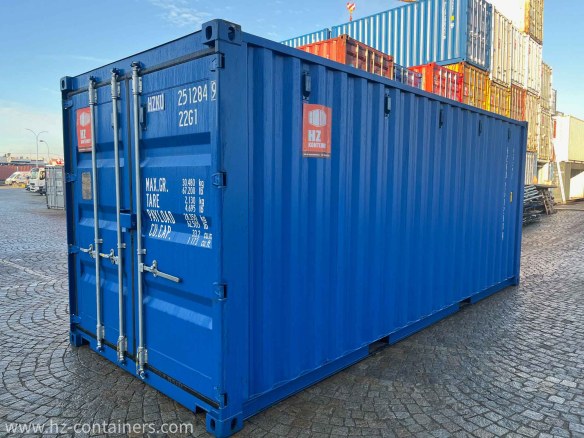
EMPTY LIFT ONLY
What does the “EMPTY LIFT ONLY” warning mean?
The designation EMPTY LIFT ONLY represents a key safety warning placed on shipping containers that strictly prohibits lifting or any handling of the container in a loaded state. This designation indicates that the given lifting points, structural elements, or even the entire container are not designed to safely bear the combined weight of the container’s own body and cargo (so-called gross weight).
Why is this warning critical?
- Accident prevention: Failure to observe this designation can lead to structural collapse of the container, damage to expensive lifting equipment, and endangerment of operator lives.
- Compliance with standards: The designation reflects the requirements of international regulations (ISO, OSHA) for safe working environments.
- Specific cases: Most commonly applies to internal pockets for forklifts, containers after modifications (e.g., window/door cutouts), or damaged or corroded units.
Typical scenarios where the marking is used:
| Area of Use | Example | Risk When Ignoring the Designation |
|---|---|---|
| Internal pockets for forklifts | Lifting a 20′ container by center pockets | Floor bending and destruction |
| Structurally modified container | Container with cutouts for windows/doors | Loss of stability, deformation, collapse |
| Damaged/corroded container | After accident, significant corrosion damage | Weld cracking, collapse under load |
| Inappropriate lifting method without spreader | Lifting a loaded container with binding materials | Horizontal forces, destruction of top frame |
Difference in handling: Empty vs. loaded container

Handling empty containers
- Tare: 20′ container – approx. 2,200 kg, 40′ container – approx. 3,800 kg.
- Lifting forces: Low, evenly distributed, structure is sufficiently robust.
- Handling methods:
- Greater tolerance for non-ideal angles of binding materials.
- Possibility of using standard forklifts with correct pockets.
- Special “empty container handlers” allow fast and efficient handling.
- Safety: Risk of structural damage is minimal when correct procedures are followed.
Handling loaded containers
- Gross weight: Up to 30,480 kg (standard according to ISO 668).
- Critical points: Top longitudinal beams and corner elements are exposed to extreme loads.
- Necessity: Use of approved methods (spreader, correct forklift pockets, gantry crane).
- Danger: Lifting with binding materials at an angle without a spreader leads to horizontal forces → deformation, container breakage, cargo drop.
Comparison of forces acting on the structure:
| Container State | Weight | Recommended Lifting Method | Risk with Incorrect Method |
|---|---|---|---|
| Empty | 2–4 t | Ropes, forklift (with correct pockets) | Minimal |
| Loaded | 24–30 t | Spreader, gantry crane | Deformation, collapse, injury |
Structural integrity and ISO standards
Basic structural elements of ISO containers
| Element | Function and Load | Special Risks with Incorrect Use |
|---|---|---|
| Corner fittings (ISO 1161) | Strongest points, lifting, stacking | If damaged – handling prohibited |
| Bottom longitudinal beams | Transfer cargo weight to corners | Poor load distribution – deformation |
| Top longitudinal beams | Maintain shape, lower strength | When lifting with binding materials – collapse |
| Corner posts | Vertical force transfer during stacking | When modified (windows, doors) – weakening |
| Walls, roof | Rigidity, but not primary load-bearing function | Cutouts significantly reduce strength |
Modifications and their impact on load capacity
- Cutouts and modifications: Cut openings, built-in doors or windows fundamentally compromise original strength.
- Damage/corrosion degradation: Reduces declared load capacity, inspection required before any lifting.
- “EMPTY LIFT ONLY” designation: Must be clearly and permanently marked in accordance with ISO 6346, possibly supplemented with safety pictograms.
Pockets for forklifts
- External pockets: Designed for lifting even loaded 20′ containers – must be used only with high-capacity forklifts.
- Internal pockets: Exclusively for handling empty containers! Lifting a loaded container here leads to floor and frame destruction.
- 40′ containers: Mostly have no pockets, forklift handling is extremely risky even when empty.
Approved handling methods and lifting equipment
Overview of methods according to ISO 3874:
| Method | Empty Container | Loaded Container | Note |
|---|---|---|---|
| Spreader | YES | YES | Safest, required for loaded |
| Ropes on top corners | YES | NO | Permitted only for empty |
| Ropes on bottom corners | YES | CONDITIONALLY | For loaded only when angles are maintained |
| Forklift with correct pockets | YES | ONLY 20′ and per capacity | Must verify maximum weight |
| Empty container handler | YES | NO | Special machines for empty containers |
| Side-loader | NO | YES | Allows lifting of loaded containers |
Technical details of spreader:
- Twistlock mechanism: Secures all four top corners, transferring all forces vertically.
- Load capacity: Standard up to 45 t (when used in port cranes).
- Safety element: Prevents horizontal forces that could damage the frame.
Forklifts and pockets:
- Pocket dimensions: Usually 350 mm high and 150 mm wide.
- Use: Always check whether the given pocket is designated by the manufacturer for a loaded container (usually only external).
- Missing pockets: Most 40′ containers do not have them due to bending risk.
Additional equipment:
- Grappler pockets: Special openings for handling by side-loaders.
- Gooseneck tunnels: Allow safe placement of container on special trailers (especially for 40′ units).
Regulatory and safety framework
Basic standards and regulations
| Standard/Regulation | Area of Regulation | Brief Description and Significance |
|---|---|---|
| ISO 3874 | Container handling and securing | Defines approved lifting and securing methods |
| ISO 1496-1 | Construction and testing | Certifies containers for declared load capacity |
| ISO 6346 | Coding, identification and marking | Regulates “EMPTY LIFT ONLY” designation and other labels |
| OSHA 29 CFR 1918 | Port and handling safety | Requires weight marking, inspections and training |
| IMO, ICHCA | International safety recommendations | Rules for multimodal transport |
Practical recommendations
- Visible marking: Each unit must clearly show empty weight (TARE), maximum permitted weight (MAX GROSS), and any handling restrictions.
- Personnel training: Operators must be familiar with the meaning of all markings and trained in identifying “EMPTY LIFT ONLY”.
- Regular inspections: Check physical condition of container and legibility of markings before each lift.
Container marking in practice
Types of markings and their meaning
| Type of Marking | Explanation and Example |
|---|---|
| “EMPTY LIFT ONLY” | Lift empty only |
| “NO FORKLIFT” | Forklift use prohibited |
| “MAX GROSS 30,480 KG” | Maximum total weight |
| “TARE 2,200 KG” | Weight of empty container |
| Warning pictograms | Visualization of restrictions |
| Accompanying instructions | E.g., “Use spreader only” |
| Combined data table | Summary of all operational data |
Most common errors and risks
- Physically damaged or faded markings: Risk of misinterpretation, regular renewal required.
- Incorrect use of forklift pockets: Lifting large container with unsuitable pockets → immediate destruction.
- Ignoring “EMPTY LIFT ONLY”: Regularly leads to accidents, cargo losses, and fatalities.
Frequently Asked Questions (FAQ)
Why is it not sufficient to lift a loaded container with binding materials on the top corners?
Because ropes at an angle create horizontal forces that the top frame cannot withstand – it will bend and be destroyed. Always use a spreader.
How can I safely tell if a container is empty?
It must be clear from documentation, markings on the container, and communication with dispatch. Never guess, always verify.
Can all forklift pockets be used with a loaded container?
No – internal pockets only for empty! External pockets only when forklift and container load capacity requirements are met.
What if I lift a structurally modified (e.g., residential) container in a loaded state?
Immediate structural failure is likely, door/window blockage, weld cracking, or complete container collapse.
Who is responsible for observing the “EMPTY LIFT ONLY” designation?
The operator, their supervisor, and the employer – all must ensure and monitor compliance with safety procedures.
The “EMPTY LIFT ONLY” designation is not a bureaucratic formality, but a vital safety element based on structural principles, tests, and experience from global shipping. Respecting this designation protects not only the containers and equipment themselves, but above all the health and lives of workers. Modern logistics, where tens of tons are handled, cannot afford compromises in safety. Everyone working with containers must know the meaning of this designation, respect it, and uncompromisingly require its observance.
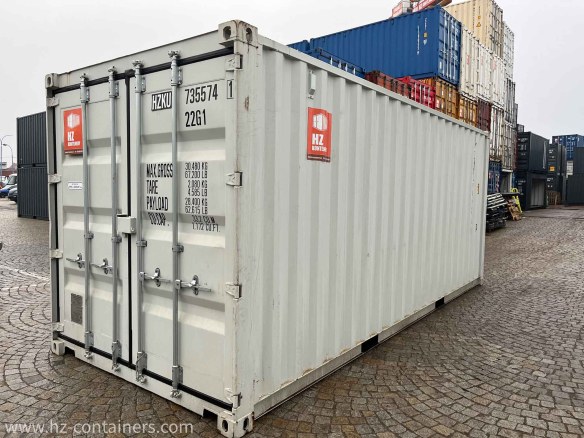
 Czech Republic, Hradec Králové
 FREE SHIPPING