
Corner Casting – Certificate 3.2
Corner casting with Certificate 3.2 is a highly standardized metal component according to ISO 1161, which is a key node in the construction of intermodal containers. Certificate 3.2 according to EN 10204 is the strictest form of material verification, meaning that the material properties, its chemical composition and production traceability have been independently inspected and confirmed not only by the manufacturer’s authorized quality department but also by an independent third party – an inspection agency or classification society. This double validation provides the highest possible assurance of quality, origin, and integrity of the critical component.
Overview of Basic Terms
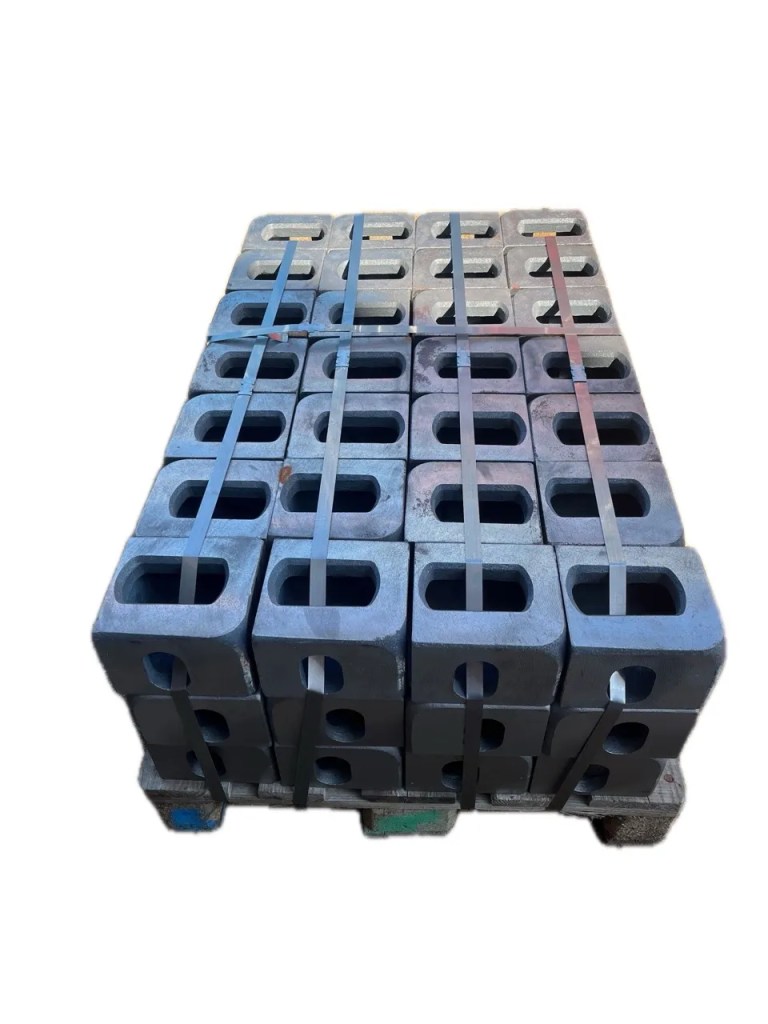
What is an ISO corner casting?
- A corner casting (ISO 1161) is a basic, block‑shaped steel part located at the eight corners of a shipping container.
- Functions:
- Handling: Standardized attachment for cranes and spreaders.
- Stacking: Enables stable stacking of containers on ships, in ports and depots.
- Securing: Serves as attachment points for locking devices (twistlocks) and for anchoring to decks, rail wagons or trailers.
Why is quality important?
Because the failure of a single corner casting can cause a catastrophic collapse of the entire structure. Therefore dimensions, shape, and strength are precisely defined by the ISO 1161 standard.
What is EN 10204?
- EN 10204 – European standard Metal products – Types of inspection documents.
- Defines the types of inspection certificates for material quality and the scope of their verification.
- Allows unambiguous proof of quality and conformity with the order across international supply chains.
Types of EN 10204 certificates:
| Certificate Type | Meaning | Verification / Signature |
|---|---|---|
| 2.1 | Declaration of conformity with the order | Manufacturer only, no specific tests |
| 2.2 | Test report | Manufacturer, routine tests, not batch‑specific |
| 3.1 | Inspection certificate | Manufacturer (independent department), specific batch, specific tests |
| 3.2 | Inspection certificate | Manufacturer + independent third party (e.g., ABS, BV, Lloyd’s Register) |
Certificate 3.2 in Detail
What does “independent third‑party verification” mean?
- In addition to the manufacturer’s internal control, the entire process of production, testing, and documentation is physically verified by a certified inspector from an independent agency.
- Common agencies: American Bureau of Shipping (ABS), Bureau Veritas (BV), DNV, Lloyd’s Register, etc.
- The process includes:
- Audit of the production process (factory visit, batch tracking and marking).
- Physical witnessing of mechanical and impact tests (e.g., Charpy V‑notch test at –20 °C).
- Documentation review of chemical composition, test results, and traceability.
- Dimensional and visual inspection of the final castings according to ISO 1161.
Why is the 3.2 certificate essential for corner castings?
- Structural safety: Corner castings transmit loads up to 190 tonnes to the lower corner points. Certificate 3.2 guarantees that the material has the required strength, toughness, and resistance to brittle fracture at low temperatures.
- Regulatory requirement: For special containers (e.g., offshore DNV 2.7‑1, tank containers, oil and gas industry structures) a 3.2 certification is often mandatory.
- Counterfeit protection: In the global supply chain the 3.2 certificate acts as a “trust seal” for the component.
- Proof of origin and properties: Enables traceability of the production batch, chemical composition, and mechanical properties.
Comparison: Certificate 3.1 vs. 3.2
| Property | Certificate 3.1 | Certificate 3.2 |
|---|---|---|
| Verification | Manufacturer (independent department, outside production) | Manufacturer + independent third party |
| Level of assurance | High, based on internal control | Highest, independent external verification |
| Process | Manufacturer performs specific tests and issues the certificate | Third party witnesses tests, reviews documentation, co‑signs |
| Cost | Standard, usually included in the price of quality components | Significantly higher, includes third‑party inspector fees |
| Typical use | General engineering, standard containers | Critical applications: offshore, pressure vessels, specialized containers |
Certification Process 3.2 for ISO Corner Castings
- Order: The buyer must explicitly request EN 10204:2004 type 3.2 and specify acceptable inspection agencies.
- Manufacturer’s production and control process:
- Melt and batch traceability.
- Chemical analysis of the material (spectrometry).
- Mechanical tests (tensile strength, yield point, elongation).
- Impact tests (Charpy V).
- Complete documentation.
- Third‑party inspection:
- Audit of the production process and documentation.
- Sampling and witnessing of tests.
- Inspection of marking, dimensions, and visual condition.
- Co‑signature of the certificate = formal confirmation of type 3.2.
Practical Tips and Limitations
- Precise specification in the order: Clearly require the type of certificate, product, standard, and approved agencies.
- Certificate approval before use: Always obtain the certificate for approval before incorporating the casting into the structure.
- Limitation: Certificate 3.2 does not automatically approve the entire container for a specific use according to classification society rules – additional project approval may be required.
What does the 3.2 inspection certificate contain?
- Manufacturer and product name (ISO 1161 corner casting)
- Dimensions, quantity, melt number, batch number
- Chemical composition and mechanical test results for the specific batch
- Results of additional tests (impact, ultrasonic, visual)
- Traceability protocol
- Signatures: authorized manufacturer representative and inspector from the independent third party
Related Terms and Standards
- ISO 1161: International standard for dimensions, materials, and strength requirements of container corner castings
- EN 10204: Standard for inspection documents of metal products
- Third Party Inspection (3PI): Independent agency providing objective verification
- Material traceability: Ability to trace material origin from chemical analysis to final component
- Charpy V‑notch test: Impact test to verify material toughness at low temperatures
- ABS, BV, DNV, Lloyd’s Register: Leading inspection and classification societies in transport and engineering
Conclusion
The ISO 3.2 certificate for corner fittings is the gold standard for safety and reliability in the field of container components. It guarantees that each piece is manufactured, tested and documented according to the most stringent requirements of international and European standards, and that its properties have been verified by an independent authority. In critical applications where safety, integrity and traceability are key, this certificate is indispensable.

 Czech Republic
  WITHOUT SHIPPING
