
U Handle Holder
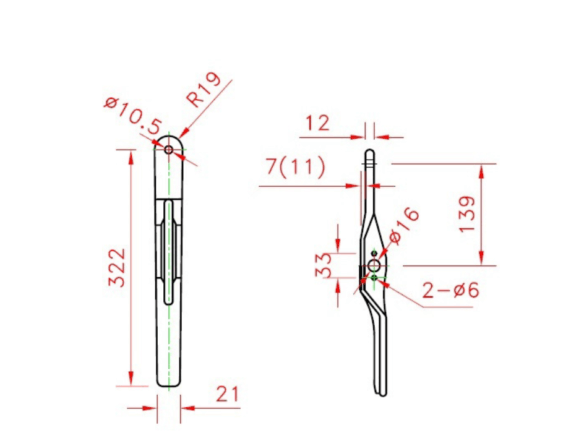
The door handle holder (known also as U Handle Holder, also professionally as Door Handle Retainer or Retainer Catch) is an inconspicuous but crucial part of the external mechanism of a shipping container door. Its key function is to securely fix the handle controlling the locking rods (vertical rods) in the closed and locked position. This simple U-shaped steel holder prevents the long handles from moving spontaneously during transport, thus ensuring that the locking mechanism remains fully engaged and the container doors hermetically sealed.
Catalog number: HZ000254 and HZ013133
Significance in the Security System
The handle holder is an integral part of the door locking system. It is usually permanently welded to the corrugated steel sheet of the door leaf. During door handling, engaging the handle into the holder is the final step that ensures safe transport or storage of the container.
Without the holder, due to vibrations and movements during transport (by sea, rail, road), the handle could disengage from its locked position, leading to the door loosening or failing – with potentially catastrophic consequences for the cargo.
Detailed Anatomy and Function of the Door Handle Holder
Placement and Mounting in the Door System
The handle holder is precisely situated on the front side of each door leaf, in the position where the handle engages when the rods are fully locked. On a standard
ISO container with four vertical locking rods, you will find four handle holders – two on each door. The placement is designed so that the handle is easily accessible from the ground and does not compromise the door’s strength.
Technical Diagram of the Container Door Mechanism
| Component | Function | Material / Surface Finish | Standards |
|---|---|---|---|
| Locking rods | Fix the doors in the frame, ensure hermetic sealing | Steel (galvanization, coating) | ISO 1161, ISO 1496 |
| Handle | Provides leverage and rod rotation | Steel, Corten, stainless steel | ISO, EN standards |
| Handle holder (U Holder) | Secures the handle in a fixed position | Welded steel, Corten | ISO, EN standards |
| Retainer eye/tab | Additional security against spontaneous opening | Steel, stainless steel | – |
| Door seal | Prevents water/dust ingress | EPDM rubber | ISO 1496, EN 283 |
Construction, Materials, and Durability
The U-shape is chosen for the easiest handle engagement and maximum resistance to mechanical stress. Holders are almost exclusively made from the same material as the frame and door panels – high-strength, corrosion-resistant steel, Corten, or stainless steel (especially for refrigerated containers).
Material Properties:
- Corten : The surface itself naturally passivates and protects against corrosion, ideal for marine environments.
- Stainless steel : Used mainly for reefers, it has increased resistance to seawater and chemicals.
- Galvanization : Some holders are galvanized for an additional level of protection.
Robustness is key – the holder must withstand:
- Extreme temperatures (-40 to +70 °C)
- Humidity, salt atmosphere, UV radiation
- Repeated impacts and vibrations
Safety Features:
Many holders are equipped with a rotating tab (Retainer Catch), which, after the handle is inserted, rotates over its top side – thereby preventing the handle from spontaneously disengaging even during strong shocks. Here, it is also possible to apply a seal or padlockdirectly through the hole in the tab and handle.
Mechanical Function in the Locking Sequence
The process of locking container doors culminates in the locking of the handle in its holder. The correct sequence is as follows:
- Closing the doors – first the left, then the right leaf, the seal is pressed against the frame.
- Rotating the locking rods – the handle rotates the rods, causing the upper and lower cams to engage into the keepers in the frame.
- Securing with the lever – the handle is a lever with great force, allowing it to overcome the resistance of the seal and any potential deformations.
- Engaging into the holder – the handle is folded into the holder and locked.
- Flipping the tab/retainer – the tab is rotated over the handle, and optionally locked with a padlock or seal.
As a result, the entire locking system is under constant tension and cannot spontaneously disengage.
The Handle Holder in Relation to the Entire Door System
The handle holder is just one of many parts of a container’s complex door system. Its importance is best understood by comprehending its connection to other components:
- Door panels : Two large, corrugated steel leaves to which the handle holders and other mechanisms are firmly welded.
- Locking rods : Vertical steel rods that run the full height of the doors and secure them in the frame.
- Handle : A welded lever-shaped component that allows the rod to be rotated and generates the necessary force.
- Cams & keepers : Steel protrusions on the rod (cams) and robust eyes in the frame (keepers) into which they engage and prevent opening.
- Door gasket : A durable rubber seal around the perimeter of the doors, ensuring watertightness.
- Hinges : Robust hinges allowing the doors to open up to 270°; any corrosion or deformation can cause problems when closing.
- Container frame : The load-bearing skeleton of the container (top/bottom rails, corner posts) to which all door elements are attached.
The handle holder is the final link that translates the worker’s force into the secure locking of the entire assembly.
Types, Variants, and Industrial Standards
Common Types of Holders
- Standard handle holder : Welded from strip steel, with a rotating tab, common on dry containers.
- Holder for reefer containers : Typically made of stainless steel, with a more massive construction due to stronger sealing and higher force required for locking.
- Holder for special containers : For open-top or flat rack containers, the holder is used only if they have doors.
Number of Holders per Container
- Standard ISO 20’ and 40’ containers: 4 holders (2 on each leaf).
- Older or atypical container: Exceptionally only 3 holders.
Industrial Standards
- ISO 1161, ISO 1496 : Specify the dimensions, strength, and placement of all door elements.
- EN 283 : Testing standards for containers in Europe.
- CSC (Container Safety Convention) Certification : A prerequisite for sea transport.
New Trends and Technologies
- Surface treatments with higher corrosion protection (e.g., cataphoresis)
- Modern security features (RFID seals, electronic locks)
- Optimization for easier/faster service and replacement (modular holders)
Most Common Failures, Maintenance, and Repairs of the Handle Holder
Typical Faults
- Corrosion and seizing : The most common issue is a rusted or stiff tab (retainer), especially in marine environments.
- Deformation : Industrial accidents, impacts from equipment or other containers can bend or break the holder.
- Worn or fatigued welds : After thousands of manipulations, the weld can loosen, causing the holder to wobble or fall off completely.
- Misalignment : Deformation of the door or frame prevents the handle from seating correctly in the holder.
Recommended Service and Maintenance
- Regular visual inspection – look for signs of rust, cracks, bends.
- Lubrication – treat the tab’s joints with high-quality grease, ideally marine grade (marine grease).
- Cleaning – remove mud, ice, and other debris that prevent the handle from seating correctly.
Repairs and Replacements
If the holder is damaged, immediate replacement is necessary:
- Grind off the old holder (angle grinder).
- Carefully clean the door surface of rust and old paint.
- Position the new holder precisely in the original location, check the handle’s function in the closed position.
- Weld firmly (ideally 3-4 welds around the perimeter).
- Treat with primer and final paint against corrosion.
Important: Never transport a container with a damaged or missing holder! You risk the safety of the cargo, the watertightness of the doors, and the container’s lifespan.
Glossary of Related Terms
| Term | Meaning |
|---|---|
| Bottom side rail | Main frame beam in the lower part of the side wall |
| Container frame | Steel skeleton forming the load-bearing structure of the entire container |
| Handle | Lever for rotating the locking rod |
| Locking system | Complete set of all parts for secure door locking |
| Door parts | All individual components of the container door |
| Corner casting | Massive blocks on the corners for handling and stacking |
| Door gasket | Rubber seal around the perimeter of the doors |
| Locking rods | Vertical rods fixing the doors in the frame |
| Shipping container | Standardized steel box for transport and storage |
| Reefer container | Insulated and often refrigerated container for food and sensitive goods |
| Top side rail | Main frame beam in the upper part of the side wall |
Frequently Asked Questions (FAQ)
What is the purpose of a door handle holder on a container?
It secures the handle in the locked position – preventing it from moving and thus the door from opening spontaneously during transport.
Are handle holders universal for all containers?
The basic principle is the same, but they differ in material (stainless steel/steel), dimensions and type (with or without a tongue), depending on the type of container.
What to do if the handle holder is rusty?
Use penetrating oil and try to move the tongue. If it is completely seized, it must be professionally replaced.
How many holders are there on a standard container?
Most modern ISO containers have four holders (two on each door).
Is it safe to use a container with a damaged handle holder?
No, always repair the holder before loading and transport. A damaged part poses a risk to tightness and safety.
 Czech Republic
  WITHOUT SHIPPING

