
Gooseneck tunnel
What is a Gooseneck Tunnel?
Gooseneck tunnel is a special construction element in the floor of a transport container, designed for efficient placement of the container on the lowered part of a specialized chassis (gooseneck chassis). It is a longitudinal recess in the front part of the container, whose main purpose is to lower the overall transport height of the train (tractor + chassis + container). This is essential especially when transporting High Cube containers (HC), which would otherwise exceed legal limits for maximum vehicle height on the road with a standard chassis.
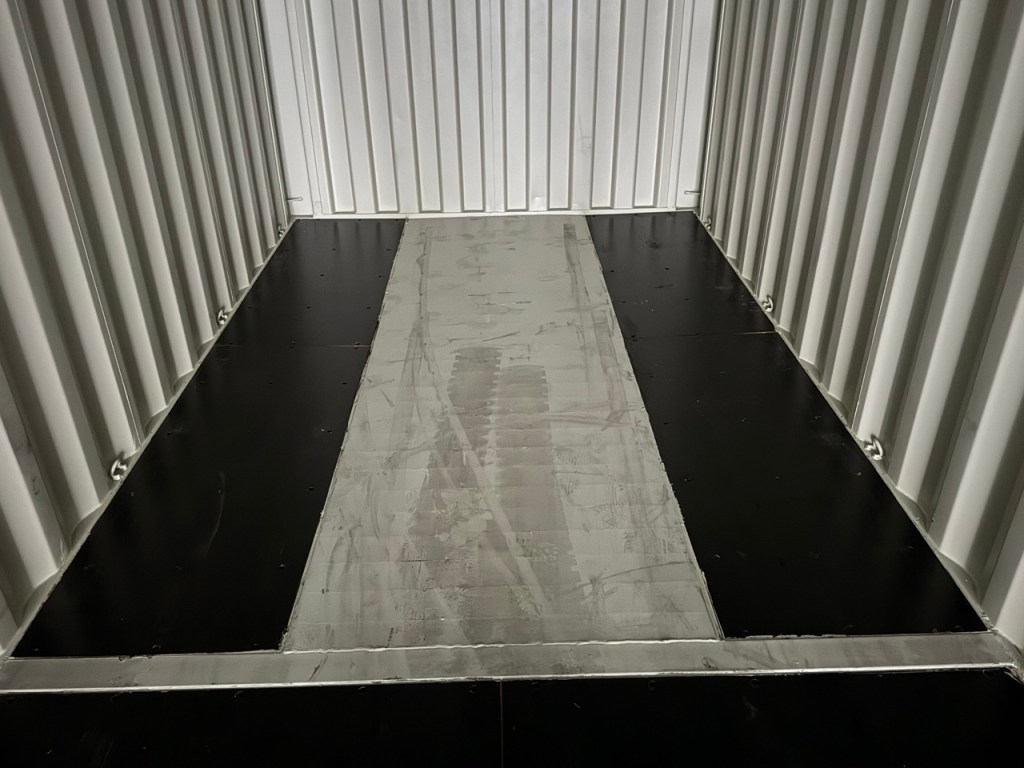
Related and alternative terms
- Gooseneck recess
- Tunnel for chassis with goose neck
- Recess for gooseneck chassis
- Gooseneck container (container with tunnel)
- Gooseneck chassis (special trailer)
Detailed explanation of the Gooseneck Tunnel
Importance in modern logistics
Standardized transport containers are the backbone of global goods movement because they can be easily transferred between ship, train and truck. To maximize cargo volume, higher High Cube containers (9’6”/2,896 mm high versus standard 8’6”/2,591 mm) were introduced. The higher container, however, creates a taller train, which can be problematic due to maximum allowed height restrictions (typically 4 m in the EU).
Why was the gooseneck tunnel created?
- Problem: A High Cube container on a standard chassis exceeds the permitted height for road transport.
- Solution: The gooseneck chassis has a lowered front profile, into which the gooseneck tunnel fits in the container floor. This lowers the front part of the container and meets legal limits.
Construction of the gooseneck tunnel
Construction elements according to ISO 1496-1 and technical standards:
| Element | Description |
|---|---|
| Location | Always in the front part of the container, typically 3–4 m from the front |
| Depth | Standard approx. 130 mm (according to ISO 1496-1, Annex E) |
| Width | Approximately 1 025 mm (according to ISO 1496-1) |
| Length | Usually 3 250–3 300 mm, depending on container type |
| Material | Steel profiles with reinforcements, often with steel sheet inside the tunnel |
| Reinforcement | Heavily reinforced to avoid weakening the floor structure (steel beams, transverse braces) |
Diagram of a typical 40’ HC container with a gooseneck tunnel:
- The tunnel runs along the longitudinal axis in the front part of the floor.
- The reinforced area around the tunnel transfers loads to the side frames.
- The tunnel floor is often separately drained and protected against corrosion.
Standards and technical requirements
ISO standards
The gooseneck tunnel is described in several ISO standards, especially:
- ISO 1496-1 – specifications and testing of containers; Annex E defines the dimensions and construction of the tunnel.
- ISO 668 – container dimensions and classification.
- ISO 830 – container terminology.
Selected requirements:
- The tunnel is permitted for types 1AA, 1A, 1AX (i.e., 40’ and 45’ containers).
- It must be compatible with all gooseneck chassis according to the standard.
- It must not compromise the strength or stackability of the container.
Benefits of using the Gooseneck Tunnel
- Reduced overall train height – legal for road transport, minimizing risk of fines or traffic issues.
- Maximized internal volume – especially for HC containers, where volume increases by about 13 % compared to standard.
- Improved stability – lower centre of gravity thanks to the lowered front.
- Safety – better weight distribution, lower risk of train overturn.
- Economic efficiency – more goods per trip, lower unit transport cost.
Which containers have a gooseneck tunnel?
| Container type | Height | Length | Gooseneck tunnel |
|---|---|---|---|
| 40’ High Cube (40’HC) | 9’6” (2 896 mm) | 12 192 mm | YES |
| 45’ High Cube (45’HC) | 9’6” (2 896 mm) | 13 716 mm | YES |
| 20’ Standard | 8’6” (2 591 mm) | 6 058 mm | NO |
| 40’ Standard | 8’6” (2 591 mm) | 12 192 mm | EXCEPTIONALLY (more for versatility) |
Reefer and special containers: Some 40’/45’ HC reefers may also have a tunnel for compatibility.
Gooseneck tunnel vs. standard floor
| Feature | With gooseneck tunnel | Standard floor |
|---|---|---|
| Purpose | Primarily for HC containers | Standard containers |
| Floor | With recess in front part | Entire floor flat |
| Compatibility | Gooseneck chassis and flat chassis | Only flat chassis |
| Space utilization | Slightly limited volume in tunnel area | Fully usable volume |
| Stackability | Meets ISO requirements | Standard |
Technical specification and strength
- The floor with a tunnel must pass load tests – it must withstand at least 7 260 kg over a 600 mm width (ISO 1496-1).
- The area around the tunnel requires reinforced transverse beams and additional braces to prevent local deformation or loss of load‑bearing capacity.
- The tunnel floor is often made of corrugated steel with increased thickness to distribute stresses during stacking and point loading.
Practical use
The gooseneck tunnel is essential in sectors that need to transport tall but lightweight goods (e.g., electronics, furniture, consumer goods, textiles) because it allows the use of larger HC container volume without special permits. It is also valuable for:
- Automotive industry (transport of parts)
- Furniture manufacturers
- Logistics companies with high cargo volumes
Handling and maintenance requirements
- Containers with a gooseneck tunnel can be loaded and unloaded with the same equipment as standard containers (crane, reach stacker).
- During handling, the floor area around the tunnel must be inspected – increased loading creates a higher risk of local corrosion and mechanical damage, especially on older containers.
- Regular inspection of welds and reinforcements in the tunnel area is recommended.
Frequently Asked Questions (FAQ)
What is a gooseneck tunnel?
A construction recess in the floor of the front part of a container, allowing it to sit on a lowered chassis.
Who determines the dimensions of the gooseneck tunnel?
Dimensions are standardized in ISO 1496-1, Annex E, and must be compatible with all gooseneck chassis.
Can a standard container be transported on a gooseneck chassis?
Yes, but the lowered chassis portion will not be utilized – the container will sit higher.
Is the tunnel a weak point in the structure?
No, if properly designed and reinforced. ISO standards include specific strength and load‑test requirements for this modification.
Does the gooseneck tunnel increase the container weight?
Slightly, due to the reinforced construction around the tunnel, but the increase is negligible compared with the container’s total load capacity.
Summary
The gooseneck tunnel is a key structural element for the transport of high-cube containers in modern logistics. It enables the legal and safe road transport of High Cube containers, without the need for special permits, and contributes to increasing efficiency and safety throughout the supply chain. Anyone involved in shipping containers should know the design principle, advantages and technical requirements of the gooseneck tunnel.

 France, Rouen
  WITHOUT SHIPPING

