
What is the 4 Fold shipping container suitable for?
What is the 4 Fold shipping container?
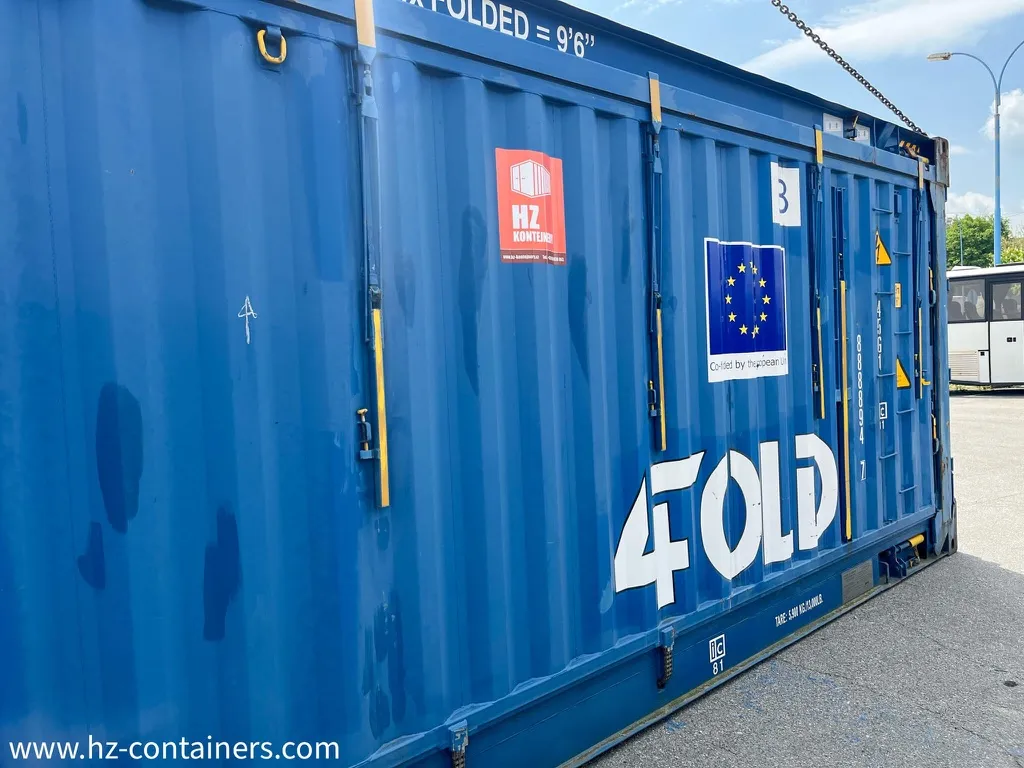
The shipping container 4 Fold – often referred to as 4FOLD foldable container – represents a revolutionary innovation in global logistics and transport. It is a fully certified, standardized maritime container of size 40‑foot High Cube (HC), whose unique feature is the ability to fold down to just a quarter of its original height. This technology was developed by the Dutch company Holland Container Innovations (HCI) and is protected by several patents worldwide.
Key technical parameters:
| Parameter | Value |
|---|---|
| Type | 40′ High Cube (HC) |
| Material | High‑strength steel |
| Empty container weight | approx. 4 100 kg |
| Weight in folded state | approx. 4 100 kg |
| Height in folded state | approx. 650 mm (0.65 m) |
| Load capacity | up to 30 480 kg |
| Certifications | ISO, CSC, UIC, AAR |
| Number of patent families | 10+ |
Operating principle
After folding, four 4 Fold containers can be connected into a single bundle with the dimensions of a standard 40′ container. This bundle can be handled, transported and stored just like a regular container. The seemingly simple concept addresses a major problem in global trade: inefficient transport of empty containers.
Main problem addressed by 4 Fold: Transport of empty containers
Global logistics suffers from a significant imbalance between imports and exports. While, for example, Asia massively exports goods to Europe and the Americas, the return flow is much smaller – leading to a surplus of empty containers in certain regions.
Key facts:
- At sea: Up to 20 % of containers shipped on vessels are empty.
- On land: In road and rail transport the share can reach 40 %.
- Financial impact: Shipping lines spend more than €25 billion annually on repositioning empty containers.
- Environmental footprint: Empty moves generate over 200 million tonnes of CO₂ per year – comparable to the emissions of the entire EU transport infrastructure.
- Space requirement: More than 30 million m² of storage area is used for empty containers.
This inefficiency not only causes financial losses but also increases emissions, port congestion and wear on infrastructure.
How does the 4 Fold container work? Mechanism and handling
Folding and unfolding process
Folding (≈ 10 minutes, 2 workers):
- Fold side walls – side panels fold inward onto the floor.
- Raise the roof – the roof, attached to the front walls, is lifted.
- Fold front walls – the door and front wall are placed on the inside.
- Lock the roof – the roof is lowered and locked onto the folded walls.
Unfolding (reverse steps):
- Same number of workers; can be performed anywhere with standard handling equipment.
4‑in‑1 transport concept
- Four folded containers are stacked and connected into one bundle.
- The bundle matches the exact dimensions of a single 40′ container and has standard corner fittings.
- It can be handled with all ordinary equipment: spreaders, cranes, container handlers.
- No special equipment is required.
Robustness and lifespan
- Made from high‑strength steel.
- Tested under extreme conditions (marine salinity, vibration, stacking).
- Service life and load capacity are comparable to a standard ISO container.
Why is the 4 Fold container suitable? Key advantages and applications
Economic benefits
- Up to 75 % cost savings on repositioning empty containers (4 for the price of 1).
- Reduced storage and handling fees – you pay for the bundle, not each individual container.
- Faster handling = lower operating costs.
Environmental benefits
- Up to 37 % reduction in CO₂ emissions associated with moving empty containers.
- Fewer trips mean lower NOx, PM10 and noise emissions.
- Supports climate commitments and enables environmental certification.
Operational benefits
- Space savings in depots and ports – 4 × more containers in the same area.
- Reduced congestion at logistics hubs.
- Greater flexibility and faster response to demand for empty containers.
Wide range of uses
| Application area | Benefit / Specific features |
|---|---|
| International maritime transport | Ideal for unbalanced routes (Asia‑USA, Asia‑EU) |
| Road and rail transport | Fewer vehicles, higher efficiency |
| Port depots and terminals | Maximised storage capacity |
| Humanitarian aid | Rapid transport, field storage |
| Mobile facilities | Temporary warehouses, offices, workshops |
| Construction | Mobile base, technical stores |
Technology, construction and certifications
Certifications and standards
- ISO (International Organization for Standardization): Dimensions and handling standards.
- CSC (Container Safety Convention): Safety and stackability.
- UIC (International Union of Railways): International rail transport.
- AAR (Association of American Railroads): Rail operations in the USA.
Certifying authorities: Korean Register, Lloyd’s Register, ABS, DEKRA, China Classification Society.
Technological innovations
- Patented folding mechanisms (more than 10 patent families).
- Production optimized for serial manufacturing in China – ensures availability and fast delivery.
- Ongoing design and process updates to improve efficiency and reduce costs.
Additional technical specifications
- Weight of folded bundle: approx. 16 400 kg (4 × 4 100 kg).
- Assembly/disassembly: Typically 2 people complete the task in 10–15 minutes without special equipment.
- Durability: Fully comparable to standard containers, including watertightness, corrosion protection and mechanical strength.
Case studies and real‑world implementation
Pilot projects and deployments
HCI carried out pilot projects with leading shippers and logistics firms in Europe, Asia and the USA. The solution proved especially effective on routes with a high proportion of empty moves.
Pilot results:
- Verified emission reductions on tested routes.
- Rapid adoption in selected European ports (Hamburg, Rotterdam, Antwerp).
- Creation of certified 4Fold depots: Training and audits ensure safe handling worldwide.
User feedback
- Positive comments on the ease of folding and structural robustness.
- Significant operational savings confirmed in real‑world use.
- Turnaround time in depots reduced by up to 60 %.
Special applications and benefits for different segments
Humanitarian and crisis response
- Fast transport of supplies, mobile hospitals and temporary shelters.
- Ability to unpack directly on site after a disaster.
Construction and modular architecture
- Mobile construction bases, workshops, storage spaces.
- Easy relocation according to project needs.
Temporary storage and mobile infrastructure
- Ideal for seasonal businesses, festivals, sports events.
- Can be linked into larger modular systems.
History and development
- Origin at TU Delft: Academic project turned commercial product.
- Founding of HCI (2008): Start of commercial development and patent protection.
- EU support (Horizon 2020): Grant of over €2.5 million for development, serial production and pilots.
- Awards: Eco Performance Award, European Business Award, among others.
- Production expansion: Partnership with a Chinese factory for mass production.
Future of folding containers
- Automation of folding and unfolding (robotic depots).
- Extension to other sizes (45′, 53′ containers).
- Integration into global fleet‑management systems.
- Planned “green corridors” – optimized routes for folding containers.
Frequently asked questions
| Question | Answer |
|---|---|
| Is 4Fold suitable for cargo transport? | Yes, it fully complies with ISO and CSC standards. |
| Can a folded container be stacked? | Yes, a bundle of four folded containers can be stacked and shipped like a regular 40′ container. |
| Can 4Fold be used as a warehouse or office? | Yes, thanks to insulation, conversion options and accessories. |
| Is folding safe? | Yes, folding/unfolding is certified and performed under supervision of trained personnel. |
| What is the container’s lifespan? | Comparable to a classic ISO container, about 15–20 years. |

 Czech Republic, Prague
  FREE SHIPPING

Other container news...


Detention Fee and Its Significance
Demurrage, known in English as “demurrage” or “detention fee”, is one of the most important and frequently discussed items in shipping and container transport. It is a fee that must be paid by the person responsible for returning a rented shipping container if it is not returned at the agreed time. This fee is calculated for each day of delay and is intended to motivate all participants in the logistics chain to return containers to their original location or designated return location on time.

What is Demurrage in Sea Container Shipping?
Demurrage is a penalty fee charged by ports, shipping lines or port terminal operators when a loaded shipping container remains in a port or port terminal longer than the free time allowed in the contract of carriage or bill of lading.

CSC Certificate for a Converted Shipping Container
The CSC (Convention for Safe Containers) certificate is one of the most important documents in international container transport. Established by the International Maritime Organization (IMO) in 1972, the CSC is a binding international agreement that sets uniform safety standards for shipping containers used in global trade.