
Shipping containers Budapest Hungary
Shipping containers in Budapest and the wider Hungary represent a surprisingly developed market, which can offer favorable prices and a wide selection for Czech and Slovak buyers. Hungary, despite not having its own seaport, figures as one of the key container hubs of Central Europe — and Budapest is its logistical heart. This guide will provide you with all the information needed to navigate the Hungarian container market, from selecting the right type through price comparison to organizing transport to the Czech Republic.
What are shipping containers and why is Budapest a key market?
A shipping container — more precisely an ISO container — is a standardized transport unit that revolutionized global trade. Its history dates back to the 1950s, when American entrepreneur Malcom McLean came up with the idea of unifying the dimensions of transport boxes so that they could be transshipped between ships, trains, and trucks without the need to transship the goods themselves. This innovation gave rise to intermodal transport and reduced the costs of maritime transport by tens of percent.
For illustration: HZ Containers offers for sale at the Budapest depot a 40′ HC Cargo Worthy container for an indicative price of €1,331 (approximately 525,000 HUF).
Definition of a shipping (ISO) container
An ISO container is a steel (usually made of CORTEN steel) or aluminum transport unit of standardized dimensions, constructed to withstand the demanding conditions of maritime transport. Every container intended for international transport must carry a valid CSC plate (International Convention for Safe Containers), which confirms its safety and suitability for transport. This certification is regularly renewed and is one of the main distinguishing features between a full-fledged shipping container and a simple storage container.
Key difference: A shipping (ISO) container has a valid CSC certification and can be used for international maritime transport. A storage container lacks this certification and is intended exclusively for static storage on land.
The main types of shipping containers include:
- Standard container (Dry Van / General Purpose) — fully enclosed, for ordinary goods
- High Cube (HC) — an increased variant with a height of 2,896 mm instead of the standard 2,591 mm
- Double Ventilated (DV) — standard height with additional ventilation openings
- Reefer (refrigerated/freezer) — with an integrated cooling unit
- Open Top — with an openable roof for oversized cargo
- Flat Rack — with folding ends for heavy or bulky goods
- Side Door — with side doors for easier access
Why are Hungary and Budapest an important node of container logistics?
The answer lies in the numbers that define the Hungarian trade balance. Imports to Hungary exceed exports at a ratio of approximately 70:30. In practice, this means that significantly more loaded containers flow into the country than leave it filled. Roughly half of all imported containers return to Asia empty — and it is precisely these surplus units that create a robust domestic market for used shipping containers.
| Factor | Significance for the container market |
|---|---|
| Import/export ratio 70:30 | High surplus of empty containers → lower prices for used units |
| BILK terminal | Main rail hub for intermodal transport |
| MAHART Container Center | Trimodal terminal (road-rail-Danube), 2,800 TEU capacity |
| Proximity to the Czech Republic and Slovakia | Truck transport feasible within 1 day, distance 300–500 km |
What is a container depot and how does it work in Budapest?
A container depot is a specialized facility designed for the storage, maintenance, repairs, and management of shipping containers. In the context of Budapest, it represents a crucial link between maritime transport, land logistics, and end customers.
The depot performs several key functions: safe storage of empty and loaded containers, their cleaning and regular maintenance, damage repairs including recoating and seal replacement, customs clearance and administrative services, and last but not least, logistical coordination — that is, ensuring that the right container is at the right place at the right time.
| Property | Container Depot | Container Terminal | Warehouse |
|---|---|---|---|
| Main function | Long-term storage, maintenance, repairs | Transshipment between transport modes | Short-term storage of goods |
| Range of services | Wide (repairs, cleaning, customs services) | Narrow (transshipment) | Minimal |
| Location | Strategic, near ports/hubs | Directly on transport corridors | Anywhere |
| Typical operator | Specialized companies | Logistics companies | Carriers, traders |
Which sellers and container depots operate in Budapest and surroundings?
The Hungarian market for shipping containers is quite concentrated — several major players cover most of the supply and the rest is made up of smaller specialized sellers. For a Czech buyer, it is key to know both the large depot operators and the smaller companies that can offer an individual approach.
HZ Containers — a Czech seller with international operations. On their website, you can find specific pieces with exact prices.
How to choose the right seller?
When choosing a seller of shipping containers in Budapest, we recommend evaluating the following criteria:
- Size of stock — the larger the depot, the higher the probability that you will find exactly what you need.
- Guarantees and warranties — buyback is a significant added value.
- Language proficiency — not all Hungarian sellers communicate in English. HZ Containers manage English communication.
- Transport services — find out whether the seller also arranges international transport, or whether you have to arrange it yourself.
How much does a shipping container cost in Budapest? Current prices and comparison
Shipping container prices in Hungary depend on several factors: the type of container, its technical condition, age, current demand, and last but not least, the location of the depot. The following overview is based on real offers valid for 2026.
Prices of used containers
Used containers are typically divided into two main categories:
- Cargo Worthy (CW): The container is fully suitable for maritime transport. It has a valid CSC plate, is watertight, without significant damage. This is the highest quality category of used containers.
- AS IS: The container is sold “as is.” It may have minor damage, surface corrosion, or dents. It is fully functional for storage but may not have a valid CSC certification.
| Container type | Condition | Indicative price (HUF) | Indicative price (EUR) | Indicative price (CZK) |
|---|---|---|---|---|
| 20′ (6 m) standard | AS IS | 350,000 – 500,000 Ft | ~900 – 1,300 € | ~22,000 – 32,000 Kč |
| 20′ (6 m) standard | Cargo Worthy | 550,000 – 750,000 Ft | ~1,400 – 1,900 € | ~35,000 – 48,000 Kč |
| 40′ DV (12 m standard) | AS IS | 600,000 – 850,000 Ft | ~1,500 – 2,200 € | ~38,000 – 54,000 Kč |
| 40′ DV (12 m standard) | Cargo Worthy | 800,000 – 1,100,000 Ft | ~2,000 – 2,800 € | ~51,000 – 70,000 Kč |
| 40′ HC (12 m high) | AS IS | 700,000 – 950,000 Ft | ~1,800 – 2,400 € | ~45,000 – 60,000 Kč |
| 40′ HC (12 m high) | Cargo Worthy | 850,000 – 1,300,000 Ft | ~2,200 – 3,300 € | ~54,000 – 83,000 Kč |
Note: Prices are excluding VAT/ÁFA and without transport. Exchange rate: 1 EUR ≈ 395 HUF, 1 EUR ≈ 25 Kč.
Prices of new and one-way containers
“One-way” containers represent the golden middle path between new and used pieces. These are containers that have made only one maritime voyage (typically from China to Europe) and are in almost perfect condition. In Hungary, they form a significant part of the supply.
| Type | Condition | Indicative price (HUF) |
|---|---|---|
| 20′ one-way | After one voyage, as new | 700,000 – 900,000 Ft + ÁFA |
| 40′ HC one-way | After one voyage, as new | 875,000 – 1,200,000 Ft + ÁFA |
| 20′ completely new | Never used | 1,000,000 – 1,300,000 Ft + ÁFA |
| 40′ HC completely new | Never used | 1,400,000 – 1,800,000 Ft + ÁFA |
When buying a single container, the higher transport costs from Hungary are usually offset by the lower purchase price. When buying multiple pieces, the savings multiply significantly — transporting two 20′ containers on one vehicle is only slightly more expensive than transporting one.
How does the transport of a shipping container from Budapest to the Czech Republic work?
Transporting a shipping container from Budapest to the Czech Republic is logistically straightforward, but requires careful planning. The distance from Budapest depots to Prague is approximately 500–550 km, to Brno 350 km, to Ostrava 400 km.
Transport options
- Truck transport with a hydraulic arm (crane): The most common and most practical solution. The vehicle comes to the depot, loads the container itself, transports it to the destination, and unloads it. There is no need to arrange a crane on both sides. Many Hungarian sellers have their own fleet of such vehicles.
- Truck transport without a hydraulic arm: A cheaper option, but requires that a crane or forklift is available at the depot for loading and similar equipment at the destination for unloading.
- Rail transport: For larger volumes (5+ containers), it can be economically advantageous. The BILK terminal in Budapest is connected to the Czech rail network. The disadvantage is the need to arrange transport from the destination terminal.
- Self-pickup: If you have a suitable vehicle (container carrier, flatbed with sufficient load capacity), you can pick up the container in person. This option is particularly suitable for 20′ containers (weight ~2,200 kg).
Indicative transport prices
| Route | 20′ container | 40′ container | Note |
|---|---|---|---|
| Budapest → Prague | 18,000 – 25,000 Kč | 22,000 – 30,000 Kč | With hydraulic arm |
| Budapest → Brno | 13,000 – 20,000 Kč | 17,000 – 25,000 Kč | With hydraulic arm |
| Budapest → Ostrava | 15,000 – 22,000 Kč | 19,000 – 27,000 Kč | With hydraulic arm |
| Two 20′ on one vehicle | 22,000 – 28,000 Kč total | — | Significant savings |
| Budapest → Érd | ~12,000 – 17,000 HUF | ~20,000 – 35,000 HUF | Local transport, depending on seller |
The prices listed are indicative and do not include any tolls, oversized load permits, or waiting times.
What to watch out for when buying cross-border
- VAT and reverse charge: Hungarian ÁFA is 27%. When buying between VAT payers from different EU member states, the reverse charge principle applies — the tax is paid by the buyer in their own country. The seller invoices without VAT. For Czech VAT payers, this means they do not pay Hungarian ÁFA and pay VAT in the Czech Republic (21%), where they can also deduct it.
- Customs duty: Since both Hungary and the Czech Republic are EU members, no customs duty applies to cross-border movement of goods.
- Documentation: When transporting the container, have the invoice, delivery note, and in the case of a used container, proof of its origin (if available).
- Transport insurance: The container is a robust construction, but in the event of an accident during transport, damage can occur. We recommend checking whether the carrier has cargo insurance, or consider your own transport insurance.
What types of shipping containers are available?
Understanding the typology of containers is the basis of a successful purchase. Each type has specific dimensions, load capacity, and method of use.
Standard types and dimensions
The basic building block of the container world is the standard dry container (Dry Van / General Purpose). It is made of Corten steel, which is a low-alloy steel with extraordinary resistance to atmospheric corrosion, which over time self-passivates with a characteristic rusty-orange patina.
| Type | External dimensions (L × W × H) | Internal dimensions (L × W × H) | Volume | Empty weight | Max. load |
|---|---|---|---|---|---|
| 20′ standard | 6,058 × 2,438 × 2,591 mm | 5,898 × 2,350 × 2,390 mm | ~33 m³ | ~2,200 kg | ~28,280 kg |
| 40′ DV | 12,192 × 2,438 × 2,591 mm | 12,032 × 2,350 × 2,390 mm | ~67 m³ | ~3,800 kg | ~26,680 kg |
| 40′ HC | 12,192 × 2,438 × 2,896 mm | 12,032 × 2,350 × 2,695 mm | ~76 m³ | ~4,000 kg | ~26,480 kg |
The HC (High Cube) variant provides 30 cm more internal height, which is a significant advantage for storing taller items or for conversion into residential or office spaces, where every centimeter of headroom matters.
Special types of containers
In addition to standard dry containers, the Hungarian market also offers a wide range of special types:
- Refrigerated and freezer containers (Reefer): Equipped with an integrated cooling unit. They maintain temperatures ranging from +25 °C to −25 °C. Both Konténer Hungária and EuroBox have them in their offer. Use: storage of food, flowers, pharmaceuticals.
- Office containers: Fully equipped containers with insulation, electrical installation, windows, and doors. They can be used immediately as a site office, reception, or backstage area.
- Residential containers: Completely equipped for living — with a bathroom, kitchen, and heating. A growing trend in Hungary.
- Flat Rack: A container without side walls and a roof, only with a solid floor and folding ends. Designed for oversized or heavy cargo.
- Open Top: A standard container with a removable tarpaulin roof for loading by crane from above.
How to choose the right type according to the intended use?
- Storage of tools, equipment, materials: 20′ or 40′ DV standard dry container, AS IS or CW condition.
- Transport of goods by sea: Only Cargo Worthy with a valid CSC plate.
- Workshop: 20′ or 40′ container with additional insulation and electrical installation. Ideally a side-door variant for easy access.
- Office / construction site facilities: Office container or modified 20′ container with windows and doors.
- Housing: Residential container or 40′ HC as a basis for your own conversion (more ceiling height).
- Garage for car / motorcycles: A 20′ container is sufficient for a passenger car, 40′ HC for larger vehicles or a double garage.
Frequently Asked Questions (FAQ)
Is customs duty required when importing a container from Hungary to the Czech Republic?
No. Both Hungary and the Czech Republic are member states of the European Union. The movement of goods (including shipping containers) between member states is not subject to customs duty. Neither the buyer nor the seller needs to file a customs declaration. However, standard tax obligations apply — VAT is handled under the reverse charge regime between payers.
How do I recognize a quality used container?
We recommend focusing on:
- Tightness: Inside the container, no daylight should be visible. Close the doors and see if light penetrates anywhere — this indicates a lack of tightness.
- Floor: It should be firm, without rotten or significantly damaged areas. Most containers have a plywood floor impregnated against pests.
- Doors: They should open and close smoothly, the seal should be intact.
- Corrosion: Surface rust on Corten steel is normal and harmless. Deep corrosion with perforation of the sheet is a problem.
- CSC plate: For Cargo Worthy containers, check the validity of the certification.
What is the difference between Cargo Worthy and AS IS?
Cargo Worthy (CW) means that the container is fully suitable for maritime transport. It has a valid CSC certification, is watertight, without major damage, has passed an inspection. It is suitable for both storage and international transport.
AS IS means that the container is sold in its current condition without a guarantee of suitability for maritime transport. It may lack a valid CSC plate, may have minor damage or corrosion. For storage purposes, it is usually fully sufficient — and significantly cheaper.
How long does delivery of a container from Budapest to the Czech Republic take?
When arranging truck transport, the standard delivery time is 1–5 working days from ordering. It depends on the carrier’s workload and the availability of a specific container in the depot. Most major sellers (HZ CONTAINERS) promise delivery within Hungary within a few days.
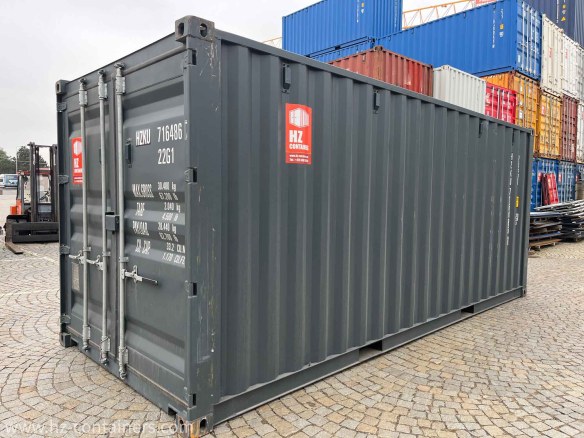
 Budapest, Hungary
 WITHOUT SHIPPING


Other container news...

Contamination of the inner walls of a shipping container: Why this is a normal operating condition and not a reason for a complaint
Dark streaks, scuffs, and marks on the interior walls of a shipping container are a completely normal occurrence during use. They arise naturally during the loading and unloading of goods via handling equipment and have no impact on the container’s watertightness or structural integrity. Find out why these aesthetic marks are not grounds for a complaint and how they can be easily touched up if necessary.

Obligation to Check Tightness When Selling a Reefer Container
Who is responsible for the refrigerant leak check when selling a refrigerated container? Find out what obligations the seller has at the time of handover and why they must provide a PTI report along with the technical data plate. Learn which regulatory requirements and F-gas record-keeping duties become the sole responsibility of the new owner.

New shipping containers
If you are currently considering purchasing a new shipping container, you are not alone. While just twenty years ago containers were used almost exclusively for maritime transport, today they have found their way into construction, storage, business, and even housing. This growing popularity brings with it a host of questions: Which type should you choose? How much does it cost? How do you recognize quality? How can you avoid falling victim to scammers?
New sea shipping containers
If you are currently considering purchasing a new shipping container, you are not alone. While just twenty years ago containers were used almost exclusively for maritime transport, today they have found their way into construction, storage, business, and even housing. This growing popularity brings with it a host of questions: Which type should you choose? How much does it cost? How do you recognize quality? How can you avoid falling victim to scammers?