
Operating Manual for Shipping Containers
How to Operate a Shipping Container?
Shipping containers represent an indispensable part of modern logistics, enabling efficient transportation of goods worldwide. However, for them to function properly, it is important to pay attention to the correct operation of shipping containers and their maintenance. This manual focuses on key aspects that will ensure long-term lifespan and trouble-free use of your container. Proper operation and maintenance of shipping containers is crucial for their long-term use and safety. By following basic rules and recommendations, you will ensure that your container continues to reliably serve its purpose. Do not forget about regular inspection and maintenance, which is essential for preserving its functionality and integrity.
Preparation of Building Space
The foundation for correct container placement is a solid and stable base. Make sure that the reinforced surface on which you place the container is level and dry. Avoid placing it directly on the ground or in a damp environment, which could cause corrosion or deformation. For larger container assemblies, we recommend consulting with an expert who will design the ideal foundation according to local conditions.
Proper Container Unloading
When unloading a container from a truck, it is necessary to ensure a crane that will safely move the container to its destination. This step is crucial for ensuring safety and protecting the container from damage during handling. The crane must have sufficient capacity and reach to safely move the container. The customer typically arranges this service independently.
Container Maintenance and Care
Regular maintenance is crucial for preserving the functionality and appearance of your container. Before each use, check for visible signs of damage, such as cracks, corrosion, or structural deformation. It is also important to clean regularly, which will prevent the accumulation of dirt and protect the material from damage. If any defect is found, it must be repaired immediately or consulted with an expert.
Efficient Use of Space
Shipping containers are designed to allow maximum use of internal space. Standardized dimensions ensure that containers can be efficiently stacked and integrated into logistics chains. For optimal use of space inside the container, we recommend carefully planning the placement of goods and using compatible pallets and packaging materials.
Safety Measures
Safety is paramount when handling containers. Make sure that all doors and locks function properly and that the container is securely anchored in place. When stacking containers, follow recommended procedures to prevent accidents or structural damage. Always follow safety standards and regulations when handling and transporting containers.
Conditions for Installation, Use, and Maintenance of Containers
For containers to remain in perfect condition for a long time and to fully utilize their lifespan, it is essential to follow the following rules for their use and maintenance. HZ-containers.com bears no responsibility for damage on the customer’s side or third parties resulting from violation of these rules.
Handling Containers

- The container structure is designed for transportation on a flat loading surface of a cargo truck, 2.5 m wide, which allows support of the load-bearing floor structure over the entire transport area.
- If the transport vehicle does not meet the requirement according to section 1 of this article, the floor must be supported at least every 3 m of container length across the loading surface, i.e., a 6-meter container minimum 3 times, an 8-meter container 4 times, etc.
- Before beginning to handle containers, all loosely loaded parts and components transported inside the container must be secured. All openings in the walls, floor, and roof must be firmly closed.
- For stacking containers and their placement, a properly dimensioned crane must be used.
- The length, thickness of suspension cables, and the angle formed by the suspension cables must be chosen by a professionally qualified person.
- Only container eyes located in the upper corners of the container can be used to suspend containers on crane cables. The container can only be lifted from eyes in the lower corners if special lifting devices are used (spreader bar and special locks for container ISO-eyes – instead of ordinary hooks). Openings in the upper corner plates must not be used to suspend the container. If additional suspension eyes are bolted or welded to the top frame of the container, only these eyes must be used for container handling.
- In some cases, containers can also be handled using a forklift capable of bearing the weight of the container. For this purpose, only the handling openings in the bottom frame of the container are used. The forklift forks should, if possible, pass through the entire width of the container; in no case should they be inserted less than 3⁄4 of the container width (i.e., 1825 mm for a container 2438 mm wide and 2245 mm for a container 3000 mm wide). These openings are not standard and containers are equipped with them only at the express request of the other contracting party.
- During handling, all obligations imposed by legal regulations must be observed (for example, for work with a crane, forklift, or occupational safety and health protection).
Building Readiness
- Containers are placed on a reinforced horizontal concrete base, for example concrete pads, in the following number:
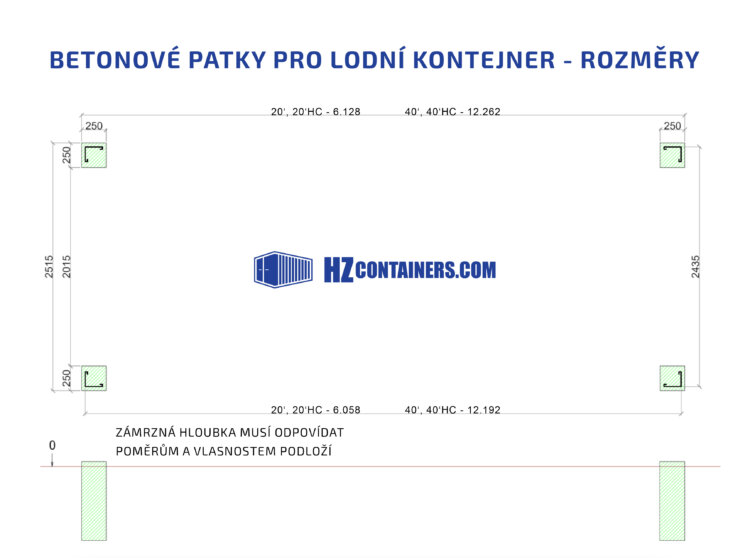
a) container length up to 5 m: support at the corners of the container, i.e., at 4 points
b) container length 5.5-8 m: support at the corners and in the middle of the longitudinal side, i.e., at 6 points
c) container length 8.5-10 m: support at the corners and thirds of the longitudinal side, i.e., at 8 points
d) container length 10.5-12 m: support at the corners and quarters of the longitudinal side, i.e., at 10 points
- The foundation must be prepared at least one week (in summer) or 10 days (in winter) before placing containers to allow the concrete to cure sufficiently.
- The foundation for container assemblies must be designed by a responsible designer according to local foundation conditions.
- The foundation must be made with a flatness tolerance of ± 5 mm. Before placing containers, irregularities must be leveled to ± 1 mm. Inaccuracies in the foundation structure or imperfect leveling of foundations before placing containers can lead to twisting of the container structure. As a result, doors and windows do not close properly and resulting leaks in windows and doors occur. With drywall cladding, excessive cracking of joints between boards can occur.
- If containers are not placed on concrete foundations immediately after transport, they must be placed on an alternative parking area, which must be level and free of protruding objects to prevent container deformation or other damage to the load-bearing structure.
Container Ventilation
- A minimum distance of 50 mm must be maintained between the bottom of the containers and the ground, creating a ventilated space. This prevents water vapor from penetrating into the containers and the possibility of subsequent condensation in them.
- To ensure proper air exchange, the 50 mm gap around the perimeter of the containers must not be closed. However, to prevent animals from entering under the containers, the gap can be equipped with perforated sheet metal or metal mesh.
Container Drainage
Proper drainage of rainwater from the container roof and sloping of the surrounding terrain must be ensured so that water does not seep under the containers. Water that would accumulate under the containers would increase the concentration of moisture in the space under the containers and subsequently increase the risk of water vapor condensation in the interior spaces of the containers.
Connection of Containers to Utility Networks
- Connection of containers to utility networks is the responsibility of the other contracting party. The customer is obliged to obtain an inspection report on the connection at their own expense after connection to electrical power. In case of rental longer than 12 months, the customer is obliged to repeat the inspection after 12 months from the last inspection report.
- In case anything happens to the container, we bear no responsibility for goods stored in the container. In case of malfunction of cooling in a freezer container or a defect in the electrical installation in all types of containers equipped with an electrical connection, we also bear no responsibility for stored goods.
- The tenant is responsible for loss, vandalism, and other damage to the container.
Electrical Power and Grounding

- Grounding of containers must be performed according to applicable regulations. Only grounding screws in the bottom corners of the container can be used for container grounding. The location of the grounding conductor connection to the container must be protected against corrosion.
- Random grounds, which represent water metal pipes, steel structures in the ground, etc., are also suitable for grounding. Gas distribution pipes or other flammable and explosive substances must not be used as grounds under any circumstances.
- Connection of containers to electrical power distribution must be performed only by an authorized person. The power supply must be adequately sized for the installed power and must meet safety and technical requirements. Its protection must not exceed the rated value of the distribution board or installed devices. Care must be taken to ensure even loading of individual phases in the installation. The container’s electrical installation is designed for connection to a 3×230 V / 400 V distribution network – (3 x phase conductor L1, L2, L3; neutral N and protective conductor Pe). Connection must be made with a cable with a minimum conductor cross-section of 4mm² and corresponding protection of this cable (usually 3 x 16 A). This cable must meet the conditions of external influences that occur in the location where it is to be placed. It must be protected especially against mechanical damage, by: position or appropriate mechanical protection. Connection of the building container installation to the supply cable is made in an installation box, which is usually located near the distribution board of the internal installation. When equipping the container with an external connection socket CV16 (CV32), the supply cable with the corresponding counterpart (CZ16, CZ32) is connected to this socket.
- Connection of electrical connections must comply with applicable standards for protection against electric shock.
- If boilers are installed in containers, they must be filled with water before connection to the electrical network to prevent heating elements from burning out.
- Electrical outlets must be used for their intended purpose, for example, for heating convectors, microwave ovens, etc. The power consumed from outlet circuits must not exceed the rated current of individual outlets or wiring.
- For lighting fixtures, adequate air circulation and heat dissipation must be ensured. Maximum power supplies must be observed. The structure of lighting fixtures must not be interfered with and flammable materials must not be placed near lighting fixtures.
- Only routine maintenance and replacement of light bulbs and fluorescent tubes are permitted, and only while observing work safety and if this does not result in disruption or change to the internal electrical installation wiring. Repairs and interventions in the electrical installation can only be performed by a qualified and properly trained specialist after consultation with the supplier. It is not permitted to make holes in the walls, floor, or ceiling of the container, or to screw or hammer any objects into them (there is a possibility of damaging or interrupting the electrical installation). Persons operating electrical equipment in the container must be properly trained.
- Mechanical damage to the electrical installation during operation must be prevented and the wiring must be protected against the effects of heat and chemicals and other influences that could damage the insulation.
- Before putting the equipment into operation, after each change or expansion, an electrical inspection must be performed, which will be documented in a report. Regular electrical inspections of containers are performed at intervals specified by regulations and also always after moving the container to a new location or if it has not been used for more than two months.
- If the container or assembly of containers is out of service for a long time, it is necessary to disconnect the electrical equipment from the source. Before putting it back into operation, an inspection of the electrical equipment must be performed and its further reliable operation ensured, the completeness of the equipment checked, and the function verified from the connection point to the devices, including grounds.
- If any defects are found, it is necessary to immediately take measures to eliminate or repair them.
- The electrical installation is performed according to external influences specified in the Protocol for Determining External Influences prepared by the manufacturer. The operator can further specify other influences according to the use of the container.
- Electrical devices and appliances must not be sprayed with water.
- An electric direct heater can only be connected to an outlet intended for this purpose. The direct heater is switched on with the main switch and temperature adjustment is performed with the thermostat controller equipped with a scale. Both controllers are located on the direct heater. It is forbidden to cover the electric direct heater with anything during operation or to dry clothes on it, etc. Never leave the switched-on device unattended.
Water Supply and Waste
- Connection of a sanitary container to water distribution and wastewater pipes must be performed only by an authorized person.
- After connection, external water distribution and waste pipes must be thermally insulated to prevent freezing in winter. If the container is used during the winter period, the interior must be heated to a minimum temperature of +5°C. If the container is not used over the winter, all water must be drained from the pipes and fixtures before the start of winter to prevent damage from frost.
- If a previously used sanitary container is to be handled, water must first be drained from all heaters and tanks to prevent damage due to overloading of fasteners.
- Fixtures must be kept clean and their secure fastening checked. Coarse dirt (sand, soil, rags, paper, etc.) must not be flushed into toilets and sinks, which could cause clogging of the sewage pipe.
- The fastening of water distribution and wastewater pipes must be continuously checked; pipes must not be loaded by placing various objects on them.
- Thermostats and safety valves on heaters must be regularly checked, i.e., proper functioning of water heating to prevent overheating and possible subsequent damage to the heater. The function of pressure reducing valves and filter cleanliness must be checked.
Hot Water Heating
- Connection of containers to hot water heating distribution must be performed by an authorized person.
- In a container with hot water heating filled, a minimum temperature of +5°C must be maintained so that water in the heating system cannot freeze. If the container is subsequently handled, water must be drained from the radiators to prevent damage due to overloading of fasteners.
Natural Gas
Connection of containers to natural gas distribution can only be performed by an authorized person and in compliance with all safety and technical regulations.