
What Is the Actual Usable Area in a Shipping Container?
The usable area in a shipping container refers to the real, practically usable space inside the container that can be effectively used for storing goods, materials, or when converting it into residential, work, or other special-purpose spaces. This concept is crucial for anyone interested in containers, as it significantly affects space planning and return on investment.
While external dimensions (for example 20 feet or 40 feet) are standardized for transport and logistics, the actual usable space inside is always smaller. Its size is affected by:
- Structural elements of the container: wall thickness, corrugated sheet profile, robust frame and floor.
- Method of use: efficiency of stacking cargo, need for handling space, air circulation.
- Additional modifications: installation of insulation, partitions, cladding, technical wiring, etc.
The key is to distinguish between nominal size, internal dimensions and actual usable area. Anyone planning to buy, rent or convert a shipping container should understand these differences well.
Standardized Dimensions of Shipping Containers: The Basic Framework
Shipping containers (ISO containers, Conex boxes) are the basic building block of global transport thanks to strict standardization. The International Organization for Standardization (ISO 668, ISO 1496) has defined their exact dimensions, which allows seamless handling, stacking and transport across continents.
Table of the Most Common Container Types and Dimensions
| Container type | External length (m) | External width (m) | External height (m) | Internal length (m) | Internal width (m) | Internal height (m) | Volume (m³) | Tare weight (kg) | Payload (kg) |
|---|---|---|---|---|---|---|---|---|---|
| 20′ Standard | 6.058 | 2.438 | 2.591 | 5.898 | 2.350 | 2.390 | 33.1 | 2,200 – 2,400 | 28,000 to 30,000 |
| 40′ Standard | 12.192 | 2.438 | 2.591 | 12.032 | 2.350 | 2.390 | 67.7 | 3,700 – 4,200 | 26,500 – 28,800 |
| 40′ High Cube | 12.192 | 2.438 | 2.896 | 12.032 | 2.350 | 2.690 | 76.4 | 3,900 – 4,400 | 26,000 – 28,500 |
| 10′ Standard | 2.991 | 2.438 | 2.591 | 2.831 | 2.350 | 2.390 | 15.8 | 1,300 – 1,500 | 8,000 – 10,000 |
| 45′ High Cube | 13.716 | 2.438 | 2.896 | 13.556 | 2.350 | 2.690 | 86.0 | 4,700 – 5,200 | 27,000 – 29,000 |
Note: Dimensions and weights may vary slightly depending on the manufacturer, year of manufacture and specific specification.
Coding and Designation
- DV (Dry Van): Standard closed container for dry cargo.
- HC (High Cube): Increased height version, 2.896 m high.
- OT (Open Top): Open top, suitable for oversized cargo.
- RF (Reefer): Refrigerated container with insulation.
Why Is This Important?
- Standardization = efficiency: ISO standards allow stacking up to 9 layers on a ship and transport by rail and truck without modifications.
- Dimensions for planning: Knowing exact dimensions is necessary not only for logistics, but also when designing interiors or buildings from containers.
External vs Internal Dimensions: Where Is Space Lost?
Structural Elements Affecting Usable Area
- Walls and frame: Corrugated Cor-Ten steel sheet 1.6 mm (14-gauge), frame made of massive profiles (7-gauge, up to 10 mm).
- Floor: Steel cross members + 28 mm waterproof plywood, total floor build-up height approx. 15 cm.
- Corners: Corner posts and reinforcements significantly affect dimensions in the corners (the door opening is narrower than the internal width).
- Corrugated profile: Uneven wall surface makes it harder to push shelving or cladding fully against the wall.
Overview of Space Losses
| Element | Width loss (cm) | Length loss (cm) | Height loss (cm) |
|---|---|---|---|
| Walls (corrugated sheet) | 4 – 9 | 8 – 10 | 15 – 20 |
| Frame (posts) | 5 – 8 | 5 – 8 | 15 – 20 |
| Floor | 0 | 0 | 10 – 15 |
Overall, the average internal width is 2.33–2.35 m, the internal length is 15–20 cm shorter than the external length, and the height depends on the type (standard vs. high cube).
Floor Area vs Usable Volume: How to Calculate?
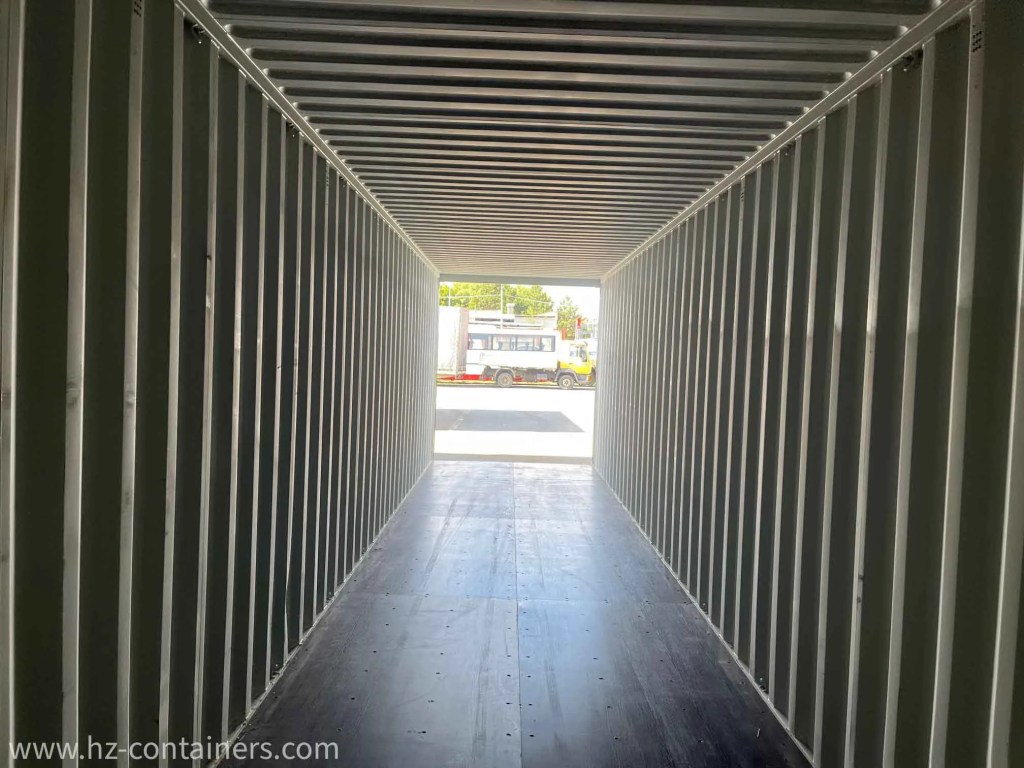
Floor Area
Determines how much space you have for arranging equipment, furniture, or pallets.
- 20′ container: approx. 13.8 m²
- 40′ container: approx. 28.2 m²
- 40′ HC: approx. 28.2 m² (volume is higher)
- 10′ container: approx. 6.6 m²
Usable Volume
The maximum internal volume is effectively reduced by:
- Irregular package/box shapes
- Handling aisles (for access to goods)
- Securing elements (straps, timber)
- Air circulation (to prevent mould and moisture)
Practically usable volume is about 28 m³ for a 20′ container (vs the theoretical 33.1 m³) and about 58–60 m³ for a 40′ container (vs 67.7 m³).
Effect of Modifications on Usable Space
Any interior modification reduces usable floor area and volume:
Insulation
- Sprayed PUR foam: 5–10 cm from each wall and the ceiling, loss of width and length up to 20 cm, height loss 10 cm.
- Mineral wool + battens: total build-up up to 12–15 cm (walls), floor additionally with impact sound insulation and new covering.
- Insulated panels: more space-efficient but still about 10 cm loss on each side.
Internal Partitions, Services
- Partitions: minimum thickness 8–10 cm.
- Wiring/services: routed in service voids/false walls, losing another 2–5 cm.
New Floors, Ceilings
- Floors: vinyl, laminate, tiles + insulation, height loss 2–5 cm.
- Suspended ceilings: plasterboard, LED lighting, height loss 3–8 cm.
Overall, a conversion can reduce the width from 2.35 m to 2.10–2.15 m and the height from 2.39 m to 2.10–2.15 m (standard), or to 2.40–2.50 m (High Cube).
Comparison of Container Types: Standard, High Cube, Half Height, Speciality
Standard vs High Cube
| Parameter | Standard 40′ | High Cube 40′ |
|---|---|---|
| External height (m) | 2.591 | 2.896 |
| Internal height (m) | 2.390 | 2.690 |
| Volume (m³) | 67.7 | 76.4 |
| Clear height after modifications | 2.10–2.15 | 2.35–2.40 |
- High Cube is ideal for: residential conversions such as shipping container homes, stacking higher pallets, storing bulky goods.
Other Types
- Half Height (HH): height approx. 1.29 m, used to transport heavy materials (gravel, ore).
- Open Top (OT): open roof for oversized or bulk cargo.
- Flat Rack: without walls, suitable for machinery, vehicles.
Practical Calculations and Planning
How Much Really Fits in a Container?
Calculation for a 20′ container:
- Standard moving box 45×45×45 cm = 0.091 m³
- Theoretically: 33.1 / 0.091 ≈ 363 boxes
- In reality (usable volume 28 m³): 28 / 0.091 ≈ 307 boxes
- Allow for a margin! Due to shape combinations, aisles – realistically 200–280 boxes.
Pallets:
- Euro pallet 1200×800 mm: a 20′ container holds 11 pcs (1 layer), a 40′ up to 25 pcs.
How to Choose and Plan a Purchase Properly?
Recommendations:
- Detailed dimensions: Request exact external and internal dimensions, ideally including a technical drawing.
- Photo documentation: Ask for photos of the interior, floor detail, corners, doors (see “preview 3000×3000 quality” in modern e-shops).
- Type and condition: Consider whether it is new (one-trip), used (wind & watertight), or a refurbished container.
- Modifications: If you plan modifications, factor in the loss of space! Always prepare a floor plan study.
Tips from Practice:
- Choose High Cube whenever you need a comfortable interior.
- For storing heavy items (e.g. on a construction site), several smaller containers may be more advantageous than one large one due to floor load capacity and handling.
- Do not forget ventilation – moisture often condenses in containers.
FAQ: Frequently Asked Questions
What Is the Difference Between Floor Area and Volume?
- Floor area (m²): How much space the container occupies on the ground – important for planning layout and equipment.
- Volume (m³): How much cargo actually fits inside – important for transport and storage.
What Is the Real Loss of Space After Insulation?
- Standard container: loss of up to 10–15% of volume and 10–20 cm on each side.
- High Cube: smaller percentage loss, but still retains greater clear height.
Is It Possible to Connect Containers into Larger Units?
- Yes, containers can be connected lengthwise and crosswise; walls are often cut out and the structure reinforced. Connection joints, however, further reduce usable floor area.
Conclusion
The actual usable area in a shipping container is always a compromise between the theoretical maximum and practical limitations. The key is to always allow for a margin for: structural elements, handling needs, possible modifications (insulation, partitions, wiring), safety and logistical requirements.
To effectively use a container – whether in warehouse logistics, construction, or when building a shipping container house – it is necessary to know not only the standardized dimensions, but also all the factors that will actually affect the usable area and volume.

 Czech Republic, Kladno
  FREE SHIPPING

