
Insulation of Shipping Container with Polystyrene EPS 150
Steel Shipping Container – Initial State
| Property | Value / Description |
|---|---|
| Material | Corten or carbon steel |
| Wall thickness | typically 1.6–2.0 mm |
| Thermal conductivity (steel) | approx. 50 W/mK |
| Problems | High temperature in summer, rapid cooling in winter, condensation, corrosion, noise |
Polystyrene EPS 150 – Properties and Standards
Polystyrene insulation of type EPS 150 is manufactured in accordance with the standard ČSN EN 13163, which defines requirements for compressive strength, thermal conductivity, water absorption, dimensional stability, dimensional accuracy, and fire reaction.
Technical Parameters of EPS 150 (according to manufacturer Isover, EPD 2023):
| Parameter | Value |
|---|---|
| Compressive strength at 10% deformation | 150 kPa (15,000 kg/m²) |
| Bulk density | 23–25 kg/m³ |
| Thermal conductivity coefficient λ | 0.035 W/mK |
| Thermal resistance (100 mm) | 2.85 m²K/W |
| Thickness | 20–140 mm (minimum 50 mm recommended for walls, 100 mm for floor) |
| Water absorption | low, closed-cell structure |
| Fire reaction | E (self-extinguishing additives, cannot be considered non-flammable) |
| Service life | > 50 years |
| Ecology | recyclable, does not contain CFCs |
The standard ČSN EN 13163 guarantees long-term stability of declared values, which is key for energy-efficient buildings.
Procedure for Insulating Container with EPS 150
1. Surface Preparation
- Removal of dirt and rust: Carefully clean and sand steel surfaces, and repair any damage if necessary.
- Anti-corrosion coating: Apply protective coating to prevent corrosion under the insulation.
2. Choice of Insulation Method
- Interior insulation: More economical option, reduces net interior space, easier application.
- Exterior insulation: Protects the structure from weather influences, preserves interior space, higher costs.
3. Installation of Support Structure (Framing)
- Wooden battens or steel profiles: Create a framework for fastening insulation boards, level irregularities of corrugated sheet, allow for installation routing (electrical, water).
- Creation of air gap: Ventilates any moisture, improves thermal efficiency.
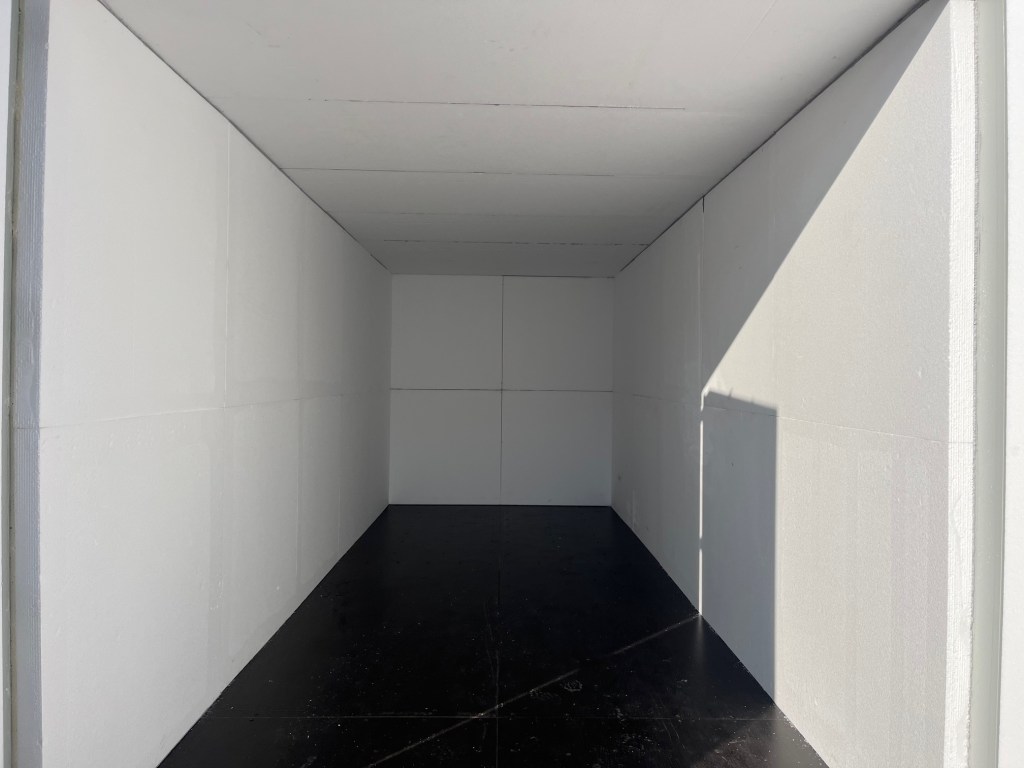
4. Insertion and Fastening of EPS Boards
- Cutting to size: EPS is easily cut with a knife or saw to the required dimensions.
- Fastening: Polystyrene adhesive (solvent-free); optionally mechanical anchoring.
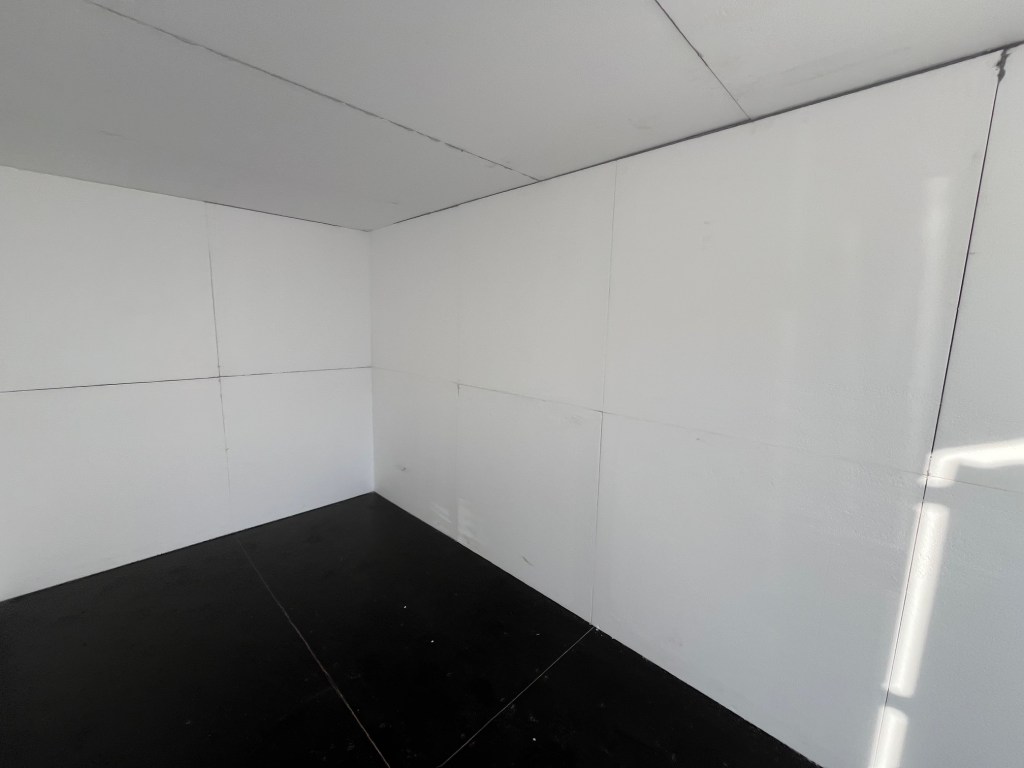
- Thorough filling: Boards must fit tightly, without gaps.
5. Treatment of Joints and Details
- Filling joints with PUR foam: Prevents thermal bridges.
- Emphasis on corners, connections of floor/walls/ceiling, installation penetrations.
6. Vapor Barrier
- Polyethylene film (min. 0.2 mm): Installation on the warm side of insulation (interior side), prevents moisture penetration to the steel wall.
- Overlapping and sealing of joints: Always with minimum 10 cm overlap, joints sealed with appropriate tape.
7. Ventilation
- Necessary for condensation prevention: Ventilation grilles, optionally forced ventilation (heat recovery).
- At least 2x air exchange per day is recommended.
8. Final Interior Finishing
- Construction boards: Drywall, OSB, planks, plywood.
- Final surface: Paint, wallpaper, etc.
Comparison of EPS 150 with Other Insulation Materials
| Material | λ [W/mK] | R (100 mm) [m²K/W] | Fire resistance | Price | Advantages | Disadvantages | Best use |
|---|---|---|---|---|---|---|---|
| EPS 150 | 0.035 | 2.85 | E | Low | Low price, easy installation, high strength, recyclable | Flammability, lower sound insulation | Floor, walls, ceiling, reasonable budget |
| XPS | 0.030 | 3.33 | E | Higher | Better water resistance, higher strength, lower water absorption | Higher price | Floor, extreme moisture, foundation |
| Mineral wool | 0.035-0.045 | 2.2–2.85 | A1 (non-flammable) | Medium | Excellent acoustics, non-flammability | Higher dust, requires vapor barrier | Walls, ceiling, where fire resistance is priority |
| PUR foam (sprayed) | 0.020-0.025 | 4.0–5.0 | B–E | High | Seamless insulation, vapor barrier in one | High price, professional application | Highest efficiency, complex spaces |
| Blown cellulose | 0.040 | 2.5 | B–C | Higher | Ecological, acoustically effective | Difficult application, moisture sensitivity | Interiors, complex cavities |
Recommended Insulation Thickness and Other Practical Tips
- Walls and ceilings: 5–10 cm EPS for moderate climate, 15–20 cm in extremely cold regions.
- Floor: Minimum 10 cm EPS 150 due to high load and limitation of cold rise.
- Combination with other materials: To achieve better acoustics or fire resistance, you can combine e.g. EPS and mineral wool.
- Subsidies: Possibility of using subsidy programs for ecological buildings and insulation.
Solutions to Main Problems – Condensation and Vapor Barrier
Condensation
- Occurs when warm, humid air contacts a cold wall.
- Most common problem in uninsulated containers!
- Solution: Continuous insulation layer, quality vapor barrier, effective ventilation (ideally with heat recovery).
Vapor Barrier
- Necessity to use polyethylene film min. 0.2 mm.
- Correct installation: Overlaps, sealing of joints, connection to windows/doors.
- Without vapor barrier, hidden condensation and rapid degradation of interior and insulation are at risk.
Environmental and Economic Aspects of EPS 150
- Recyclability: EPS can be recycled and reused for the production of new insulation boards.
- Low carbon footprint: Due to low weight, transport and installation are energy-efficient.
- Service life: Properly applied insulation lasts decades without loss of functionality.
- Safety: Modern EPS does not contain CFCs or other harmful substances.
- Price: EPS 150 is among the cheapest insulation materials with a very good price/performance ratio.
Most Common Mistakes When Insulating Container with EPS 150
- Insufficient surface treatment against corrosion.
- Incorrect or missing vapor barrier.
- Poorly filled joints between boards (thermal bridges).
- Insufficient insulation thickness.
- Absence of ventilation.
- Use of unsuitable adhesive (containing solvents – dissolves EPS!).
Use of EPS 150 in Container Buildings
- Housing: Year-round container homes, cottages, tiny houses.
- Offices: Modern, quickly buildable workspaces.
- Warehouses: Protection of goods from frost/overheating, reduced risk of condensation.
- Workshops and studios: Stable climate, protection of equipment and materials.
- Technical and server rooms: Stable temperature, moisture minimization.
Comparison Table: Advantages and Disadvantages of EPS 150 in Containers
| Advantage | Description |
|---|---|
| Low price | Ideal for budget projects, wide availability. |
| Easy installation | Possible as DIY, does not require special tools. |
| High strength | EPS 150 suitable even for floors where load-bearing capacity is needed. |
| Ecological aspect | Recyclable, low carbon footprint. |
| Long service life | > 50 years without loss of insulation parameters. |
| Disadvantage | Description |
|---|---|
| Flammability | Combination with fire-resistant boards or plaster required. |
| Sensitivity to UV radiation | When used externally, EPS must be protected by cladding. |
| Slightly lower acoustic insulation | If needed, can be supplemented with mineral wool. |
Frequently Asked Questions (FAQ)
What thickness of EPS 150 should I choose?
For typical residential use, we recommend walls/ceilings 80–120 mm, floors at least 100 mm.
Is a vapor barrier necessary even when using EPS 150?
Yes, always on the interior side! EPS limits moisture penetration, but is not vapor-tight.
How to anchor EPS 150 to container sheet?
With acrylic-based adhesive without solvents, optionally with mechanical anchors.
Can EPS 150 be combined with mineral wool?
Yes, for example in sandwich walls – you will improve acoustics and fire resistance.
Insulation of container with EPS 150 is an affordable, effective, and long-term proven solution that significantly extends the service life of the container, saves operating costs, and significantly increases user comfort. The key is proper execution of all details – especially quality vapor barrier, corrosion treatment, elimination of thermal bridges, and ventilation. EPS 150 is a long-term proven material by Czech and European standards with a very favorable price/performance ratio for all types of container buildings.

 Czech Republic, Hradec Králové
  FREE SHIPPING

