
How to Insulate a Shipping Container?
Shipping containers are becoming an increasingly popular alternative to traditional building materials when creating residential spaces such as container homes or commercial spaces. Thanks to their relative availability, modularity, and resistance to adverse conditions, they provide an excellent foundation for low-cost construction. However, for containers to be habitable and energy-efficient, it is essential to insulate them properly. This article provides detailed answers to the question “How to insulate a shipping container?” and provides technical details on various insulation options, procedures, and materials.
1. Why is Shipping Container Insulation Important?
Shipping containers are made of steel, which has excellent mechanical properties but poor insulation capabilities. Without adequate insulation, significant heat loss occurs in winter and overheating in summer, making the container uninhabitable. Steel also has high thermal conductivity, which leads to significant temperature fluctuations inside the container. Another problem is moisture condensation, which can cause corrosion and damage the interior.
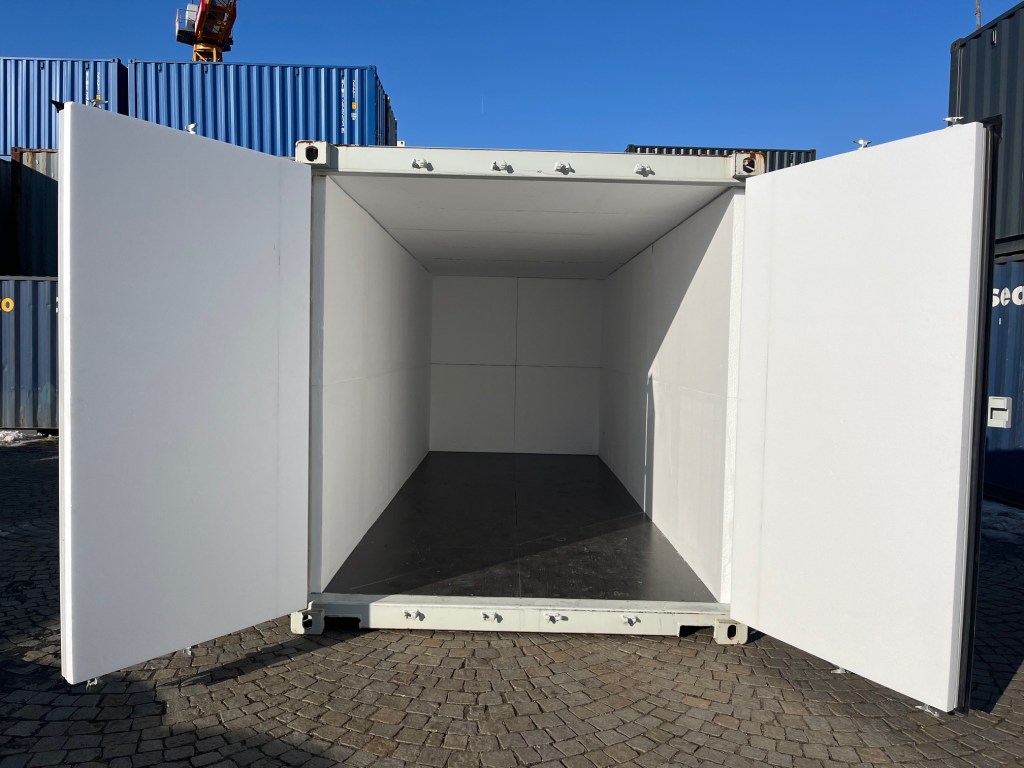
Main Benefits of Insulation:
- Energy Efficiency: Proper insulation minimizes the need for heating and cooling, leading to lower operating costs.
- Improved Comfort: Stable interior climate ensures a pleasant environment for living or working.
- Corrosion Prevention: Insulation prevents condensation on interior walls, extending the container’s lifespan.
- Noise Reduction: Quality insulation contributes to noise dampening, which is important especially in densely populated areas.
2. Types of Insulation Materials
Selecting the right insulation material is a key step when insulating a container. Different materials offer different properties, advantages, and disadvantages.
2.1 Sprayed PUR Foam
Sprayed polyurethane foam is one of the most effective insulation materials due to its ability to eliminate thermal bridges and provide a vapor barrier.
- Technical Properties:
- Thermal conductivity coefficient: 0.020–0.025 W/mK.
- Lifespan: Up to 30 years.
- Density: 30–60 kg/m³.
- Advantages:
- Quick application.
- Resistance to moisture, mold, and pests.
- Compatibility with various surfaces.
- Disadvantages:
- Higher acquisition costs.
- Requires professional application.
2.2 Mineral Wool
Mineral wool, made from natural or synthetic fibers, is a popular insulation material due to its versatility.
- Technical Properties:
- Thermal conductivity coefficient: 0.035–0.045 W/mK.
- Fire reaction class: A1 (non-flammable material).
- Advantages:
- Price availability.
- Excellent fire resistance.
- Disadvantages:
- Requires use of a vapor barrier.
- Higher space requirements.
2.3 Polystyrene (EPS/XPS)
Expanded (EPS) and extruded (XPS) polystyrene are lightweight insulation materials suitable for various applications.
- Technical Properties:
- Thermal conductivity coefficient: 0.030–0.040 W/mK.
- Density: 15–35 kg/m³.
- Advantages:
- Low costs.
- Easy handling.
- Disadvantages:
- Low fire resistance.
- Moisture sensitivity.
2.4 Blown Cellulose

Blown cellulose is an environmentally friendly alternative suitable especially for interior insulation.
- Technical Properties:
- Thermal conductivity coefficient: 0.040 W/mK.
- Ability to fill hard-to-reach spaces.
- Advantages:
- Ecological material.
- Good acoustic properties.
- Disadvantages:
- Requires professional application.
- Higher acquisition costs.
3. Insulation Methods
3.1 External Insulation
This procedure is ideal for protecting the steel structure from temperature fluctuations and weather effects.
- Work Procedure:
- Clean the surface of rust and apply an anti-corrosion coating.
- Attach the supporting structure.
- Apply insulation and cover with cladding.
- Advantages:
- Maximum utilization of interior space.
- Better protection of the structure.
3.2 Internal Insulation
This approach is suitable for projects where preserving appearance is a priority.
- Work Procedure:
- Prepare the surface and apply anti-corrosion protection.
- Install insulation and vapor barrier.
- Cover the interior surface with drywall.
- Advantages:
- Lower costs.
- Easy installation.
4. Practical Recommendations
- Insulation Thickness: 5–10 cm is recommended for moderate climates, 15–20 cm for cold regions.
- Ventilation: Ensure adequate ventilation to minimize condensation.
- Subsidies: Explore options for government subsidies for ecological insulation.
5. Conclusion
Insulating a shipping container is key to creating a comfortable and energy-efficient space. Choosing the right insulation material and method can significantly affect the resulting comfort and container lifespan. Investment in quality insulation pays off not only in terms of energy savings but also in long-term protection of the structure.
 Czech Republic, Třebíč
  FREE SHIPPING

