
Purchase of a Shipping Container
Purchase of a shipping container represents the process of acquiring a robust transport unit primarily intended for international cargo transport and storage. Today, shipping containers far exceed their original purpose – they are used in industry, logistics, construction, as well as in architecture, recycling or for individual purposes (garage, workshop, warehouse, residential module). Anyone considering their purchase should understand not only the basic types and dimensions, but also the materials, technical standards, selection processes and legal aspects related to their acquisition.
A container is much more than a “large metal box” – it is the backbone of global trade and an inspiration for modern technology and sustainability.
History: How the Container Changed the World
The modern shipping container was created in 1956 thanks to Malcolm McLean, who first standardized the transport of goods in durable boxes transferable between truck, train and ship without the need to rehandle the cargo itself. This milestone launched the era of massive globalization – thanks to a unified system of dimensions and lockable steel constructions, transport costs fell, safety increased and the speed of transport rose.
Interesting fact from the Czech environment:
The first containers appeared on Czechoslovak railways already in the 1960s, but mass deployment came only after 1990. Today containers are commonly used not only in maritime transport (Hamburg, Koper) but also at inland terminals (Mělník, Ostrava).
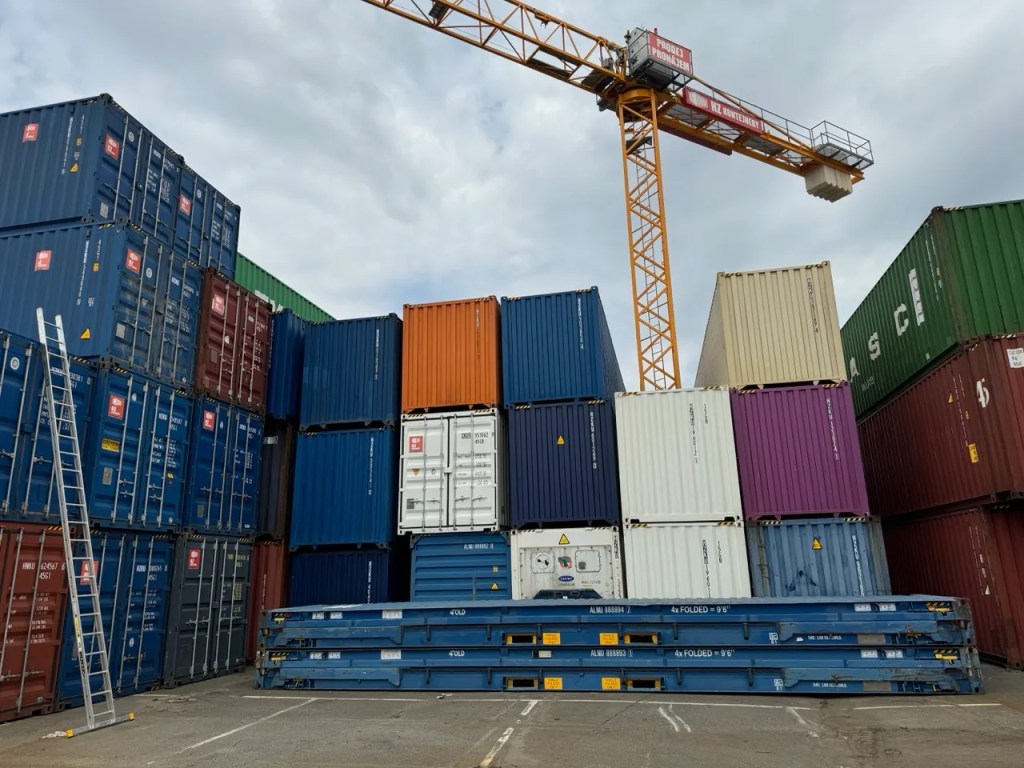
Anatomy of a Shipping Container: Materials and Construction
Material: Why Corten Steel Is Essential?
- Corten (COR‑TEN) steel: A special weather‑resistant alloy that forms a protective patina when exposed to air. This layer shields the container from deep corrosion, which is crucial for long‑term use in aggressive environments (salt, humidity, temperature fluctuations).
- Corten steel is weldable, strong and, with a service life of up to 25‑40 years without major maintenance, belongs to the eco‑friendly building material options.
Construction Elements of the Container:
| Element | Material | Function and Properties |
|---|---|---|
| Frame | Corten steel, beams | Carries the whole structure, allows stacking up to 9 containers high |
| Walls | Corrugated Corten sheet | High rigidity, better load distribution, protection from weather |
| Roof | Corten sheet | Drainage, sealing, possibility to install skylights or insulation panels |
| Floor | Plywood (bamboo, oak) | Thickness 28–32 mm, treated against pests, designed for point loads up to 5 t/m² |
| Doors | Steel, seals | Two wings, four securing rods, option to install a lockbox for increased security |
| Corner Elements | Gussets, Corten | Used for handling, crane or forklift attachment, ISO‑standard dimensions |
| CSC label | – | Safety certification, required for transport and stacking |
Safety and Standards
Every container intended for transport must meet international ISO standards and be equipped with a valid CSC label (Convention for Safe Containers). This “technical passport” confirms that the construction has passed strength, sealing and stackability tests.
Table of Dimensions and Types of Shipping Containers
Shipping containers are standardized according to ISO. The most common sizes are 20′ and 40′ (feet), but smaller and larger variants also exist. Height is either standard (STD) or increased (High Cube – HC).
Overview of Main Types:
| Container Type | External Length | External Width | External Height | Internal Length | Internal Width | Internal Height | Volume (m³) | Empty Weight (kg) | Payload (kg) |
|---|---|---|---|---|---|---|---|---|---|
| 20′ Standard (DV) | 6.058 m | 2.438 m | 2.591 m | 5.898 m | 2.352 m | 2.393 m | 33.2 | approx. 2 200 | 28 000 |
| 40′ Standard (DV) | 12.192 m | 2.438 m | 2.591 m | 12.032 m | 2.352 m | 2.393 m | 67.7 | approx. 3 700 | 28 800 |
| 40′ High Cube (HC) | 12.192 m | 2.438 m | 2.896 m | 12.032 m | 2.352 m | 2.698 m | 76.4 | approx. 3 900 | 28 600 |
Other Types:
- Open Top: Roof made of canvas, allows loading from the top with a crane.
- Reefer: Refrigerated/frozen container with thermostat and insulation.
- Flat Rack: No side walls, suitable for oversized cargo.
- Double Door: Doors on both ends for easy access.
- Pallet Wide: Wider width, fits two Euro pallets side by side.
- Tanktainer: Steel‑frame tank for liquids or gases.
Quality Categories and Markings
Price and suitability depend mainly on the container’s quality class. In the Czech Republic and EU you will commonly encounter these designations:
| Code / Name | Description | Use | CSC Label Validity |
|---|---|---|---|
| New / One Way | Only one trip from production, minimal wear, no corrosion, clean interior | Representative spaces, residential buildings, offices | 5 years |
| IICL | “Institute of International Container Lessors” – top quality among used containers, also suitable for further transport | Warehouse, transport, construction modifications | 1–2 years |
| Cargo Worthy (CW) | Fully fit for cargo transport, may have cosmetic defects, sealed | Warehouse, transport, workshop | 6 months – 1 year |
| Wind & Watertight (WWT) | Wind and water resistant, may no longer have a valid CSC label, suitable for storage | Warehouse, workshop, cheaper solution | No |
| As Is | No guarantee, possible holes or damage, suitable only for low‑demand storage or spare parts | Material storage, recycling | No |
Recommendation:
When buying, always request up‑to‑date photographs, the possibility of a physical inspection and information on CSC label validity.
Step‑by‑Step Process for Purchasing a Shipping Container
1. Define Purpose and Requirements
- Determine whether you need a container for international transport (requires a valid CSC label) or only for storage or conversion.
- Choose size, type and desired quality.
2. Select Supplier and Offer
- Prefer specialized companies with physical warehouses in the Czech Republic (e.g., HZ Containers) that allow personal inspection.
- Request a price quote including delivery and on‑site assembly.
3. Inspection of the Container
- Check:
- Frame quality (no deep corrosion or cracks)
- Floor condition (must not be rotten, oily or sagging)
- Door sealing and gasket condition
- Absence of holes or leaks (inspect with light)
- CSC label validity (for transport)
4. Logistics and Delivery
- It is advisable to prepare a reinforced base (concrete pads, gravel, panels).
- Delivery is usually performed by a truck with a hydraulic crane (HIAB) that can place the container precisely.
- Consider site accessibility (entrance width, ground bearing capacity).
5. Legal Aspects
- Permanent placement often requires building authority consent (especially when converting to a residential unit).
- Verify land‑use planning, possibly treat the project as a temporary structure or “storage object”.
Advantages and Disadvantages of Buying a Shipping Container
Advantages
- Robustness and durability: Designed for extreme conditions, long service life.
- Safety: Steel construction, optional lockbox.
- Modularity: Can be joined, stacked, modified (cut windows, add extensions).
- Economic efficiency: Cheaper than constructing masonry buildings.
- Mobility: Can be moved within a site or to another location.
- Immediate availability: Stocked in the Czech Republic, fast delivery.
Disadvantages
- Initial investment: Higher upfront cost when buying a new container.
- Condensation risk: Uninsulated containers may develop moisture (solution: ventilation, insulation).
- Aesthetics: Industrial look may not suit residential settings (can be clad or painted).
- Maintenance needs: Regular checks of paint, sealing and floor.
Alternative and Creative Uses of Containers
Shipping containers are employed in many unconventional areas:
- Modular homes, cabins, recreational buildings: Container architecture is a trend due to fast construction and sustainability.
- Mobile offices: Quick installation, possible HVAC and full amenities.
- Pop‑up shops, bars, cafés, food trucks: Easy transport to events, festivals, markets.
- Pools, wellness, saunas: After conversion with a pool liner they become unique water tanks.
- Storage spaces for businesses or households, garages, workshops, agricultural structures.
- Data centres, server rooms, laboratories, school classrooms.
Frequently Asked Questions and Expert Recommendations
- How long does a shipping container last?
- Average service life is 15–25 years with proper maintenance. Corten steel significantly extends life compared with regular steel.
- Is a building permit required?
- For permanent placement, conversions and residential use, yes – coordinate with the building authority.
- How does transport and assembly work?
- Professional suppliers provide truck delivery with a hydraulic crane. Containers can also be placed by forklift if site access permits.
- How to secure a container against burglary?
- Use a lockbox (lock protection), security locks (e.g., hanging lock from HZ CONTAINERS) or a hasp, optionally install alarms.
- Can the container be insulated?
- Yes, common methods include mineral wool, PUR panels or spray foam. Proper ventilation is also advisable.

 Czech Republic, Třebíč
  FREE SHIPPING


Other container news...

Where to Rent a Freezer Container?
Renting a freezer container from HZ KONTEJNERY s.r.o. is a sophisticated, safe and economical solution for anyone who needs short-term or long-term controlled storage or transportation of temperature-sensitive goods. High-quality containers meet strict technical, hygienic and legislative standards, thanks to which they can be safely used in the food industry, pharmacy, agriculture and other fields.

Horizontal Connection of Shipping Containers with Bridge Fitting
Bridge Fitting is an indispensable element of modern logistics and construction. Without properly selected, installed and maintained Bridge Fittings, safe container transport, efficient storage and rapid construction of modular buildings would not be possible. By choosing certified connectors, following the correct installation procedure and regular maintenance, you fundamentally influence the safety, longevity and efficiency of the entire system.

What does a MULTI TRIP shipping container mean?
MULTI TRIP shipping container is a technical term in the field of logistics that refers to a used shipping container – a unit that has undergone several cycles of international sea, rail or road transport. Most often, these are containers that have been in operation for 8 to 15 years, often transported thousands of tons of cargo and were exposed to extreme conditions: humidity, salt, UV radiation, temperature changes and mechanical stress.

Forklift Pockets – Construction, Standards, Safe Use
Forklift Pockets are rectangular openings integrated into the longitudinal beams of the bottom frame of some types of shipping containers. Their primary purpose is to enable safe, fast and efficient handling of the container by special forklift trucks (VZV), especially in environments where the use of a crane is not possible or practical.