
How much does a shipping container weigh?
Shipping container weight
When you look at shipping containers, you might ask: “How much does it actually weigh?” The weight of a shipping container is key for logistics, handling and transport. This weight can vary according to the size, type and construction of the container. Let’s look at the most common variants and their weight.

Weight of a 20-foot container
20-foot containers belong to the most common types of containers. Their standard weight is around 2200 to 2500 kg. This type of container offers a volume of approximately 33 m³, making it an ideal choice for small to medium-sized shipments. Additionally, thanks to its compact size, it is easy to handle and suitable for various types of transport.
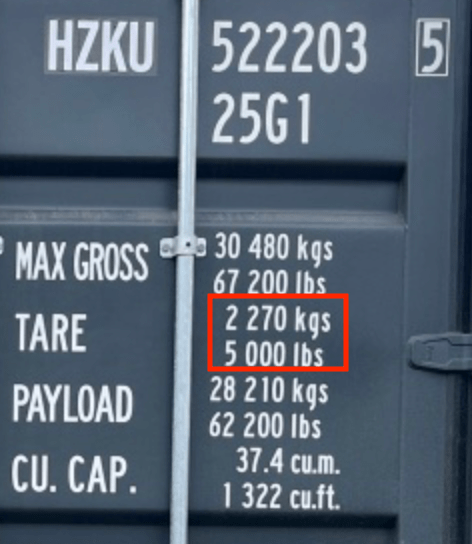
Weight of a 20-foot container with a higher roof (HC)
20-foot containers with a higher roof, known as High Cube (HC), have the same length and width as standard 20-foot containers, but their height is greater. This added height increases their volume to approximately 37 m³. The weight of these containers is usually around 2320 kg. The larger interior space allows the transport of bulkier cargo without changing their basic footprint.

Weight of a 40-foot container
40-foot containers are twice as long as their 20-foot counterparts. These containers weigh approximately 3790 to 4000 kg and offer a volume of around 67 m³. Due to their size, they are suitable for transporting larger shipments and are often used in international maritime transport. Their dimensions allow efficient loading and unloading with modern logistics systems.

Weight of a 40-foot container with a higher roof (HC)
Similar to 20-foot HC containers, 40-foot containers with a higher roof also offer a larger interior space. These containers weigh approximately 4100 kg and their volume is about 70 m³. The larger capacity is ideal for transporting bulkier cargo that requires more vertical space.
Factors influencing container weight
The weight of a container can be affected by several factors. The material used in production, such as steel, plays a crucial role. Additionally, the weight can vary according to structural features such as reinforced frames or additional elements for cargo safety. Moreover, wear and maintenance can also affect the overall weight of the container.
Keywords: container weight, container mass, how heavy is a container

 Břeclav, Czech Republic
  FREE SHIPPING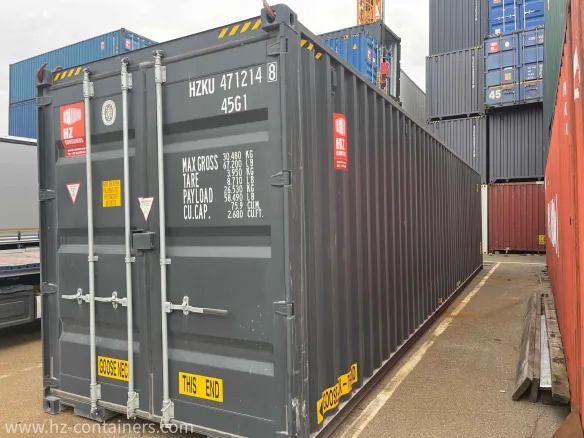

Other container news...

New shipping containers
If you are currently considering purchasing a new shipping container, you are not alone. While just twenty years ago containers were used almost exclusively for maritime transport, today they have found their way into construction, storage, business, and even housing. This growing popularity brings with it a host of questions: Which type should you choose? How much does it cost? How do you recognize quality? How can you avoid falling victim to scammers?

6m shipping container
Are you thinking about buying a 6-meter shipping container but aren’t sure what to look for? You are not alone—this 20-foot container is the best-selling size on the Czech market, and the differences between various types, conditions, and prices can be significant. In this guide, you will find everything you need to know: from exact dimensions and a comparison of categories (such as “one-way,” refurbished, and “Cargo Worthy”) to current prices and shipping advice.
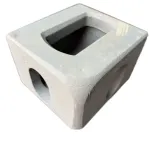
Corner casting steel vs aluminum
Every shipping container in the world — all 40 million of them — rests on eight critical components. Corner castings are the load-bearing blocks at each corner of an ISO shipping container, and they are the universal interface between the container and every crane, twistlock, spreader, and chassis on the planet. When you lift a container, stack it nine high on a ship, or lock it to a truck trailer, every ton of force flows through these fittings.

Construction cabin – selection, tips, dimensions and prices
Every construction project – whether a family house, a development project or a reconstruction – starts with the infrastructure. No construction manager, craftsman or investor who needs an on-site office, a changing room for workers or a safe storage for tools can do without a quality construction cell. But navigating the offer is not easy: residential containers, sanitary cells, storage modules, rental, purchase, refurbished pieces… This guide will give you answers to all the essential questions in one place.