
Concrete footings for the container
Where to place the container after delivery?
What are concrete footings under the container? Where to place the shipping container? These are questions that everyone who wants their container to last as long as possible will need to address. You will agree that placing a shipping container on an uneven and grassy surface will not be ideal due to potential future corrosion and difficulties with opening doors, which can easily occur with a poorly positioned container. There are several suitable ways to support a shipping container…
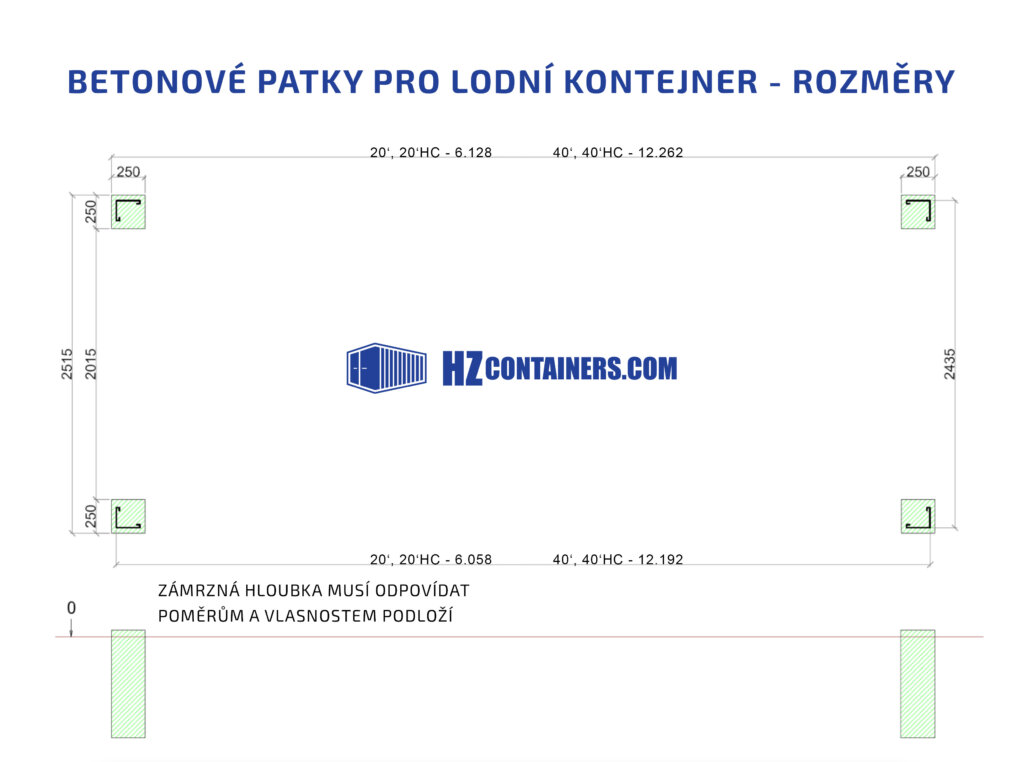
IT DEPENDS ON THE BASE YOU HAVE AT THE SITE:
If it is an unpaved surface
1) You can have concrete footings poured under the container to level as needed, which is the best possible option. It is sufficient to pour the base only under the corner blocks of the container. That is, at all 4 points (corners).
The construction of the shipping container is self-supporting, so it is unnecessary to create footings or support the container at more points than recommended.
If you are also storing heavy materials in the container and using the total capacity of the container, we definitely recommend choosing poured footings. It is important to leave a space between the bottom of the container and the base for ventilation. Ideally, 20-25 cm.
2) A cheaper and functional option is also to support the container with, for example, sleepers, concrete tiles of size 50×50 cm, wooden shims, etc.
Here, however, it is necessary to consider how firm your base is. Because, generally, over time, the container may „sink“ slightly into the ground, so it is better to place more concrete tiles on top of each other and anticipate that the container will sink slightly into the soil over time.
This method of support is recommended if the load in the container, including the weight of the container, is not too large.
If you have the shipping container placed on an already paved surface
where there is no risk of the shipping container sinking, it is generally not necessary to support the container. It can remain on its „own“ structure, i.e., on the four corner blocks. However, it is important that there is adequate airflow underneath the container’s structure. This is to prevent moisture from accumulating under the container and to avoid, for example, mold developing on the underside of the container.
Consider the information in the text more as recommendations than precise instructions. It is always necessary to take into account local conditions, the size of the container, as well as the weight of the shipping container including the load.
Other container news...

Shipping containers in Trieste Italy
Shipping containers in Trieste are a key element of international maritime logistics and trade. Trieste, Italy’s largest container port, is located in the northern Adriatic Sea and serves as a strategic logistics hub for the transport of goods from all corners of the world. Shipping containers are standardized shipping units that allow for the efficient handling, storage and transport of goods by sea, and they are handled in huge quantities in Trieste every day.

Reduction of emissions in maritime shipping
Shipping emissions reduction is a set of measures, technologies and regulatory standards aimed at reducing pollutants and greenhouse gases emitted by maritime vessels. Shipping carries around 90% of world trade, but also produces around 3% of global CO₂ emissions and is one of the fastest growing sources of pollution. Reducing shipping emissions is therefore a critical part of the global effort to combat climate change and improve air quality.

Container transport is one of the most eco-friendly methods of transportation
Container shipping is one of the most environmentally friendly and efficient ways to transport goods in the world. This standardized transportation system allows for seamless movement of cargo between ships, trains and trucks, revolutionizing global trade and logistics. Today, container shipping is the backbone of international trade and remains the most economical solution for transporting large volumes of goods over long distances.

Shipping Containers in Palermo, Italy
Shipping containers in Palermo are a key element of global logistics and maritime trade in the Mediterranean. As the second largest port in Sicily, the port of Palermo has become an important hub for handling thousands of containers annually and serves as a gateway for the distribution of goods throughout Europe. Understanding how shipping containers in Palermo work is essential for traders, logisticians and entrepreneurs involved in the international transport of goods.