
Shipping container 8 feet
8ft shipping container (often also referred to as 8ft shipping container, “mini container”, “storage mini container”) is the smallest standardized unit among shipping containers. It is made of highly durable steel and primarily intended for ground storage or as a mobile storage unit. Its dimensions and construction are based on large containers (20ft, 40ft), but it is adapted for use in areas with limited space – for example on construction sites, in companies, near family houses, in gardens, but also at festivals and events.

Characteristics of 8ft containers
- Compact dimensions – fits even where a larger container would be impossible.
- Robust design – body made of Cor-ten steel, strong welded frame, waterproof floor.
- Security – solid doors with multiple locking points, option for a lockbox.
Modern 8ft containers are available as new (IICL 6, one-way, directly from production), slightly used (IICL 5, after several sea voyages), used (Cargo Worthy, CIC, with minor cosmetic defects), and retired from maritime transport (AS IS). Both new and used containers meet high standards for watertightness and security, while retired containers are ideal for less demanding storage applications.
8FT SHIPPING CONTAINERS FOR SALE – FULL OFFER HERE
Exact dimensions and specifications – The key to understanding
For proper planning of use and placement, it is essential to know the various sizes of shipping containers and their exact technical parameters. With 8ft containers, the dimensions vary slightly by manufacturer, but stay within narrow tolerances.
Overview table: Technical specifications of the 8ft container
| Parameter | Metric units | Imperial units | Description |
|---|---|---|---|
| External length | 2,438 mm (2.44 m) | 8′ 0″ | Total length including frame |
| External width | 2,200 mm (2.20 m) | 7′ 2.6″ | External width |
| External height | 2,260 mm (2.26 m) | 7′ 5″ | Standard height (High Cube variant is rare) |
| Internal length | 2,280 mm (2.28 m) | 7′ 5.7″ | Free space length inside |
| Internal width | 2,110 mm (2.11 m) | 6′ 11″ | – |
| Internal height | 2,020–2,112 mm | 6′ 7.5″ – 6′ 11″ | Depending on manufacturer |
| Door width | 2,100 mm (2.10 m) | 6′ 10.7″ | Maximum entry width |
| Door height | 1,950 mm (1.95 m) | 6′ 4.7″ | Maximum entry height |
| Internal volume | 9.8–9.9 m³ | approx. 346 cubic feet | Total storage volume |
| TARE (empty weight) | 600–950 kg | 1,320–2,100 lbs | Depending on manufacturer and design |
| Max. payload | 1,500–5,050 kg | 3,300–11,130 lbs | Maximum load |
| Max. gross weight (MGW) | 6,000–10,160 kg | 13,230–22,400 lbs | TARE + Payload |
Parameter analysis:
- Compactness – footprint approx. 2.4 x 2.2 meters, allowing placement even in parking spots or narrow passages.
- Internal capacity – up to 10 m³, suitable for tools, equipment, small materials, bikes, motorcycles, garden machines.
- Large door opening – enables loading even of bulky items (small construction machines, pallets).
- Low weight – can be handled with a hydraulic arm, small crane, or forklift.
For sale, we can offer you for example these 8ft shipping containers:
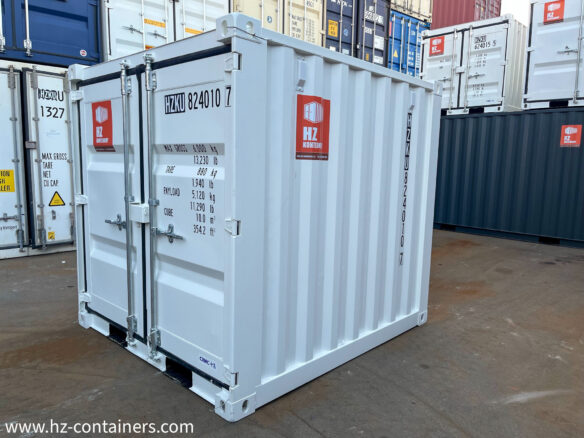
 Czech Republic, Třebíč
  FREE SHIPPING

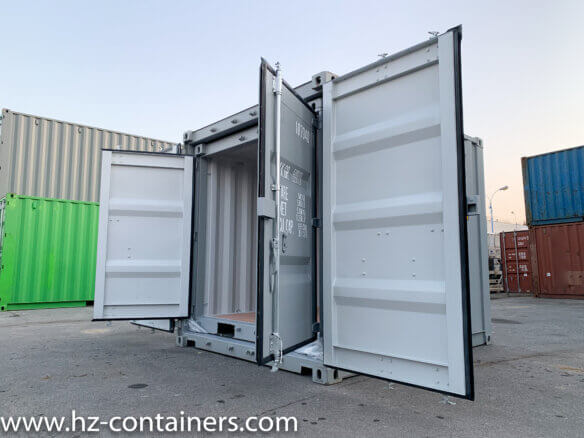
Construction and Materials – Guarantee of Durability and Safety
8-foot containers are designed as robust, long-term durable, and safe solutions with a lifespan of many decades. They use the most modern methods and materials, ensuring protection against weather conditions and vandalism.
Typical structural elements:
- Corten steel (weathering steel):
- Self-regenerating surface layer protects against deep corrosion.
- High strength and durability, minimal maintenance.
- Allows use in extreme climatic conditions.
- Welded frame:
- Frame made of thick-walled steel (usually 7-gauge, approx. 4.5 mm).
- Corner castings for easy lifting, stacking, and handling.
- Walls and roof:
- Profiled steel sheet (14-gauge, approx. 1.9 mm).
- Corrugated shape significantly increases strength and impact resistance.
- Slightly arched roof for effective water drainage.
- Floor:
- Steel crossbars and multi-layer waterproof plywood 28 mm (marine-grade).
- Impregnated against rot, pests, and mold.
- High point load capacity (also suitable for pallet jacks).
- Doors:
- Double-winged, with robust hinges and four locking bars.
- Full-surface rubber seal – 100% watertight and dustproof.
- Lockbox option for increased security.
ISO standards and certification:
- ISO 668 – defines precise dimensions, strength, handling/stacking capabilities.
- 8-foot containers are often not certified for maritime transport (CSC certification only exceptionally) – they are primarily intended for storage and land transport.
Comparison with Other Shipping Container Sizes
Overview of Standard Container Sizes:
| Type | Length | Width | Height | Internal Volume |
|---|---|---|---|---|
| 8’ | 2.44 m | 2.20 m | 2.26 m | 9.8 m³ |
| 10’ | 3.05 m | 2.44 m | 2.59 m | 15.9 m³ |
| 20’ | 6.06 m | 2.44 m | 2.59 m | 33.2 m³ |
| 40’ | 12.19 m | 2.44 m | 2.59 m | 67.7 m³ |
| 40’ HC | 12.19 m | 2.44 m | 2.89 m | 76.4 m³ |
8’ vs. 20’ and 40’ containers
- 20’: Standard of global logistics, suitable for transport and storage. Offers more than triple the volume compared to 8’.
- 40’: The largest commonly used container, ideal for transporting large volumes or building modular structures.
- 8’: Small, easily movable, ideal for areas with limited space.
Intermodal transport, ISO and stackability
- 20’ and 40’ containers meet ISO standards and can be stacked on ships.
- 8’ containers can be stacked on land (e.g. in a storage facility), but are not intended for full-height stacking on ships.
- For long-distance transport, the 8’ container is often placed inside a larger container or shipped as break bulk.
Uses and Applications – More Than Just Storage
Most common uses of the 8ft container:
- Construction: Mobile storage for tools, materials or a handy workshop on site.
- Industry: Secure storage for machinery, components, spare parts, tools or finished products.
- Private individuals: Garden shed, seasonal equipment storage, sports gear storage or temporary storage during renovations.
- Events and festivals: Ticket booths, info stands, technical facilities, mini bars or catering storage.
- Commercial use: Pop-up shop, café, snack stand, equipment rental.
- Special applications: Technical rooms for generators, pumps, compressors or server rooms.
- Modification options: Installation of windows, doors, electrics, insulation – can be turned into a gatehouse, small office, hobby workshop or tiny home.
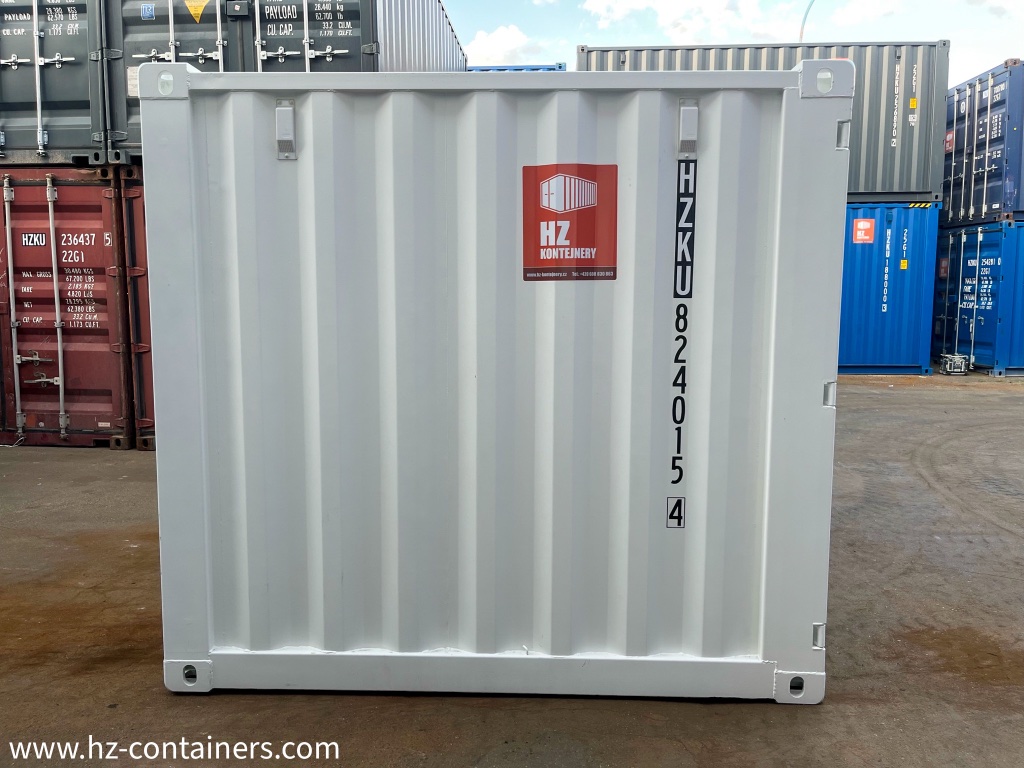
Advantages and Disadvantages of the 8ft Container
Advantages
- Compact dimensions: Ideal for limited spaces.
- Easy transport: Low weight, simple handling.
- Quick installation: Can be deployed immediately.
- Security: Steel construction, sealing, lockbox option.
- Affordability: Lower purchase price compared to larger containers.
- Customizability: Can be tailored to fit specific needs.
Disadvantages
- Limited capacity: Smaller internal volume, unsuitable for large quantities of material.
- Lower availability: Less common on the market, may have higher price per m³.
- Unsuitable for international shipping: Not standard for maritime logistics.
- Higher price per cubic meter: Compared to 20 and 40ft containers.
The 8ft shipping container is an ideal solution where a secure, mobile and compact storage space is needed. Compared to its larger counterparts, it offers exceptional flexibility, easy handling and the option to be customized for specific needs. It is suitable for businesses, construction sites, households and events. Thanks to its solid construction and quality materials, it is reliable and safe in the long term.