
Swap body
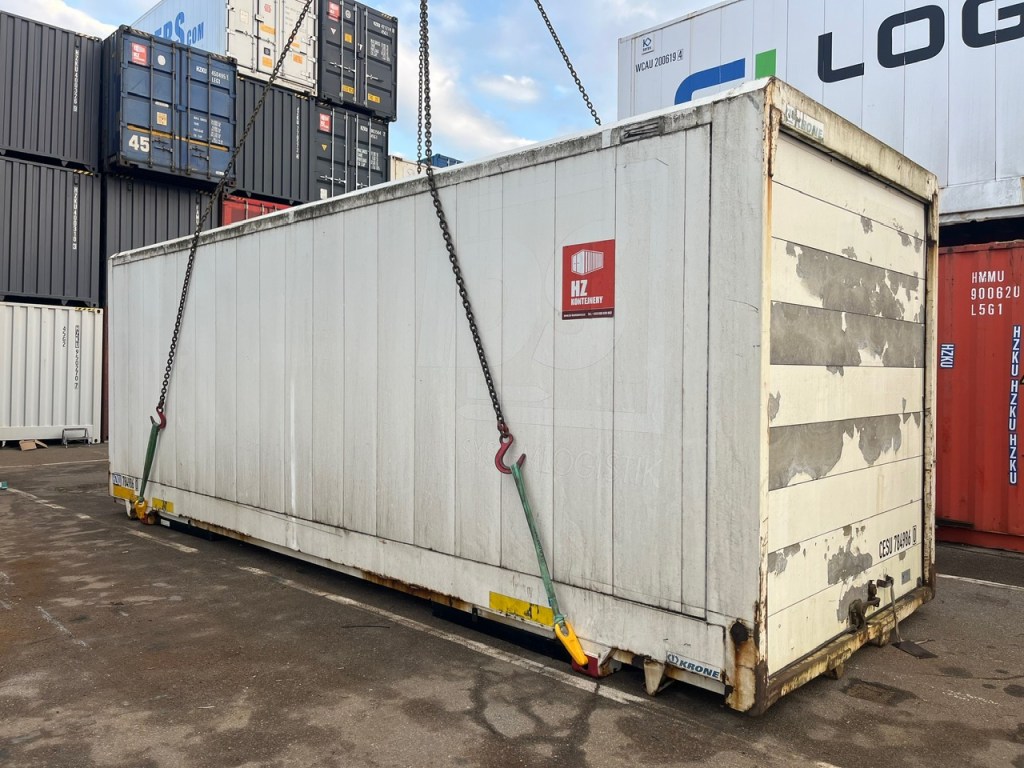
Swap body is a standardized, repeatedly usable freight transport unit intended primarily for European land (road and rail) logistics. Its key feature is the ability to efficiently transfer cargo between different modes of transport without the need for long vehicle and driver stoppage during loading and unloading. Unlike a conventional ISO container, the swap body is equipped with four integrated, fold‑down support legs that allow it to stand independently of the truck chassis. This makes it easy to “detach” the body so the vehicle can continue to the next task without delay.
Swap bodies are designed to meet European standards (especially EN 284) and enable efficient use within modern, combined (intermodal) logistics chains. They are essential for fleet optimisation, productivity increase and transport cost reduction.
The role of swap bodies in logistics
The swap body addresses a fundamental problem in land logistics – how to eliminate the inefficiency caused by vehicle and driver waiting during loading and unloading. In traditional road operations, drivers often have to wait hours for cargo to be loaded or unloaded. This leads to lower productivity, higher costs and under‑utilised vehicle capacity.
The swap system solves this problem with a revolutionary idea: the freight unit is completely separable from the vehicle. The driver arrives at the site, lowers the chassis with air suspension, deploys the support legs, disconnects the body and can immediately depart with the chassis for the next body or job. The whole process takes only 10–15 minutes. The body itself can then be loaded or unloaded at any time, without blocking the vehicle.
This “drop & swap” capability is the basis of efficiency: loading and unloading occur in parallel with vehicle movement, which is crucial especially in hub‑and‑spoke networks or when combining road and rail transport. The swap body is therefore not just a “box” – it is a core element of a flexible and high‑performance logistics system.
Construction, standards and types of swap bodies
Key construction elements
- Light yet robust construction: Swap bodies are not intended for multi‑layer stacking (as ISO containers are), so they can be made from lighter materials (steel, aluminium, plywood, or a combination with canvas sides).
- Integrated support legs: A fundamental feature – four retractable/fold‑down legs enable the body to stand independently of the vehicle. The legs are usually telescopic, easy to operate and fold into the floor during transport.
- Grappler pockets: For movement in terminals, bodies are equipped with special pockets for the shoulders of reach stackers or portal cranes, which lift the bodies from the lower frame (unlike ISO containers lifted by corner castings).
- Standardised dimensions (C‑size system): European standard EN 284 defines the basic dimensions:
- C715 – 7 150 mm length
- C745 – 7 450 mm length (very common type, two fit on one 18.75 m tractor‑trailer)
- C782 – 7 820 mm length (larger volume)
- A‑class – 13 600 mm length (equivalent to a standard trailer)
- Width: 2 550 mm standard (refrigerated versions 2 600 mm), allowing efficient loading of two Euro pallets side by side.
- Height: Typically 2 500–3 000 mm, depending on type and purpose.
Types of swap bodies
| Construction type | Description and use |
|---|---|
| Box | Solid walls (steel, plywood, aluminium), safe and protected transport of general goods, parcel services. |
| Canvas (tautliner) | Sliding or folding canvas sidewalls, easy side access, ideal for palletised goods and handling in confined spaces. |
| Reefer | Insulated body with cooling unit, transport of food, pharmaceuticals and other temperature‑sensitive cargo. |
| Platform | Open or low platform for oversized or non‑standard loads. |
Role of swap bodies in modern transport operations
Efficiency in road transport
- Shuttle system: The carrier operates multiple bodies – some loading, some unloading, the rest in transit. Vehicles stay on the move, minimizing downtime.
- Night logistics: Ready bodies wait for drivers who deliver them overnight over long distances – maximising fleet utilisation.
- Just‑in‑Time (JIT): Bodies positioned at factories enable immediate pick‑up without delay.
- E‑commerce and parcel services: Fast and flexible movement of large shipment volumes between logistics centres.
Foundation of combined road‑rail transport
- First mile (road): Vehicle picks up a loaded body from the shipper.
- Terminal: Body is unloaded with a reach stacker/crane onto a specialised rail wagon.
- Main haul (rail): Bodies travel by rail over long distances (dozens at a time).
- Destination terminal: Body is placed back on a chassis for the final road leg.
- Environmental advantage: Reduces truck traffic on highways, lowers CO₂ emissions and eases infrastructure load.
Comparison: swap body vs. ISO container vs. trailer
| Feature | Swap body | ISO container | Road trailer |
|---|---|---|---|
| Main use | Road + rail (EU) | Global transport (sea, rail, road) | Road transport |
| Support legs | Yes | No | No |
| Stackability | No | Yes (up to 9–10 high) | No |
| Construction | Light, non‑stackable | Heavy, stackable, steel | Chassis + body in one |
| Width | 2 550 mm (pallet width) | 2 438 mm | 2 480–2 550 mm |
| Loading system | From the bottom/on supports | Corner castings (top/bottom) | Rear or side loading |
| Flexibility | High, vehicle‑independent | Limited, crane required | Low, vehicle tied to trailer |
| Typical floor area | 38–48 m² | 33–37 m² | 38–45 m² |
Conclusion:
Each transport unit type has specific advantages; the swap body excels in continental flexibility and rapid handling.
Advantages and disadvantages of swap bodies
Main advantages
- Maximum flexibility: Ability to quickly detach cargo from the vehicle means fewer downtimes and higher productivity.
- Higher efficiency: Fast swaps at terminals, accelerated loading/unloading, vehicles are not blocked.
- Cost reduction: Better vehicle utilisation, lower labour costs (driver does not wait).
- Ecology: Enables rail transport, reduces CO₂ and road congestion.
- Temporary storage: Body can also serve as a mobile warehouse.
Disadvantages and limitations
- Need for special chassis: A standard tractor is insufficient; a chassis with lift/air‑suspension is required.
- Equipped terminals: Combined transport needs reach stackers, grappler‑capable cranes, etc.
- Non‑stackability: Cannot be stored in multiple layers like ISO containers, limiting terminal storage capacity.
- Higher initial investment: Special chassis and bodies are more expensive than conventional trailers.
- Standardisation mainly in Europe: Outside Europe the system is not widely adopted or standardised.
Swap process and required handling equipment
Handling process
- With the vehicle:
- Driver backs under the body and aligns with guide rollers.
- Inflates air suspension, raising the chassis and body.
- Legs fold down and lock.
- Locking mechanisms engage; the vehicle is ready to depart.
- For detaching, the process is reversed – chassis lowers, legs unfold, vehicle leaves.
- At the terminal (intermodal):
Special vehicle requirements
- Chassis for swap bodies: Air suspension, guide rollers, locking pins and mechanisms.
- Digitalisation: Most operators use GPS and RFID to track bodies in real time.
Conclusion: Strategic importance of swap bodies
The swap body is a key tool for boosting efficiency, flexibility and sustainability in European logistics. Its construction and functionality enable fast, seamless integration between road and rail transport, which is crucial amid pressure to cut emissions and optimise transport costs. Companies that use swap bodies achieve higher fleet utilisation and significantly speed up logistics processes.
For modern carriers or logistics firms, swap bodies are not just an option but a strategic necessity. The segment continues to evolve toward greater standardisation, automation and digitalisation.
FAQ – Frequently asked questions
1) What is the main difference between a swap body and an ISO container?
A swap body has foldable support legs, is lighter, and is designed for continental road and rail transport. An ISO container is stackable and designed for worldwide transport, including by ship.
2) Can any truck transport a swap body?
No, a special chassis with the possibility of lowering/raising the frame (air suspension), guide rollers and locking mechanisms is required.
3) Are swap bodies also used outside Europe?
They are most widespread in Europe, where there is a dense network of combined transport. In other regions, they are only found rarely or are not standardized.
4) Why are they called “swap bodies”?
Because they can be “swapped” very quickly between different vehicles or between a vehicle and a terminal without the need for a crane.
5) What does the C745 type mean for a swap body?
This is a standard European type with a length of 7,450 mm, which is one of the most common dimensions for effective use in combined transport.