
Shipping containers Bremen Germany
Shipping containers are standardized transport units used in international intermodal transport. The largest concentration of these steel boxes in Germany is found precisely in the ports of Bremen and Bremerhaven — one of the most important container hubs in Europe, which handles over 4.7 million TEU annually.
Bremen and its North Sea outpost Bremerhaven form the backbone of German maritime trade and represent a key point for anyone considering the purchase, rental, or transport of shipping containers in Central Europe. This glossary article provides a comprehensive overview of everything related to this topic — from history, through technical parameters, to practical advice for purchase and logistics.
What are shipping containers and how did they originate?
Definition of a shipping container
A shipping container (also known as a maritime container or transport container) is a standardized, enclosed or open transport unit made primarily from durable weather-resistant steel (most commonly COR-TEN type). Its key feature is intermodality — the ability to be transported by various modes of transport (sea, rail, road) without the need to reload the actual contents. This feature fundamentally distinguishes modern containers from historical forms of transport, where goods had to be manually reloaded with every change of transport mode.
Standardization of dimensions according to ISO 668 and ISO 1496 ensures that a container manufactured in China can be loaded onto a ship in Bremerhaven, transferred onto a train in Hamburg, and unloaded in Prague without any problems. The basic unit of measurement is TEU (Twenty-foot Equivalent Unit), i.e., the equivalent of one twenty-foot container.
History of containerization — from Malcolm McLean to the present
The story of the modern shipping container begins in 1956, when American entrepreneur Malcolm P. McLean — originally a truck driver — fundamentally changed the centuries-old shipping industry. McLean, frustrated by hours of waiting to unload his truck at the port, came up with a revolutionary idea: why not transport the entire cargo space of a truck as a separate unit?
“I had to wait most of the day. I sat in the truck and watched workers loading other trucks. I was struck by how much time and money I lost there.”
Together with engineer Keith Tantlinger, he developed the first modern intermodal container — a steel box measuring 2.44 × 2.44 × 3.05 meters with rotating locks at all four corners. In 1957, after the successful inaugural voyage of a converted tanker, Tantlinger took a crucial step: he persuaded McLean to release the patented design freely. This opened the way for international standardization.
In 1968, the ISO organization introduced formal standards — primarily the ISO 668 standard, which still defines container dimensions today, and the ISO 1161 standard establishing the parameters of corner castings. The result was an explosive growth in international trade: today it is estimated that approximately 90% of all global goods are transported in containers. In 2024, approximately 866 million TEU passed through the world’s ports, and by 2028, the one billion threshold is expected to be exceeded.
Timeline of containerization development
| Year | Event | Significance |
|---|---|---|
| 1766 | James Brindley — first wooden boxes for coal | Beginning of unified transport |
| 1830s | First intermodal boxes (train-ship) | Expansion of the concept |
| 1933 | Establishment of the International Bureau for Containers (Paris) | First regulatory body |
| 1948 | U.S. Army develops the “Transporter” | Military precursor of the modern container |
| 1950–1953 | CONEX boxes in the Korean War | Proven in practice |
| 1956 | Malcolm McLean — first container transport | Birth of modern containerization |
| 1957 | Tantlinger releases the patent | Path to standardization |
| 1968 | ISO 668 — international standardization of dimensions | Global unification |
| 1971 | Opening of Container-Terminal Bremerhaven | Bremen enters the container era |
| 2024 | World’s ports: ~866 million TEU | Peak of globalized transport |
What role does the port of Bremen / Bremerhaven play in European container transport?
Geographic location and strategic significance
The ports of Bremen and Bremerhaven form one of the most important maritime hubs in Northern Europe. While the city of Bremen itself lies approximately 60 km inland on the Weser River, Bremerhaven is located directly on the North Sea coast and serves as a deep-water gateway for the world’s largest container ships. Both locations together form the federal state of Free Hanseatic City of Bremen — the smallest German federal state, yet with enormous economic significance.
The quay wall of the container terminal in Bremerhaven measures 4,680 meters and is the longest in Europe. Up to 14 large container ships can dock here simultaneously, including next-generation Post-Panamax vessels. The open storage area reaches three million square meters, covered warehouses offer 30,000 m², and refrigerated areas provide an additional 8,000 m².
Key figures and statistics
According to 2020 data, the ports of Bremen/Bremerhaven handled a total of 4,771,000 TEU, ranking them in seventh place among the busiest container ports in Europe. Approximately 6,500 containers are transshipped here daily, and the storage area capacity reaches 32,000 TEU. The main customer of the terminal is MSC (Mediterranean Shipping Company), one of the largest container shipping operators in the world.
Comparison of major European container ports
| Port | Country | Annual volume (TEU, 2020) | Rank in Europe | Specialization |
|---|---|---|---|---|
| Rotterdam | Netherlands | 14,349,446 | 1. | Largest transshipment hub, empty container center |
| Antwerp | Belgium | 12,031,469 | 2. | 60% of European purchasing power within 500 km |
| Hamburg | Germany | 8,527,000 | 3. | 4 terminals, 2,000+ train connections weekly |
| Piraeus | Greece | 5,437,000 | 4. | Largest Mediterranean hub (owned by COSCO) |
| Valencia | Spain | 5,428,307 | 5. | Gateway to Southern Europe and North Africa |
| Algeciras | Spain | 5,107,873 | 6. | Closest European port to Africa |
| Bremen/Bremerhaven | Germany | 4,771,000 | 7. | Cars, containers, break bulk |
History of container transport in Bremerhaven
The first mentions of container transport in Germany date back to the 1960s. On May 6, 1966, the first shipment of containers from overseas arrived in Germany. The Container-Terminal Bremerhaven itself was put into operation in 1971 and has since undergone continuous expansion and modernization. In 2010, it was even the largest continuous container terminal in Europe.
What types of shipping containers exist and what are their dimensions?
Overview of basic types and technical parameters
There are several standardized types of shipping containers, each designed for a specific type of cargo. The following table provides a comprehensive overview of the most common types available on the market:
| Container type | External dimensions (L × W × H, m) | Internal dimensions (L × W × H, m) | Empty weight (kg) | Max. payload (kg) | Volume (m³) |
|---|---|---|---|---|---|
| 20′ Dry (Standard) | 6.058 × 2.438 × 2.591 | 5.898 × 2.352 × 2.392 | 2,250 | 28,230 | 33.2 |
| 20′ High Cube | 6.058 × 2.438 × 2.896 | 5.898 × 2.352 × 2.697 | 2,400 | 28,080 | 37.4 |
| 40′ Dry (Standard) | 12.192 × 2.438 × 2.591 | 12.032 × 2.352 × 2.392 | 3,780 | 26,700 | 67.7 |
| 40′ High Cube | 12.192 × 2.438 × 2.896 | 12.032 × 2.352 × 2.697 | 4,020 | 26,460 | 76.3 |
| 45′ High Cube | 13.716 × 2.438 × 2.896 | 13.556 × 2.352 × 2.697 | 4,820 | 27,680 | 86.1 |
| 20′ Reefer (refrigerated) | 6.058 × 2.438 × 2.591 | 5.534 × 2.316 × 2.331 | 3,030 | 27,450 | 29.9 |
| 40′ Reefer High Cube | 12.192 × 2.438 × 2.896 | 11.563 × 2.286 × 2.532 | 4,120 | 29,880 | 67.0 |
| 20′ Open Top | 6.058 × 2.438 × 2.591 | 5.897 × 2.350 × 2.377 | 2,350 | 28,130 | 32.5 |
| 40′ Open Top | 12.192 × 2.438 × 2.591 | 12.030 × 2.350 × 2.377 | 3,850 | 26,630 | 66.4 |
| 20′ Flat Rack | 6.058 × 2.438 × 2.213 | 5.612 × 2.210 × — | 2,740 | 31,260 | — |
| 40′ Flat Rack | 12.192 × 2.438 × 1.981 | 11.826 × 2.224 × — | 4,200 | 26,280 | — |
How to choose the right container type
When choosing a shipping container, consider the following key factors:
- Dry (Standard) container — a universal choice for most dry cargo, storage, and construction projects. The most widespread and most affordable type.
- High Cube — a 30 cm (1 foot) taller variant. Ideal for bulkier but lighter goods. The price-to-volume ratio is most favorable for 40′ HC among all types.
- Reefer (refrigerated) — equipped with thermal insulation and a cooling unit. Essential for transporting food, medicines, and other temperature-sensitive goods. After being retired from service, it can be used as an insulated storage facility.
- Open Top — with a removable roof for overhead crane loading. Suitable for oversized cargo exceeding the container height.
- Flat Rack — with folding ends for extremely heavy or bulky cargo (machinery, vehicles, structures).
CSC and ISO certification — what you need to know
Every shipping container intended for international transport must comply with CSC (International Convention for Safe Containers) and ISO standards. The CSC plate — a metal plate placed on the container door — contains key information:
- Owner of the container (identification code)
- Maximum Gross Weight (MGW)
- Empty container weight (Tare Weight)
- Maximum payload (Max Load / Net)
- Date of manufacture and certification validity
When purchasing a used container in Bremen, always verify the validity of the CSC certification. Containers without a valid CSC can no longer be used for international maritime transport, but can still serve for storage or construction purposes.
Containers that do not meet ISO standards do exist, but they cannot be seamlessly combined with standard containers at terminals — therefore, consider their purchase very carefully.
New vs. used container — comparison
| Criterion | New container | Used container (Cargo Worthy) | Used container (storage) |
|---|---|---|---|
| Approximate price 20′ | 2,500–3,500 € | 875–1,500 € | 700–1,000 € |
| Approximate price 40′ HC | 3,500–5,000 € | 1,500–3,000 € | 1,200–2,000 € |
| Lifespan | 15–20+ years | 8–15 years (depending on condition) | 5–15 years |
| Appearance | Perfect, no corrosion | Minor scuffs, possible surface rust | Visible wear, possible dents |
| Watertightness | 100% | 95–100% (after inspection) | 80–95% (depending on condition) |
| CSC certification | Fully valid | Valid (verify!) | Often invalid |
| Suitable for transport | Yes | Yes | Only static use |
| Suitable for storage | Yes | Yes | Yes |
What to watch out for when buying
- Verify the CSC plate — without valid certification, the container cannot be used for international transport
- Check tightness — close yourself inside and look for light leaks; check the door gaskets
- Inspect the floor — the wooden floor can be affected by mold or pests
- Check the corner castings — deformations prevent safe stacking and handling
- Check flatness — a container placed on a flat surface must sit on all corners
How does container transport from Bremen to the Czech Republic work?
Transport options
The distance from Bremen/Bremerhaven to Prague is approximately 650–700 km by road. There are three main options for shipping container transport:
- Road transport — the most flexible and most common option. Specialized companies have hydraulic container carriers (so-called “hook loader trailers” or lowboy trailers). The journey takes 8–10 hours.
- Rail transport — regular container trains run from Bremerhaven to inland terminals (e.g., Praha-Uhříněves, Přerov). Economically advantageous when transporting multiple containers at once.
- Combined transport — the container is transported by rail to the nearest terminal and from there by truck to the destination.
Approximate costs and time frames
| Transport method | Approximate price (20′ container) | Approximate price (40′ container) | Transit time |
|---|---|---|---|
| Truck (Bremen → Prague) | 600–800 € | 700–1,000 € | 1–2 days |
| Rail (Bremerhaven → Praha-Uhříněves) | 400–600 € | 500–750 € | 3–5 days |
| Combined | 500–700 € | 600–850 € | 3–5 days |
The total cost of acquiring a container from Bremen must therefore be calculated as: container price + transport + possible customs duty (outside EU) + VAT. Within the EU, no customs duty applies.
Customs and administrative aspects
Since both the Czech Republic and Germany are member states of the European Union, the free movement of goods regime applies to trade between them. This means:
- No customs duty is paid
- Intrastat — when exceeding the annual threshold (CZK 12 million for receipts), a statistical report must be submitted
- Invoicing — reverse charge mechanism for VAT (the tax is paid by the recipient in the CR)
- Documentation — an invoice, delivery note, and CMR (consignment note for road transport) are sufficient
What are alternative ways to use shipping containers?
Shipping containers have long served not only for transporting goods. Thanks to their modular design, durability, and relatively low cost, they find application in many innovative areas:
- Storage — the most common alternative use. Containers provide a secure, lockable, and weather-resistant space for tools, materials, seasonal equipment, or document archiving.
- Modular buildings — containers are used to build offices, school classrooms, dormitories, emergency shelters, and entire residential complexes. They can be stacked up to 8–9 floors high.
- Housing — the architectural trend of “container homes” is gaining popularity. Containers are converted into full-fledged residential units with insulation, windows, electrical wiring, and sanitary facilities.
- Retail and gastronomy — containers serve as pop-up shops, cafés, market stalls, or seasonal sales points.
- Art and community spaces — galleries, studios, community centers
Trends and the future of the container industry in Bremen
Bremerhaven, like other major European ports, faces challenges related to automation, greening, and capacity expansion. Key trends include:
- Full automation of transshipment operations — autonomous cranes and vehicles that minimize ship handling time
- Digitalization and blockchain — electronic bills of lading, real-time shipment tracking, smart containers with IoT sensors
- Greening — pressure to reduce emissions in ports (electrification of cranes, shore power for ships)
- Capacity expansion — preparation for the next generation of huge container ships (24,000+ TEU)
- Circular economy — a growing market for refurbished and used containers as a sustainable alternative to new production
Frequently asked questions
What exactly does the abbreviation TEU mean?
TEU is an abbreviation for the English term Twenty-foot Equivalent Unit. It is a standardized unit of volumetric capacity in container transport. One twenty-foot container (20′) represents 1 TEU, one forty-foot container (40′) represents 2 TEU. This unit makes it easy to compare the capacity of ships, terminals, and ports regardless of the specific mix of container sizes.
How does container transport from Bremen to the CR work?
The most common option is truck transport — a specialized carrier with a hydraulic carrier loads the container in Bremerhaven and delivers it directly to the destination in the CR within 1–2 days. An alternative is rail transport from Bremerhaven to inland terminals (Praha-Uhříněves, Přerov), which is more economical when transporting multiple containers, but takes 3–5 days. Within the EU, no customs duty is paid, VAT is handled by the reverse charge mechanism.
What is the difference between Cargo Worthy and storage containers?
Cargo Worthy (CW) containers have valid CSC certification and are eligible for international maritime transport — they are watertight, structurally sound, and have passed regular inspection. Storage containers no longer meet the conditions for maritime transport (e.g., rust, deformation, invalid CSC), but still provide sufficient protection for static storage on land. The price difference between CW and a storage container can be 20–40%.
What does the High Cube designation mean for a shipping container?
High Cube (HC) is a designation for a container that is one foot (30.5 cm) taller than the standard variant. While a standard container has an external height of 2,591 mm (8′ 6″), a High Cube reaches 2,896 mm (9′ 6″). This seemingly small difference increases the internal volume of a 40′ container from 67.7 m³ to 76.3 m³, i.e., by almost 13%. The HC variant is therefore ideal for bulkier but relatively light goods.
How do I recognize a quality used container when buying in Germany?
During a personal inspection, check: (1) tightness — close yourself inside and look for light penetrating through cracks; (2) floor condition — tap on the wooden boards to see if they are rotten or moldy; (3) corner castings — any deformation means a problem for stacking; (4) door mechanism — it must open and close smoothly; (5) overall flatness — a container placed on a flat surface must sit on all four corners. Always require a valid CSC certificate and written documentation about the origin and condition of the container.
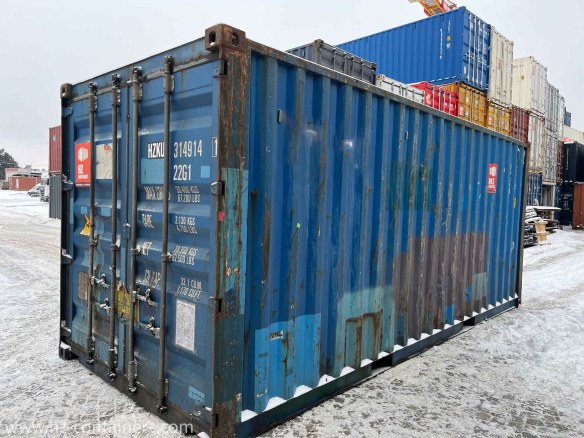
 Bremen, Germany
  WITHOUT SHIPPING


Other container news...
Shipping container 12m (40 ft)
A 12m shipping container is an investment that, if properly selected and cared for, will pay off in decades of trouble-free use. Whether you plan to use it as a warehouse, workshop, garage or the basis for a residential module — the key is careful selection of the condition, a thorough inspection before purchase and high-quality preparation of the base for placement. Take the time to compare offers, check the seller’s references and do not hesitate to personally inspect the container before buying. A properly selected 40-foot container will serve you reliably for many years.
Construction container
A construction container is an investment in safety, order and comfort — whether it is protecting tools from thieves or providing a dignified environment for workers. There are three key decisions: type (storage, residential, sanitary, rubble), form of acquisition (rent vs. purchase) and legislative provision (occupation, building code).

Construction cabin – selection, tips, dimensions and prices
Every construction project – whether a family house, a development project or a reconstruction – starts with the infrastructure. No construction manager, craftsman or investor who needs an on-site office, a changing room for workers or a safe storage for tools can do without a quality construction cell. But navigating the offer is not easy: residential containers, sanitary cells, storage modules, rental, purchase, refurbished pieces… This guide will give you answers to all the essential questions in one place.
Storage container
A storage container is a lockable steel box designed for the safe and dry storage of materials, tools, goods or equipment. Originally created as a shipping container for maritime transport, its durability and versatility have found their way onto construction sites, corporate premises and private land.