
Shipping Containers Bari Italy
Shipping containers represent the backbone of modern global trade and logistics. The port of Bari in Italy, strategically located on the Adriatic Sea, has become one of the key logistics hubs for container transport in the Mediterranean and a gateway to Central and Eastern Europe. Whether you are a new exporter, an experienced logistics professional, or a student in the field, this guide will provide you with everything you need to know about shipping containers in Bari — from technical specifications and practical procedures to the economic aspects of international transport.
What is the Port of Bari and what role does it play in international logistics?
The port of Bari is not just an ordinary port facility. It is a vibrant, pulsating logistics hub that has connected Italy with other Mediterranean and Central European markets for centuries. Understanding its role is essential for anyone involved in international shipping.
Geographical location and historical development
Bari is located on the southeastern coast of Italy, in the Apulia (Puglia) region, approximately halfway along the Adriatic Sea. This strategic location is no coincidence — the ancient Greeks and Romans already recognized its importance. During the Middle Ages, Bari became an important trading center of the Venetian Republic, which predestined it for the role of an international logistics hub.
The modern port of Bari was gradually developed during the 19th and 20th centuries. The greatest transformation came with the advent of container shipping in the second half of the 20th century. In the 1990s and 2000s, the port underwent significant modernization to compete with larger Mediterranean ports. Today it processes approximately 110,000 TEU (Twenty-foot Equivalent Units — a unit measuring container capacity) annually, placing it among the important, though not the largest, Italian ports.
The Adriatic gateway to Central and Eastern Europe — that is a precise description of the role Bari plays. While the larger ports of Genoa or Trieste serve as entry points for Northern Europe, Bari specializes in connections with the Balkans, Greece, and the Middle East. This specialization makes it an indispensable point in the logistics chains of many businesses.
Infrastructure and technical capabilities
The port of Bari has five terminals and more than 2.5 kilometers of quays. The largest capacity is dedicated to the container terminal, which has 2–3 berths designated specifically for container handling. The average depth in the port is 9–12 meters, which allows the port to accommodate larger cargo ships, though not the largest megaships that fit through the Suez Canal.
The port’s equipment includes mobile cranes with a load capacity of up to 100 tons, reach stackers, and terminal tractors. The port also has refrigerated warehouses for storing goods requiring special temperatures (such as fruit, meat, fish), which is particularly important since Apulia is an agricultural region.
| Characteristic | Parameter |
|---|---|
| Number of terminals | 5 |
| Quay length | 2.5+ km |
| Container berths | 2–3 |
| Channel depth | 9–12 meters |
| Maximum vessel length | 300+ meters |
| Annual TEU capacity | 20,000–81,500 TEU |
| Main equipment | Mobile cranes, reach stackers, terminal tractors |
| Refrigerated capacity | Available |
The port’s infrastructure is also expanding. In recent years, investments have been made in modernizing handling equipment and improving logistics processes. The port is connected to the rail network, enabling direct train connections to other European logistics hubs, particularly via the CargoBeamer service, which offers direct connections to Germany (Kaldenkirchen, Domodossola).
Comparison of Bari with other Italian ports
To understand why to choose Bari, it is useful to understand how it differs from competing Italian ports.
| Port | Location | Annual TEU | Focus | Advantages | Disadvantages |
|---|---|---|---|---|---|
| Bari | Adriatic Sea (south) | ~81,500 | Balkans, Greece, Middle East | Close to the Balkans, modern facilities, rail connections | Smaller capacity |
| Genoa | Ligurian Sea (north) | ~2.7 million | Northern Europe, transhipment | Largest Italian port, global connections | Far from the Balkans |
| Trieste | Northern Adriatic Sea | ~600,000 | Central Europe, Balkans | Close to Central Europe, free customs zones | Smaller than Genoa |
| Ancona | Central Adriatic Sea | ~200,000 | Regional trade | Close to central Italy | Small capacity |
| Messina | Sicily | ~500,000 | Transhipment | Strategic location | Limited container capacity |
As you can see, Bari occupies a specific niche. It is not the largest port, but for companies focused on trade with the Balkans, Greece, and the Middle East, it is often the most efficient choice.
What are the technical specifications of shipping containers?
Understanding the technical parameters of containers is essential for anyone involved in logistics. Containers are not simple boxes — they are precisely engineered units that must meet strict international standards.
Standard sizes and dimensions
Three primary container sizes are used in international shipping, all defined by the ISO (International Organization for Standardization) standard.
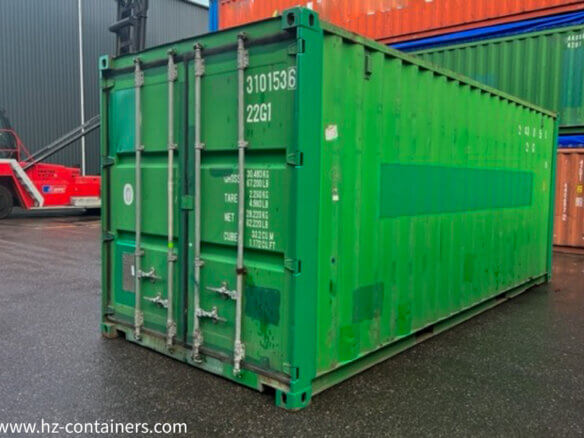
20-foot container (20 ft or 1 TEU) is the smallest standard unit. The name comes from the length in feet, where one foot corresponds to approximately 30 centimeters. External dimensions are approximately 6 × 2.4 × 2.6 meters, internal space is around 5.9 × 2.3 × 2.4 meters. Capacity is approximately 33 cubic meters. The empty container weight is around 2.2–2.5 tons, maximum load capacity is 21.8–28 tons.
40-foot container (40 ft or 2 TEU) is twice as long, but does not have twice the capacity. External dimensions are 12.2 × 2.4 × 2.6 meters, internal space is around 12 × 2.3 × 2.4 meters with a capacity of approximately 67 cubic meters. The empty container weight is 3.9–4 tons with a maximum load capacity of 26 tons. In practice, the 40-foot container is often used because the price-to-volume ratio is better than for the 20-foot.
40HC (High Cube) container is a variant of the 40-foot container, but with a higher roof. External dimensions are 12.2 × 2.4 × 2.9 meters, internal space is 12 × 2.3 × 2.65 meters with a capacity of around 70 cubic meters. Weight is approximately 4.1 tons with a maximum load capacity of 26 tons. These containers are ideal for bulky, lightweight cargo, as they offer more space at the same weight capacity.
There are also other, less common sizes, such as 45-foot containers (used mainly in Australia and Asia), but in Europe and especially in Bari, the three sizes mentioned above are dominant.
Detailed table of all types
| Parameter | 20′ Standard | 40′ Standard | 40′ HC |
|---|---|---|---|
| External length | 6.058 m | 12.192 m | 12.192 m |
| External width | 2.438 m | 2.438 m | 2.438 m |
| External height | 2.591 m | 2.591 m | 2.894 m |
| Internal length | 5.867 m | 11.980 m | 11.988 m |
| Internal width | 2.330 m | 2.330 m | 2.330 m |
| Internal height | 2.350 m | 2.320 m | 2.655 m |
| Volume (m³) | ~33 | ~67 | ~70 |
| Empty weight | 2,200–2,500 kg | 3,900–4,000 kg | ~4,100 kg |
| Maximum load capacity | 21,800–28,000 kg | 26,000 kg | 26,000 kg |
| TEU units | 1 | 2 | 2 |
| Typical use | Heavy cargo, small volumes | General use | Bulky lightweight cargo |
Container types for different types of cargo
Not all containers are the same. Although all meet ISO standards, there are special variants for different types of cargo.
Standard dry containers are the most commonly used. They are completely enclosed with doors on one side. They are used for general cargo — machinery, textiles, electronics, industrial goods. Their construction is simple but robust.
Refrigerated containers (reefers) are equipped with a cooling system. They have their own electric motor or are connected to an electrical source at the port or on the ship. They are used for transporting goods requiring controlled temperature — fruit, vegetables, meat, fish, medicines. They are significantly more expensive than standard containers and require special handling.
Open-top containers do not have rigid roofs. Instead, they have a tarpaulin that can be removed. They are used for cargo that is too tall to fit in a standard container, or for cargo that is easier to load from above (for example, construction materials, heavy machinery).
Flat-rack containers are minimalist — they have only a floor and side walls, without a roof. They are used for very bulky or heavy cargo, such as machinery, ship propellers, or structural elements. They allow easier loading and unloading from the sides.
Tank containers are special containers in the shape of cisterns. They are used for transporting liquids — oils, chemicals, wine, or even drinking water. They have special valves and are equipped with safety systems.
Materials and construction
Shipping containers are made primarily from steel. The walls are formed from profiled steel sheet approximately 2 millimeters thick. This construction ensures maximum strength at minimum weight. Containers can be stacked up to sixteen layers high on ships, which requires extreme structural integrity.
The floor is traditionally wooden, usually plywood approximately 3.5–4.5 centimeters thick. The wood is resistant to moisture and provides good adhesion for packaging. In some cases, composite or steel floors are used, especially in special containers.
In the corners of the container there are special pockets and fittings for crane handling. These points are the strongest part of the structure. The doors are double-sided, on one side of the container, with robust locks and sealing.
How does the transport of 20 and 40-foot containers differ?
This is one of the most frequently asked questions by new shippers. The answer is not simple, as it depends on many factors.
Capacity and efficiency
At first glance, it seems that a 40-foot container is simply twice as large. The reality is more complex. A 40-foot container has approximately twice the volume (67 m³ vs. 33 m³), but the weight capacity is the same (26 tons). This means that for heavy cargo (for example, steel, machinery, metals), the 20-foot container is more efficient, because you can fill it to maximum capacity and still have space remaining.
Conversely, for bulky lightweight cargo (for example, polystyrene, textiles, paper), the 40-foot container is the better choice. You can fill it completely without worrying about exceeding the weight limit.
Economically, it often turns out that the price per unit of volume is lower for the 40-foot container. If you have 60 cubic meters of cargo, you will need two 20-foot containers, but it will fit in one 40-foot container. This means lower handling and transport costs.
Practical aspects of handling
At the port of Bari, both types of containers are handled in the same way — using mobile cranes. The loading or unloading time is similar, regardless of size. The difference is in road transport. In the Czech Republic and many European countries, the weight limit is 40 tons including the vehicle. This means that a fully loaded 40-foot container (26 tons of cargo + 4 tons of container = 30 tons) can be transported on one vehicle, while two 20-foot containers (each 2.5 tons + 14 tons of cargo = 16.5 tons) would require two trips.
When storing, 40-foot containers are often stacked in two layers, while 20-foot containers can be stacked up to four layers if structurally safe. This means that a 40-foot container takes up less storage space per area.
Economic perspective
The rental price of a 20-foot container in Bari is around 1,500–2,500 EUR for one trip (one-way), while a 40-foot container costs 2,500–4,000 EUR. At first glance, the 20-foot seems cheaper, but when you divide the price per cubic meter, it is the opposite. A 20-foot container costs approximately 45–75 EUR per m³, while a 40-foot is 37–60 EUR per m³.
Transport costs to and from Bari vary depending on the specific route and operator. For example, transport to Patras in Greece costs approximately 1,200–1,800 EUR for a 20-foot and 2,000–3,000 EUR for a 40-foot container.
What services does the port of Bari offer?
The port of Bari is not just a place where containers are loaded and unloaded. It is a comprehensive logistics center with a range of services.
Container terminal and its services
Loading and unloading of containers is the basic service. The port of Bari has the capacity to process 81,500 TEU annually. Loading typically takes 30–60 minutes per container, unloading similarly. The port offers both full-service operations (24/7) during high season and limited services off-season.
Storage is another key service. The port has open and covered storage areas. Storage fees are around 30–50 EUR per container per day. If you leave a container at the port for more than 7 days, additional long-term storage fees are usually charged.
Inspection and control are mandatory. Port workers check the physical condition of the container, its sealing, and the presence of damage. This inspection is important for insurance companies and for determining whether the container is suitable for further use.
Repairs and maintenance of containers are available at the port. If a container is damaged during transport, it can be repaired on site. Typical repairs include welding, painting, and door replacement. Costs range from 200 to 1,500 EUR depending on the extent of the damage.
Customs services are an integral part of operations in Bari. The port has its own customs department that processes all documentation. Customs clearance usually takes 24–48 hours if there are no issues.
Additional logistics services
Many freight forwarding companies and logistics operators in Bari offer packaging and repackaging. If you have a smaller cargo, it can be combined with other cargo in one container (so-called LCL — Less than Container Load). This service is useful for small and medium-sized enterprises that do not have enough goods for a full container.
Insurance is important. Although sea transport is relatively safe, accidents can happen. Insurance covers loss or damage to cargo. The insurance premium is usually around 1–3% of the cargo value.
Documentation and administration are often underestimated but critical. Every international shipment requires a number of documents — a commercial invoice, a packing list, certificates of origin, import/export declarations. Freight forwarders in Bari will help you with this.
Available routes and operators
The port of Bari is connected to many destinations. The most common routes are:
Greece: Direct connections to Patras and Igoumenitsa. Sailings take 24–30 hours. Operators include Anek-Superfast and Grandi Navi Veloci.
Albania: Connection to Durrës takes approximately 10 hours. The operator is primarily Grandi Navi Veloci.
Croatia: Connection to Dubrovnik and other Dalmatian ports. Takes 12–18 hours.
Mediterranean: Direct connections to Barcelona, Marseille, Valencia, and other Mediterranean ports via various operators.
Rail connections: CargoBeamer offers direct train connections to Germany (Kaldenkirchen) and via Domodossola to Switzerland and France. Rail connections are often cheaper and more environmentally friendly than road transport.
Main maritime operators in Bari include:
- CMA CGM — One of the world’s largest operators
- ZIM — Israeli maritime company
- Grandi Navi Veloci — Italian company focused on the Mediterranean
- Anek-Superfast — Greek company with a long history
How to order and transport a container via Bari?
Now that you know what a container is and what Bari offers, how does it work in practice?
Step by step: Practical guide
Step 1: Define your needs. How much cargo do you have? What is its volume and weight? What is the final destination? The answers to these questions will determine what type and size of container you need. If you have 50 m³ of lightweight goods destined for Patras, it will be a 40HC container. If you have 15 tons of heavy components for Durrës, it will be a 20-foot container.
Step 2: Contact a freight forwarder or logistics company. There are dozens of freight forwarders in Bari. You can find them online or through trade associations. The freight forwarder will provide you with a quote with the price for transport, handling, and other services. The usual time to receive a quote is 24 hours.
Step 3: Sign the contract. Once you agree on the price, the freight forwarder will send you a contract. This contract specifies all conditions — price, departure date, destination, insurance, and liability for the goods.
Step 4: Prepare the goods and documentation. You must pack the goods securely so they are not damaged during transport. The goods must also be properly labeled and inventoried. Also prepare all necessary documents — invoices, packing lists, certificates.
Step 5: Deliver the goods to the freight forwarder or directly to the port. The freight forwarder will usually provide you with an address where you should deliver the goods. If it is in Bari, you deliver it directly to the port or to the freight forwarder’s warehouse. If it is elsewhere in Italy (for example in Milan), the freight forwarder will pick it up.
Step 6: Pay. Payment is usually made in advance or upon signing the contract. The payment method varies — bank transfer, credit card, or through a trade agent.
Step 7: Track your cargo. Modern freight forwarders provide online tracking. You can see when your container was loaded, when it left the port, and when it will arrive at the destination.
Step 8: Unloading at the destination port. Once the container arrives at the destination port, the local freight forwarder unloads it and delivers the goods to you.
Documentation and customs procedures
Every international shipment requires a number of documents. Here is a list of the most important ones:
Commercial Invoice — A document from the seller to the buyer with details about the goods, price, and conditions. It is the basis for the customs declaration.
Bill of Lading (B/L) — The most important document. It is issued by the shipping company. It contains details about the cargo, consignee, and destination. There are three copies — one for the shipping company, one for the buyer, one for the consignee.
Certificate of Origin — A document confirming where the goods were manufactured. It is important for applying customs preferences (for example, EU-Mercosur agreements).
Customs Declaration — A form filled out by the freight forwarder or importer. It contains details about the goods, their value, and the purpose of import.
Insurance Certificate — If the cargo is insured, you must have this document.
Certificates and attestations — Depending on the type of goods. For example, for food a health certificate is required, for electronics a CE certificate.
Customs procedures in Bari usually take 24–48 hours. If all documents are in order, unloading is fast. If there are problems (for example, missing documents or a discrepancy between the declaration and the actual cargo), it may take longer.
Time schedules
How long does the entire process take? Here is an approximate schedule:
- Preparation and packing: 1–7 days (depends on the amount of goods and your readiness)
- Transport to Bari: 1–3 days (if you are in Italy) or 5–10 days (if you are abroad)
- Storage at the port: 2–3 days (waiting for loading)
- Loading: 1 day
- Voyage to destination: 1–7 days (depends on destination)
- Unloading and customs procedures: 1–3 days
- Delivery: 1–2 days
In total, therefore, 12–30 days from the moment you decide to send a container to the moment the recipient receives it.
What are the prices and costs of container transport?
Prices vary, but here are typical ranges.
Factors influencing the price
Distance and route — This is the most important factor. Transport to Patras (nearby) is cheaper than to Barcelona (far away). Transport to Durrës is cheaper than to Barcelona.
Container type — 40HC is more expensive than 40 standard, which is more expensive than 20-foot.
Type of goods — Dangerous goods (chemicals, flammables) have higher fees. Refrigerated containers for sensitive goods are more expensive.
Seasonal fluctuations — In summer (high season) prices are higher. In winter (low season) they are lower.
Fuel surcharges (Bunker Adjustment Factor, BAF) — If oil prices rise, transport costs also increase.
Insurance — If you want to insure the cargo, add 1–3% to the price.
Port handling — Approximately 100–200 EUR per container.
Storage — 30–50 EUR per day.
Typical prices for common routes from Bari
| Route | 20′ Standard | 40′ Standard | 40′ HC |
|---|---|---|---|
| Bari → Patras | 1,200 EUR | 2,000 EUR | 2,200 EUR |
| Bari → Igoumenitsa | 1,400 EUR | 2,300 EUR | 2,500 EUR |
| Bari → Durrës | 900 EUR | 1,500 EUR | 1,700 EUR |
| Bari → Barcelona | 2,500 EUR | 4,200 EUR | 4,500 EUR |
| Bari → Marseille | 2,200 EUR | 3,800 EUR | 4,100 EUR |
These prices are indicative and may change. Freight forwarders will always provide you with a current quote.
Example calculation: You have 50 m³ of lightweight goods that you want to send from Bari to Patras. You will need a 40HC container. The transport price is 2,200 EUR. Handling in Bari is 150 EUR. Handling in Patras is 150 EUR. Insurance (2% of the value of 10,000 EUR) is 200 EUR. The total price is 2,700 EUR.
What are the environmental aspects of sea transport?
Sea transport is often considered a more environmentally friendly alternative to air transport, but what is the reality?
Sustainability of container transport
Emissions and carbon footprint — Sea transport produces approximately 50 grams of CO₂ per ton of cargo per kilometer. That is approximately 10 times less than air transport and 3–4 times less than road transport. Transporting a container weighing 20 tons from Bari to Patras (approximately 400 km) produces approximately 400 kilograms of CO₂. That is equivalent to one person’s flight over a short distance.
The port of Bari is trying to reduce its emissions. It is investing in modernizing handling equipment to electric drive and supporting the use of lower-emission fuels.
Energy efficiency — Sea transport is extremely efficient in terms of energy. Modern container vessels can transport 20,000 TEU with one tank of fuel. That is incredible efficiency.
Recycling and reuse of containers — Containers are designed to last 10–15 years of intensive use. After the end of their service life, the steel is recycled. Wooden floors are composted or incinerated. Approximately 99% of a container is recycled.
Green initiatives at the port of Bari — The port of Bari is part of the “Green Ports” initiative. The goal is to reduce emissions, increase energy efficiency, and support sustainable development. The port is investing in:
- Charging stations for electric vehicles
- Solar panels on warehouses
- Rainwater harvesting systems for irrigation
- Programs to reduce noise and water pollution
The future of ecological transport
The future of sea transport is green. Shipping companies are experimenting with:
- Alternative fuels — LNG (liquefied natural gas), hydrogen, synthetic fuels
- Wind-powered ships — A return to old technologies, but with modern technology
- Digitalization and route optimization — Artificial intelligence can optimize routes to reduce emissions
- Circular economy — Containers and packaging materials will be designed for reuse and recycling
Frequently asked questions about shipping containers and Bari
What are the dimensions of shipping containers?
Standard shipping containers come in three main sizes: 20-foot (6.06 × 2.44 × 2.59 m), 40-foot (12.19 × 2.44 × 2.59 m), and 40HC (12.19 × 2.44 × 2.89 m). Capacities are approximately 33, 67, and 70 cubic meters.
How many containers are transported through the port of Bari annually?
The port of Bari processes approximately 81,500 TEU annually. That is equivalent to approximately 40,000–50,000 containers (the number varies depending on the ratio of 20 and 40-foot containers).
What services does the port of Bari offer?
Bari offers loading and unloading, storage, inspection, container repairs, customs services, and additional logistics services such as packaging, insurance, and documentation.
How do 20 and 40-foot containers differ?
The 20-foot is smaller and suitable for heavy cargo, the 40-foot is larger and more efficient for bulky lightweight cargo. The 40-foot is usually cheaper per unit of volume.
What are the transport options from Bari?
Bari has direct connections to Greece (Patras, Igoumenitsa), Albania (Durrës), Croatia, other Mediterranean ports, and rail connections to Germany and Switzerland.
How do you order a container?
Contact a freight forwarder, receive a quote, sign a contract, prepare the goods and documentation, deliver them to the port or freight forwarder, pay, and track the cargo online.
What are the prices of shipping containers?
Prices vary depending on the route. Transport to Patras costs 1,200–2,200 EUR (20–40HC), to Barcelona 2,500–4,500 EUR. Add handling, storage, and insurance.
How long does container transport take?
From preparation to delivery it usually takes 12–30 days depending on distance and complexity.
Is sea transport safe?
Yes, sea transport is very safe. Containers are robust and securely fastened on the ship. Insurance covers any losses.
Is sea transport environmentally friendly?
Yes, sea transport is one of the most environmentally friendly forms of transport. It produces 50 g of CO₂ per ton per kilometer, which is 10 times less than air transport.
Can I combine a small cargo with other cargo?
Yes, the LCL (Less than Container Load) service allows combining smaller cargo into one container with other shippers.
What documents do I need?
A commercial invoice, bill of lading, certificate of origin, customs declaration, insurance certificate, and possibly special certificates depending on the goods.
What are the most common problems with transport?
The most common problems are missing documents, discrepancies between the declaration and the actual cargo, damage during transport, and delays due to weather or customs procedures.
How can I track my container?
Modern freight forwarders provide online tracking. You can see the position of the container in real time.
Who is responsible for cargo damage?
Usually the shipping company is responsible if the damage occurred during sea transport. If the damage occurred during handling at the port, the port is responsible. Insurance covers losses.
Can I send dangerous goods?
Yes, but it requires special documentation and handling. Dangerous goods (chemicals, flammables, toxic substances) must be properly labeled and packaged.
Who are the best freight forwarders in Bari?
Well-known freight forwarders in Bari include Geodis, Dachser, DHL Supply Chain, and many local companies. Choose based on references and services offered.
How often do ships sail from Bari?
Frequency varies depending on the route. On main routes (Patras, Durrës) ships sail almost daily. On less common routes they may sail weekly.
What is the best time to send a container?
In winter (November–March) it is usually cheaper and less congested, but the weather can be worse. In summer (June–August) there are more ships, but it is more expensive and congested. Spring and autumn are ideal.

 Bari, Italy
 WITHOUT SHIPPING


Other container news...

Obligation to Check Tightness When Selling a Reefer Container
Who is responsible for the refrigerant leak check when selling a refrigerated container? Find out what obligations the seller has at the time of handover and why they must provide a PTI report along with the technical data plate. Learn which regulatory requirements and F-gas record-keeping duties become the sole responsibility of the new owner.

New shipping containers
If you are currently considering purchasing a new shipping container, you are not alone. While just twenty years ago containers were used almost exclusively for maritime transport, today they have found their way into construction, storage, business, and even housing. This growing popularity brings with it a host of questions: Which type should you choose? How much does it cost? How do you recognize quality? How can you avoid falling victim to scammers?
New sea shipping containers
If you are currently considering purchasing a new shipping container, you are not alone. While just twenty years ago containers were used almost exclusively for maritime transport, today they have found their way into construction, storage, business, and even housing. This growing popularity brings with it a host of questions: Which type should you choose? How much does it cost? How do you recognize quality? How can you avoid falling victim to scammers?

6m shipping container
Are you thinking about buying a 6-meter shipping container but aren’t sure what to look for? You are not alone—this 20-foot container is the best-selling size on the Czech market, and the differences between various types, conditions, and prices can be significant. In this guide, you will find everything you need to know: from exact dimensions and a comparison of categories (such as “one-way,” refurbished, and “Cargo Worthy”) to current prices and shipping advice.