
Do Container Tanks Have Different Corner Castings?
In global logistics, goods transportation, and industrial manufacturing, shipping containers represent the fundamental building block of efficiency, safety, and standardization. A key component of this standardization is the so-called corner castings, small but extremely important steel components that enable handling, stacking, securing, and connecting containers on ships, trains, and road chassis.
One of the most frequently asked questions from technicians, logistics professionals, and companies is:
Do container tanks (tank containers) have different corner castings than standard containers?
The answer is seemingly simple, but in practice involves a range of technical nuances that are essential to understand for safety, service life, and proper container selection.
What are corner castings and why are they so important?
A corner casting is a massive steel casting that is welded to all eight corners of an ISO container – four on top, four on the bottom.
Without these standardized components, it would not be possible to safely handle containers with cranes, stack them to heights of up to nine units, secure them on chassis, railway cars, or on a ship’s deck.
Main functions of corner castings in container logistics:
| Function | Description |
|---|---|
| Lifting | Allow gripping a container with a spreader or forklift |
| Stacking | Transfer high forces during vertical and horizontal container connection |
| Securing | Serve as anchor points for twistlocks and securing mechanisms |
| Interconnection | Enable connection of adjacent containers (bridge fittings, lashings) |
| Safety | Ensure structural integrity of the entire container including extreme transport conditions |
Loss of integrity or poor compatibility of these points means risk of falling, poor securing, or inability to transport.
Anatomy and construction of corner castings: Detailed technical parameters
What is a corner casting made of?
- Standard material: Low-alloy cast steel (e.g., SCW480), which is extremely strong, tough, and suitable for welding.
- Alternative materials: Stainless steel (AISI 304, 316), rarely aluminum (for non-standard, lightweight applications – NOT for heavy tank containers).
Precise dimensions and shape standards (according to ISO 1161)
| Parameter | Value |
|---|---|
| Length | 178 mm |
| Height | 162 mm |
| Width | 118 mm |
| Weight | approx. 10.5–12.5 kg/piece |
| Standard | ISO 1161:2016 |
- Each casting has three holes: top/bottom (Stacking Hole), side longitudinal (Stadium), front/rear (Shield).
- Holes are designed for twistlocks, spreaders, and horizontal connections.
Types of corner castings by position on the container
| Type | Description (English / Czech) |
|---|---|
| TL | Top Left |
| TR | Top Right |
| BL | Bottom Left |
| BR | Bottom Right |
Each container has 2x TL, 2x TR, 2x BL, 2x BR, total 8 pieces. They differ in mirror image for compatibility. Some tanks may have a larger number of corner castings – Corner Casting.
ISO 1161 Standard: Global backbone of standardization
ISO 1161:2016 specifies:
- Precise dimensions (including tolerances in mm for each hole)
- Functional requirements (must enable handling, stacking, securing)
- Minimum mechanical strength (withstands forces exceeding 86 tons per corner)
- Compatibility with all handling equipment anywhere in the world
Certification of corner castings:
- Manufacturers must provide tests and compliance with ISO 1161 (ABS, Bureau Veritas, Lloyd’s Register, etc.)
- Each piece is marked with a serial number and type (TL, TR, BL, BR)
- Guarantees the ability to use in any intermodal chain (maritime, rail, road transport)
Materials of corner castings: Steel vs. Stainless vs. Aluminum
Why is cast steel the standard?
- Strength: High yield strength and toughness (withstands impacts during handling)
- Fatigue resistance: Service life exceeding 20 years even in extreme conditions
- Weldability: Enables strong and permanent connection to the container frame
- Price and availability: Optimal price/performance ratio
Stainless steel (AISI 304/316) – when and why is it used?
- Corrosion resistance: Significantly higher than standard steel (suitable for chemical tanks, marine environment)
- Use: Tank containers for aggressive liquids (acids, bases), special applications with maximum durability and service life requirements.
- Disadvantage: Higher acquisition cost
- Dimensionally and structurally always fully compliant with ISO 1161!
Aluminum and other alloys
- Advantages: Low weight, natural weather resistance
- Disadvantages: Lower strength (unsuitable for tank containers with heavy cargo)
- Use: Construction of special containers, military and mobile applications
Technical differences of tank containers: Do they have different corner castings?
Standard tank containers
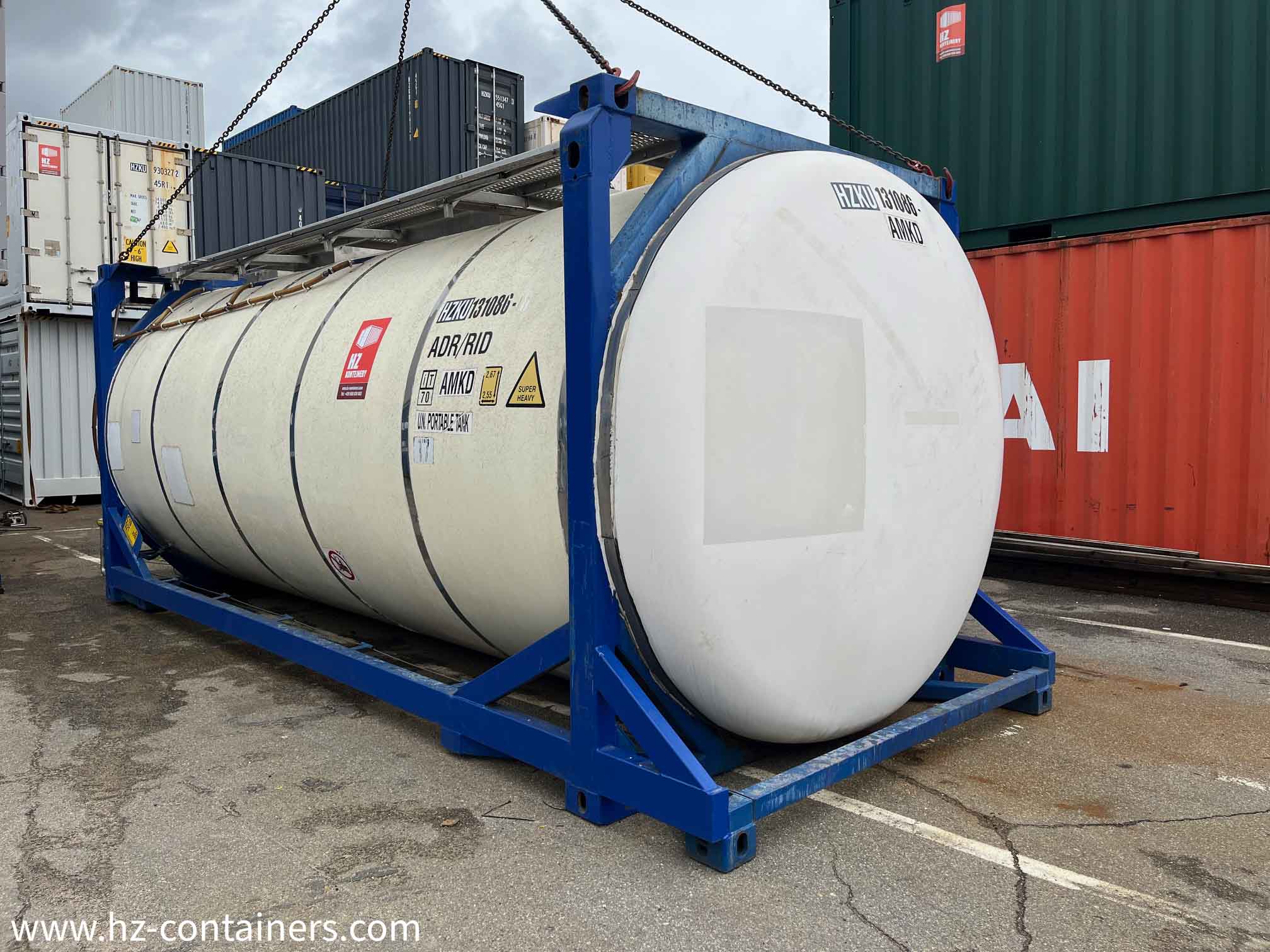
The vast majority of tank containers use exactly the same corner castings as standard ISO containers – whether for transporting liquid chemicals, food liquids, or gaseous substances.
Reason: Compatibility, safety, ability to transport and handle anywhere in the world.
Tank container construction:
- Pressure vessel (tank) is housed in a steel frame of exactly 20′ dimensions (sometimes 30′, 40′), which is equipped with 8x corner casting according to ISO 1161.
- Handling, stacking, securing proceed using the same procedures as with standard containers.
Exceptions: When can corner castings differ in tank containers?
1. Material (stainless steel)
- Tank containers for aggressive liquids (e.g., acids, bases) often have frames and corner castings made of stainless steel (AISI 304/316).
- Reason: Prevention of galvanic corrosion, extreme service life in aggressive environments.
- Dimensions and shape remain compliant with ISO 1161!
2. Non-standard frames (width, height)
- Exceptionally, you may encounter tank containers with non-standard dimensions (for example, 8’6″ width, special height), which must have modified corner castings.
- Modified corner castings maintain hole positions according to ISO, but their base/mounting may be otherwise adapted to the frame.
- Typical for military, special orders, or legislatively restricted markets (USA, Russia, inland Europe).
3. Special construction (military, laboratories, prototypes)
- Outside the main logistics stream, you can find completely non-standard corner castings.
- However, these containers CANNOT be routinely deployed in international transport!
Overview of material variants of corner castings for tank containers
| Material | Use | Advantages | Disadvantages |
|---|---|---|---|
| Cast steel | Standard shipping containers, tank containers | Strength, price, availability | Corrosion in special conditions |
| Stainless steel | Chemical tank containers, food, pharmaceuticals | Corrosion resistance, purity | Higher price |
| Aluminum | Special, lightweight construction (NOT tank containers) | Low weight, resistance | Low strength |
Maintenance, inspection, and replacement of corner castings
Why is regular inspection important?
- Corner castings carry all forces during handling, stacking, and transport.
- Damage or corrosion can cause loss of certification (CSC), risk of falling, or failure.
- Regular inspection is a mandatory part of operations (see CSC – Convention for Safe Containers).
How does replacement/elimination of defective corner casting proceed?
- A damaged casting is NOT repaired, but completely replaced with a new one.
- Removal of weld, cutting of old casting, precise welding of new certified casting.
- Replacement may only be performed by a certified welder according to approved procedures.
- After replacement, inspection and possible re-certification of the container is necessary.
Most frequently asked technical questions and answers
Q: Can steel and stainless steel corner castings be interchanged in one frame?
A: Technically yes, if both parts comply with ISO 1161. However, it is not recommended due to possible galvanic corrosion.
Q: Are there tank containers completely without corner castings?
A: NO. Every container intended for intermodal transport must have 8x corner castings according to ISO 1161.
Q: What are the weight differences between stainless vs. standard steel?
A: Weight is nearly the same (approx. 10.5–12.5 kg/piece), stainless steel slightly higher due to density.
Q: Are there special corner castings for extreme environments (arctic, tropics)?
A: Yes – special alloys are used with higher resistance to low temperatures or with anti-corrosion treatment.
Practical example: Tank containers for aggressive chemicals
- Construction: Frame and tank made of stainless steel (often 316L)
- Corner castings: Also stainless steel, typically AISI 304 or 316
- Reason: Protection against chemical and electrochemical corrosion, ensuring long-term safety even in aggressive conditions (e.g., transport of sulfuric acid, fertilizers, etc.)
- Maintained compatibility: Holes, dimensions, and markings fully comply with ISO 1161 – can stack, handle, secure like a standard container.
Summary and recommendations
**Standard ISO tank containers use exactly the same corner castings as standard shipping containers – in dimensions, shape, **load capacity, and placement.
Differences mainly concern the material used (stainless for chemical applications), exceptionally modified construction for non-standard dimensions or special orders.
When selecting a tank container, always request:
- Certification of corner castings according to ISO 1161
- Material appropriate to the nature of the transported medium (standard steel / stainless)
- Possibility of replacement and professional service of corner castings

 Czech Republic
 DELIVERY TO ADDRESS


More container news...

Corner Casting Lifting & Stacking
A corner casting is the standardized steel fitting welded into all eight corners of an ISO shipping container, and it is the single most important structural interface in modern intermodal transport. Every time a crane lifts a 30-ton container, every time a stack of boxes rides nine or ten high across the ocean, and every time a container is locked to a truck chassis or rail car, the entire force of the operation travels through these unremarkable-looking metal blocks.

What Are the Internal Dimensions of a 40 Foot Container?
A standard 40-foot dry shipping container has internal dimensions of 12,032 mm in length, 2,352 mm in width, and 2,395 mm in height — or approximately 39 feet 5⅝ inches × 7 feet 8⅝ inches × 7 feet 10¼ inches. These figures come from the published specifications of major shipping lines and align with the ISO 668 international standard for Series 1 freight containers. The internal capacity is roughly 67.7 cubic meters (2,390 cubic feet).

what is the internal dimensions of a 40 foot container
A standard 40-foot shipping container has internal dimensions of approximately 12.032 meters (39 feet 5⅝ inches) in length, 2.352 meters (7 feet 8⅝ inches) in width, and 2.395 meters (7 feet 10¼ inches) in height. These internal dimensions are significantly smaller than the external dimensions because the corrugated steel walls, structural frame, corner posts, and the floor system—composed of plywood and steel—occupy valuable space intended for cargo.

What Is the Shipping Cost for a 40ft High Cube Container?
The shipping cost for a 40ft high cube container is not a single number — it is a layered calculation spanning purchase price, international ocean freight, and local ground delivery. A used 40ft high cube container typically costs $1,550 to $5,500 to purchase, while a new one-trip unit runs $2,800 to $9,000 depending on condition, location, and whether delivery is included.